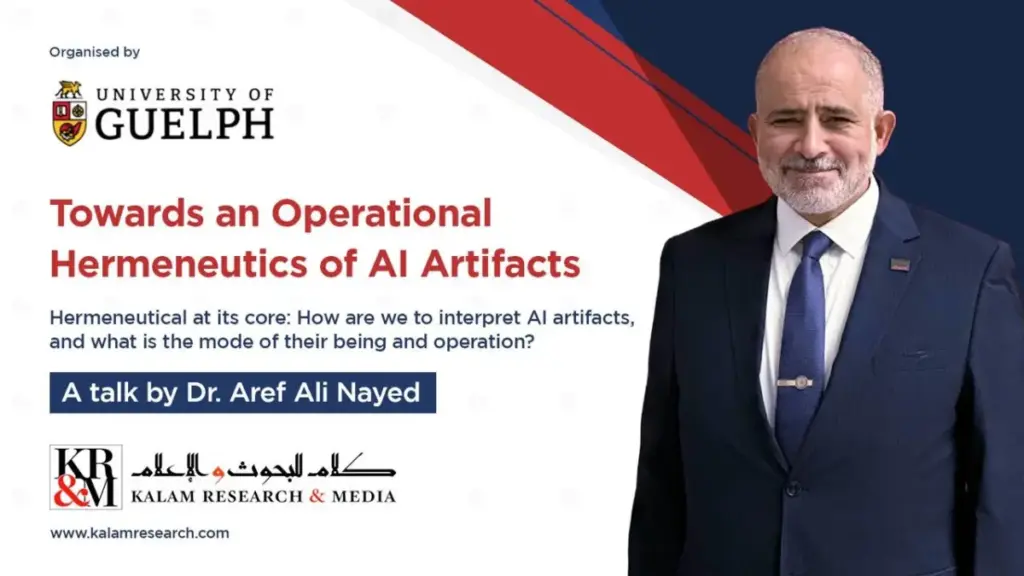
Dr. Aref Ali Nayed, Chairman of Kalam Research & Media (KRM), recently delivered a prominent academic lecture at the University of Guelph, offering a deep and forward-looking exploration of the intersection between hermeneutics, artificial intelligence, and the ethical governance of emerging technologies. The presentation marked a significant moment of intellectual homecoming for Dr. Nayed, drawing together decades of philosophical inquiry and applying them directly to the modern dilemmas posed by rapid advancements in machine learning and automated systems.
About the Lecture
The central focus of the presentation was the practical application of Operational Hermeneutics—a robust theoretical and analytical framework originally developed by Dr. Nayed during his time at the University of Guelph in the 1990s. As contemporary society grapples with the pervasive integration of artificial intelligence into daily life, communication, and decision-making structures, Dr. Nayed’s framework provides essential tools for understanding and ethically engaging with AI-generated artifacts.
During the lecture, Dr. Nayed examined how modern artificial intelligence systems function far beyond simple computational tools. Instead, they operate as sophisticated operational artifacts that actively interpret data, generate meaning, and shape human understanding. By viewing machine outputs through the lens of hermeneutics, researchers and ethicists can better grasp the underlying mechanics of how these systems construct representations of reality, manage ambiguity, and influence human perception on a mass scale.
The discussion also tackled the pressing need for rigorous ethical governance in technology development. As generative models and autonomous decision-making agents become more deeply embedded in critical sectors, the imperative to establish meaningful guardrails grows increasingly urgent. Dr. Nayed emphasized that technical innovation must be matched by philosophical clarity, ensuring that the development of artificial intelligence remains aligned with human values, dignity, and intellectual autonomy.
Watch the Full Lecture
For those interested in exploring the depth of the discussion, the complete recording of Dr. Nayed’s lecture at the University of Guelph is available for viewing online:
[YouTube video player displaying the full lecture on Operational Hermeneutics and AI governance]
Related Initiatives and Institutional Collaboration
The lecture served as a cornerstone of Dr. Nayed’s broader engagement with the Centre for Advancing Responsible and Ethical Artificial Intelligence (CARE-AI) at the University of Guelph. This visit significantly strengthened ongoing collaborations between Kalam Research & Media and Canadian academic institutions dedicated to shaping responsible AI research and policy.
The partnership with CARE-AI reflects a shared commitment to interdisciplinary approaches, uniting computer science, philosophy, and ethics to address the societal implications of new technologies. Through these cooperative efforts, researchers aim to move beyond purely technical metrics of success, fostering a comprehensive dialogue on how artificial intelligence impacts communities, cultures, and governance structures worldwide.
Those interested in learning more about the specifics of this institutional visit can read further coverage regarding Dr. Nayed’s engagements at CARE-AI through official KRM communications.
Further Reading and Academic Contributions
Expanding directly upon the themes addressed during his University of Guelph presentation, Dr. Nayed has recently published a comprehensive academic paper that dives deeper into the mechanics of machine-generated interpretation.
Titled "Towards an Operational Hermeneutics of AI Artifacts," the publication explores how outputs produced by artificial intelligence systems must be understood not merely as data points, but as complex operational artifacts that demand active hermeneutical engagement. The paper proposes innovative frameworks for interpreting machine-generated content, offering scholars and practitioners new methodologies to evaluate the reliability, transparency, and ethical dimensions of human-AI interaction.
The monograph is publicly accessible for researchers, ethicists, and technologists seeking a rigorous academic foundation in the interpretation of artificial intelligence outputs.
The University of Guelph Partnership and Intellectual Homecoming
The University of Guelph holds profound significance in Dr. Nayed’s broader intellectual journey. It was within the halls of this institution during the 1990s that he first formulated and developed the foundational concepts of Operational Hermeneutics during his doctoral research.
His return to Guelph represents a true homecoming of ideas, bringing decades of intellectual refinement, academic publishing, and practical application back to their birthplace. Today, those original theoretical insights are finding renewed relevance as scholars confront the unprecedented challenges posed by contemporary artificial intelligence.
This ongoing academic exchange is part of a wider network of collaborations that Kalam Research & Media maintains with leading Canadian research hubs. Alongside the University of Guelph and CARE-AI, KRM engages with prominent organizations such as the Vector Institute for Artificial Intelligence and the Canadian Institute for Advanced Research (CIFAR), contributing a distinct philosophical and humanistic perspective to Canada’s vibrant AI research ecosystem.
KRM’s Research in Artificial Understanding
While the vast majority of mainstream artificial intelligence research remains focused on optimizing machine performance, computational speed, and data processing capacity, Kalam Research & Media has pioneered a distinct line of inquiry known as Artificial Understanding (AU).
Rather than asking merely whether a machine can perform a task efficiently, the AU research program asks fundamental questions regarding comprehension, meaning, and interpretation within artificial systems. Grounded firmly in the traditions of Operational Hermeneutics, KRM’s research into Artificial Understanding seeks to address the profound gap between mere data manipulation and genuine semantic comprehension.
By challenging the assumptions underlying modern algorithmic design, the AU research initiative contributes critical perspectives to the global conversation on the future of technology, ensuring that humanity retains its role as the ultimate arbiter of meaning in an increasingly automated world. Additional information regarding KRM’s ongoing programs in Artificial Understanding is available through their institutional portal.