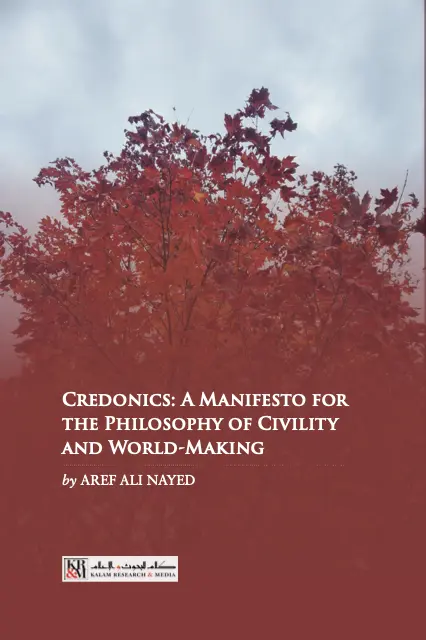
November 6, 2025 — In a significant new 43-page monograph, Dr. Nayed has introduced "Credonics," a groundbreaking philosophical discipline designed to move beyond the perceived shortcomings of traditional memetics and offer a more robust framework for understanding how civilizations transmit meaning, culture, and values across generations.
The publication addresses a long-standing challenge in cultural studies, sociology, and philosophy: how to accurately map and study the deep-seated structures that govern human societies. While previous decades saw widespread attempts to utilize memetics—the study of information propagation popularized in late 20th-century evolutionary biology and cultural theory—scholars have increasingly criticized the framework as overly superficial, reductionist, and incapable of capturing the profound complexities of human civilization. Credonics steps into this intellectual vacuum, proposing a rigorous systematic approach to how societies actually function at a foundational level.
At the core of this new discipline is the systematic study of "credos"—complex, interconnected clusters of presuppositions, foundational assumptions, and deeply lived commitments that function essentially as the "cultural DNA" of civilizations. According to the monograph, these credos are not merely abstract intellectual beliefs; rather, they serve as the active generative engines through which societies make sense of the world, create shared meaning, build enduring narratives, and construct tangible human worlds filled with institutions, legal systems, and cultural artifacts.
Rather than viewing culture as a loose collection of passing ideas or viral information units, Credonics treats civilizational frameworks as deeply rooted, cohesive systems of thought and action. To unpack this dynamic, Dr. Nayed’s framework introduces a comprehensive analytical model known as the "Fourfold of Making." This conceptual architecture breaks down the civilizational process into four distinct yet interconnected phases.
The first phase, sense-making, involves the fundamental organization of human perception, allowing individuals and groups to process raw sensory and intellectual input into coherent frameworks. This flows naturally into the second phase, meaning-making, which integrates raw human experience into a broader existential and intellectual tapestry. The third phase, narrative-making, provides temporal articulation, weaving past, present, and future into continuous stories that give societies a sense of historical trajectory and destiny. Finally, the fourth phase, world-making, translates these internal cognitive and narrative structures into physical and social realities, constructing the institutions, laws, cultural artifacts, and societal frameworks that define human habitation.
Beyond the mechanics of how worlds are built, the monograph addresses the delicate challenge of how diverse civilizations and cultural frameworks coexist. In this context, Dr. Nayed redefines the concept of "civility." Far from being reduced to mere surface-level politeness or etiquette, civility is framed as an active, rigorous discipline of interpretive coexistence. It is the vital mechanism that allows multiple, often conflicting credos to interact, negotiate space, and engage with one another without resorting to cultural erasure, suppression, or conflict.
The introduction of Credonics represents a major intervention across multiple academic and practical fields. By extending the historical presuppositional analysis pioneered by thinkers like R.G. Collingwood and successfully uniting modern hermeneutics with cultural inheritance theory, the discipline offers a fresh methodological toolkit for scholars in the humanities and social sciences. Furthermore, the framework openly critiques the limitations of memetics, arguing that human cultural transmission requires a far more sophisticated philosophical grounding than evolutionary biology models can provide.
One of the most pressing and contemporary contributions of the monograph lies in its forward-looking applications, particularly in the realm of technology. As artificial intelligence systems become increasingly autonomous and influential in shaping human discourse, Dr. Nayed proposes the integration of credonic governance for AI ethics. By understanding the underlying credos embedded in AI training data, algorithmic design, and technological deployment, developers and policymakers can better navigate the ethical implications of deploying automated systems across diverse cultural landscapes.
In addition to technological governance, the practical applications of Credonics extend deeply into educational reform, political pluralism, civilizational renewal, and interfaith or intercultural dialogue. As modern societies grapple with intense political polarization, rapid technological disruption, and the complexities of a globally interconnected yet culturally fractured world, the framework offers policymakers, educators, and diplomats a structured lens through which to approach conflict resolution, curriculum development, and cross-cultural diplomacy.
The publication is expected to spark significant debate and discussion among philosophers, cultural theorists, sociologists, and ethicists worldwide as they examine the viability and reach of this new paradigm. Researchers, academics, and professionals interested in exploring the full scope of the discipline can download and view the complete 43-page monograph by visiting the official publication link provided by Kalam Research.