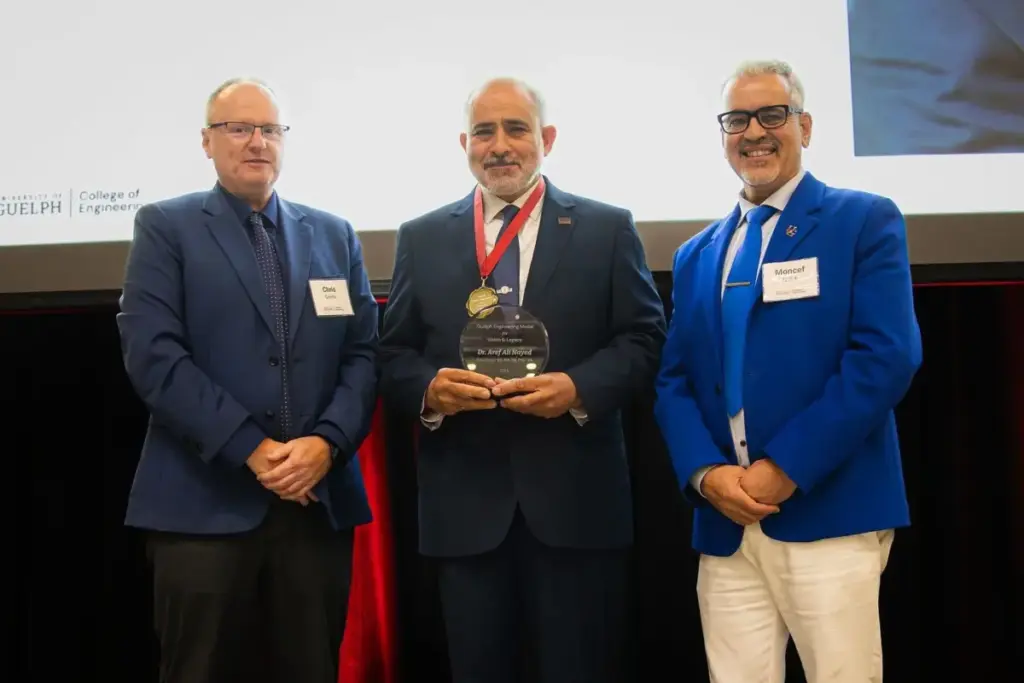
Kalam Research & Media (KRM) Chairman Dr. Aref Ali Nayed recently undertook a significant visit to the Centre for Advancing Responsible and Ethical Artificial Intelligence (CARE-AI) at the University of Guelph in Ontario, Canada. This official engagement serves to further strengthen KRM’s ongoing institutional commitment to pioneering artificial understanding research firmly grounded within rigorous ethical, philosophical, and theological frameworks.
During the visit, Dr. Nayed engaged in high-level discussions with leading researchers and scholars at CARE-AI. The dialogue centered on exploring collaborative approaches to artificial intelligence ethics, examining the complex intersections where modern machine intelligence meets deep philosophical inquiry and theological perspectives. CARE-AI has established itself as a prominent hub dedicated to the responsible development, oversight, and deployment of advanced technologies. This core mission closely mirrors KRM’s institutional vision, which insists that technological innovation must ultimately serve human flourishing, uphold human dignity, and maintain strict ethical accountability.
Dr. Nayed’s visit to the University of Guelph builds upon a foundation of established partnerships between KRM and several leading Canadian research institutions. The University of Guelph has consistently placed itself at the forefront of integrating humanistic and ethical considerations into the core of AI development. This progressive institutional stance makes it an ideal collaborator for KRM, particularly as the organization advances its distinctive research trajectory focusing on Artificial Understanding rather than mere automated computation.
Artificial Understanding vs. Artificial Intelligence
While the vast majority of global technology institutions and corporate laboratories focus primarily on Artificial Intelligence—concentrating heavily on teaching machines to simulate human behavior, optimize data processing, and execute complex computational tasks—Kalam Research & Media has charted a notably different and philosophical path. The organization’s pioneering Artificial Understanding program is deeply rooted in the foundational doctoral work of Dr. Nayed, which explored operational hermeneutics and the mechanics of genuine comprehension.
While conventional AI systems excel at pattern recognition, data correlation, and statistical prediction, KRM’s framework seeks to move beyond simulation toward a deeper, more meaningful engagement with meaning, intent, and context. This ambitious approach deliberately bridges the humanities and the hard sciences. It draws heavily upon traditional areas of academic expertise, including philosophy, dialogics, logic, critical thinking, hermeneutics, semiotics, and phenomenology. At the same time, these classical disciplines are combined with cutting-edge technical methodologies in machine learning, deep learning, and advanced natural language processing. By fusing these traditionally separate domains, KRM aims to cultivate technological systems that possess a more profound structural capacity for context-aware interpretation and ethical discernment.
Canadian AI Partnerships and Interdisciplinary Collaboration
KRM’s ongoing engagement with premier Canadian artificial intelligence research institutions represents a vital dimension of its broader technology and philosophy program. The Canadian research ecosystem is globally recognized for its robust commitment to safety, ethics, and academic rigor in tech innovation, providing a fertile environment for KRM’s interdisciplinary objectives.
In addition to its cooperative efforts with CARE-AI at the University of Guelph, KRM maintains active research partnerships with several other notable Canadian academic entities. These strategic relationships place the organization directly at the dynamic intersection of cutting-edge technological research and rigorous ethical and philosophical inquiry. This unique combination sharply distinguishes KRM’s approach to the digital age from purely commercial or engineering-driven models.
The recent visit to the University of Guelph vividly reflects KRM’s overarching conviction that the trajectory of artificial intelligence must be guided by robust ethical frameworks, human oversight, and genuine understanding, rather than being dictated solely by rapid technical capability and market pressures. Through continued collaboration with specialized centers like CARE-AI, Kalam Research & Media aims to ensure that the ongoing evolution of machine intelligence remains centered around ethical responsibility, moral clarity, and the betterment of human society as a whole.