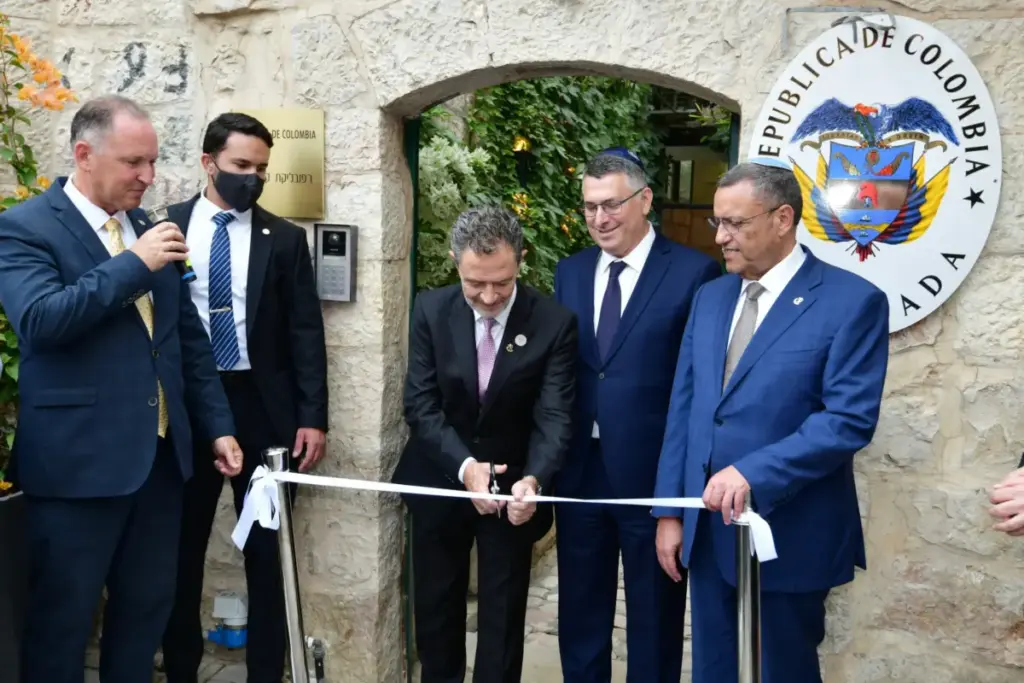
Colombia has officially opened its embassy to Israel in Jerusalem, marking a significant diplomatic pivot that aligns Bogota with a select group of nations backing Israeli sovereignty in the contested city. The inauguration took place on Wednesday, swiftly drawing sharp condemnation from Palestinian officials and regional allies who argue the move undermines international consensus and violates international law.
The high-profile opening comes at a time when Israel faces intensifying international pressure regarding its ongoing military campaign in Gaza. Following three years of relentless attacks, the death toll in the besieged enclave has surpassed 74,000 people, prompting mounting global isolation for the Israeli government. Despite this turbulent geopolitical backdrop, Colombia’s new administration has moved decisively to re-establish and strengthen bilateral ties.
The relocation of the embassy represents a stark reversal of foreign policy under Colombia’s new president, Abelardo de la Espriella. De la Espriella assumed office in August, succeeding former left-wing President Gustavo Petro. In May 2024, Petro had taken the dramatic step of severing diplomatic ties with Israel entirely, citing outrage over the war on Gaza. In addition to cutting diplomatic channels, Petro had also terminated a vital free trade agreement between the two nations.
Since taking power, President de la Espriella has rapidly dismantled his predecessor’s policies toward Israel. Alongside the embassy inauguration, his administration has successfully restored the bilateral free trade agreement that Petro had canceled.
During the embassy’s inauguration ceremony on Wednesday, Colombian Minister of Foreign Affairs Omar “Bula” Escobar delivered remarks emphasizing the urgency of repairing diplomatic channels. He stated that relations between Colombia and Israel “should never have been broken” and described the embassy’s opening as a concrete and necessary step toward fully restoring bilateral cooperation.
“Israel is a strategic partner. It always has been, and from now on, it will be an even stronger one,” Escobar declared during the ceremony, highlighting a renewed era of partnership between Bogota and Tel Aviv.
With this move, Colombia becomes the 10th country to establish its formal embassy to Israel in Jerusalem. The vast majority of the international community continues to maintain diplomatic missions in Tel Aviv, reflecting a global consensus that the city’s final status must be negotiated rather than unilaterally claimed.
Israeli Foreign Minister Gideon Saar warmly welcomed the Colombian delegation and the establishment of the embassy during the ceremony. Describing the moment as a milestone, Saar signed the Colombian embassy’s guest book and underscored the gravity of the occasion. “This is an important date for the State of Israel. It’s also an important date for the city of Jerusalem,” he said.
Echoing the foreign minister’s sentiment, newly appointed Colombian Ambassador Tania Gilinski reinforced the message of enduring alliance. Gilinski stated that Israel had historically served as a critical strategic partner for Colombia and emphasized that moving forward, the relationship would be pursued with even greater determination and strength.
‘Violation of international law’
The inauguration immediately provoked fierce diplomatic pushback from the Palestinian leadership and regional governments. The Palestinian Authority strongly condemned the decision, characterizing the embassy move as a direct violation of international legitimacy resolutions. Officials in Ramallah warned that the step actively undermines the broader international consensus regarding the legal status of the holy city.
The reaction extended beyond Palestinian territories. Jordan’s Ministry of Foreign Affairs also issued a strong critique, denouncing the relocation as a clear violation of international law and relevant international resolutions that govern the status of Jerusalem.
The broader international sensitivity surrounding Jerusalem’s diplomatic status stems largely from historical precedents set by the United States. During his first term in 2018, US President Donald Trump ordered the relocation of the American embassy from Tel Aviv to Jerusalem. That decision triggered intense Palestinian anger and widespread international condemnation, as previous US administrations and nearly every other country had deliberately refrained from placing embassies in the city. The prevailing international stance has maintained that Jerusalem’s ultimate status must be resolved through direct negotiations between Israelis and Palestinians.
The status of Jerusalem remains one of the most volatile and intractable core issues at the heart of the Israeli-Palestinian conflict. Israel claims the entirety of the undivided city as its capital, whereas Palestinians view occupied East Jerusalem as the legitimate and necessary capital of a future independent Palestinian state.
The historical context of the city’s division further complicates its legal and diplomatic standing. Israel occupied East Jerusalem during the 1967 Middle East war and subsequently annexed it, a political and territorial move that has never been recognized by the vast majority of the international community.
In the years following the United States embassy relocation in 2018, only a small number of US-aligned nations have followed suit. Prior to Colombia’s announcement, the group of countries with embassies in Jerusalem consisted primarily of Fiji, Guatemala, Honduras, Papua New Guinea, Paraguay, and Nauru. Furthermore, Kosovo and Somaliland—neither of which are recognized as member-states of the United Nations—have also established diplomatic missions in the city, aligning themselves with the controversial step taken by Washington and a handful of global allies.