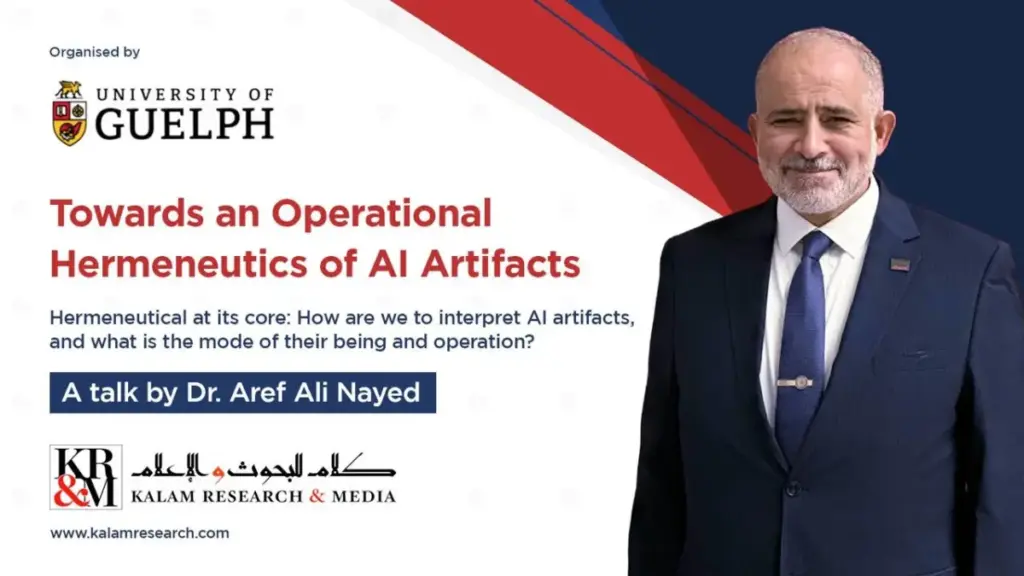
Dr. Aref Ali Nayed, Chairman of Kalam Research & Media (KRM), recently delivered a compelling and thought-provoking lecture at the University of Guelph, bringing decades of philosophical and technological research full circle. The presentation, which explored the complex intersections of hermeneutics, artificial intelligence, and the ethical governance of emerging technologies, drew faculty, researchers, and students eager to engage with pressing questions surrounding the digital age.
The event served as a major milestone in ongoing international dialogues regarding how humanity interacts with machine-generated content and autonomous systems. By bridging traditional philosophy with cutting-edge computer science, Dr. Nayed’s lecture offered a fresh perspective on the responsibilities that accompany the rapid advancement of artificial intelligence across global societies.
About the Lecture
At the core of Dr. Nayed’s presentation was an examination of how Operational Hermeneutics—a theoretical and practical framework he originally developed during his doctoral research at the University of Guelph in the 1990s—provides essential, indispensable tools for understanding and ethically engaging with AI-generated artifacts.
As artificial intelligence systems become increasingly sophisticated, they do far more than simply process data or execute repetitive commands. Dr. Nayed discussed how modern AI systems function inherently as operational artifacts that actively interpret, generate meaning, and profoundly shape human understanding. Rather than viewing technology as a neutral tool, the lecture emphasized that machine outputs carry interpretive weight, making it vital to establish robust frameworks that can rigorously evaluate how these systems construct and convey meaning.
The presentation addressed a wide array of key topics central to the philosophy of technology, highlighting the urgent need for multidisciplinary approaches that unite computer science, ethics, and the humanities to address the societal implications of autonomous systems.
Watch the Full Lecture
For those unable to attend the event in person, the complete recording of Dr. Nayed’s lecture at the University of Guelph is available for viewing online:
Related Initiatives
This high-profile lecture formed a central part of Dr. Nayed’s broader academic engagement with the Centre for Advancing Responsible and Ethical Artificial Intelligence (CARE-AI) at the University of Guelph. The visit served to strengthen and expand the ongoing collaboration between Kalam Research & Media and prominent Canadian artificial intelligence research institutions that are dedicated to formulating comprehensive ethical frameworks for the development and deployment of artificial intelligence.
By fostering international and cross-institutional partnerships, KRM continues to contribute meaningfully to global conversations surrounding AI governance, ensuring that technological progress remains aligned with human values and ethical standards.
Read more about Dr. Nayed’s visit to CARE-AI →
Further Reading
To complement the themes and insights shared during the lecture, Dr. Nayed has recently published a comprehensive academic paper that delves deeper into the subject matter.
The newly released monograph, titled “Towards an Operational Hermeneutics of AI Artifacts,” examines in detail how artificial intelligence-generated outputs must be understood as operational artifacts that require dedicated hermeneutical engagement. The paper proposes innovative frameworks specifically designed for interpreting machine-generated content and thoroughly addresses the complex ethical dimensions inherent in contemporary human-AI interaction.
About the University of Guelph Partnership
The University of Guelph holds deep intellectual significance in Dr. Nayed’s academic journey. It was on this very campus during the 1990s that he first formulated and developed the foundational concepts of Operational Hermeneutics during his doctoral research. His return to the university represented a true homecoming of ideas, bringing decades of refinement, practical application, and global experience back to their birthplace, where they are now being repurposed to meet the urgent, unprecedented challenges of modern AI ethics.
This visit underscores the enduring value of foundational academic research and its capacity to adapt across generations. KRM’s active partnership with the University of Guelph and CARE-AI is part of a broader, expanding network of collaborations with leading Canadian artificial intelligence institutions. This network also includes prominent organizations such as the Vector Institute for Artificial Intelligence and the Canadian Institute for Advanced Research (CIFAR), all working toward a shared vision of responsible technological innovation.
KRM’s Artificial Understanding Research
While mainstream artificial intelligence research has traditionally concentrated heavily on raw machine performance, computational speed, and data throughput, Kalam Research & Media has taken a radically different path. KRM has pioneered dedicated research into Artificial Understanding (AU)—a distinctive and visionary approach that asks fundamental questions about comprehension, meaning, and interpretation within artificial systems.
The AU research program, deeply rooted in the traditions of Operational Hermeneutics, seeks to move beyond mere data processing to explore how machines can genuinely engage with human meaning. This ambitious program pursues foundational aims centered on bridging the gap between mechanical output and true human comprehension, ensuring that future technologies are built upon a transparent and ethically sound foundation of interpretive clarity.