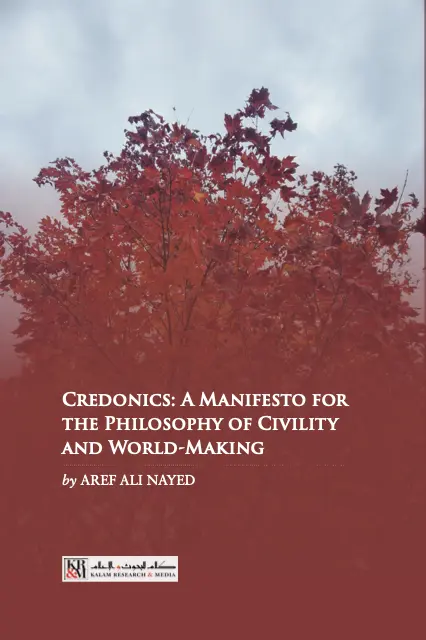
November 6, 2025 — In a comprehensive 43-page monograph released today, Dr. Nayed has introduced "Credonics," a groundbreaking philosophical discipline designed to move beyond the perceived limitations of memetics and offer a more robust framework for studying how civilizations transmit meaning and culture. The publication arrives as scholars, technologists, and policymakers grapple with increasingly complex global interactions, cultural pluralism, and the rapid rise of artificial intelligence.
The core of Dr. Nayed’s new discipline addresses what he identifies as the shortcomings of traditional memetics, which he critiques as too superficial to capture the deep currents of human history and societal transmission. Instead, Credonics proposes a systematic study of "credos"—defined as intricate clusters of presuppositions, foundational assumptions, and lived commitments that act as the structural "cultural DNA" of civilizations. According to the monograph, these credos are the underlying engines that dictate how societies organize perception, construct institutions, and navigate the complexities of shared existence.
By examining these foundational commitments, Credonics seeks to explain the mechanics behind how societies make sense of reality, create enduring meaning, build temporal narratives, and ultimately construct the tangible artifacts and institutions that define their world. This intricate process is encapsulated in what the discipline terms the "Fourfold of Making," moving sequentially from sense-making and meaning-making to narrative-making and world-making.
Sense-making focuses primarily on organizing human perception, allowing individuals and communities to interpret raw sensory and social input. Building upon this, meaning-making integrates these perceptions into a cohesive understanding of human experience. Narrative-making introduces a temporal dimension, providing the historical and future-oriented articulation necessary for a civilization to view itself as a continuity moving through time. Finally, world-making brings these abstract processes into concrete reality by constructing the institutions, laws, cultural products, and physical artifacts that characterize human societies.
Beyond the theoretical architecture of cultural transmission, the monograph introduces the concept of "civility as ethical regulation." Rather than reducing civility to mere politeness or superficial social etiquette, Dr. Nayed frames it as a rigorous discipline of interpretive coexistence. This ethical regulation is presented as a vital mechanism that allows multiple, and sometimes competing, credos to interact within the same societal or global space without resulting in mutual erasure or violent conflict.
The publication positions itself as a major interdisciplinary contribution, bridging several established fields of inquiry. In addition to offering a direct critique of memetics, the work extends the philosophical tradition of R.G. Collingwood’s presuppositional analysis, merging it with modern hermeneutics and cultural inheritance theory. This synthesis provides a fresh theoretical lens that its author argues is urgently needed to address contemporary challenges in global diplomacy, education, and technological development.
One of the most pressing applications highlighted in the monograph is the field of artificial intelligence ethics and design. As autonomous systems and machine learning models increasingly influence human discourse, decision-making, and information ecosystems, the framework proposes "credonic governance" as a novel approach to AI ethics. By analyzing the underlying credos embedded within training data, algorithmic design, and technological deployment, developers and policymakers could better align artificial intelligence with diverse human values and cultural frameworks, mitigating the risk of inadvertent cultural homogenization or bias.
Beyond technology, the applications outlined in the text span a wide array of societal domains, including educational reform, political pluralism, civilizational renewal, and the advancement of interfaith and intercultural dialogue. In education, the framework could transform how curricula are developed, shifting focus toward teaching students how to recognize and critically examine their own foundational assumptions and those of other cultures. In the realms of politics and diplomacy, the concepts offer new pathways for navigating pluralistic societies where different worldviews must find ways to coexist productively.
The release of the monograph is expected to spark significant debate across academic philosophy, cultural studies, and applied ethics. Researchers, educators, and professionals interested in examining the complete text of Dr. Nayed’s 43-page study can access and download the document directly through the Kalam Research publication portal by visiting the provided link.