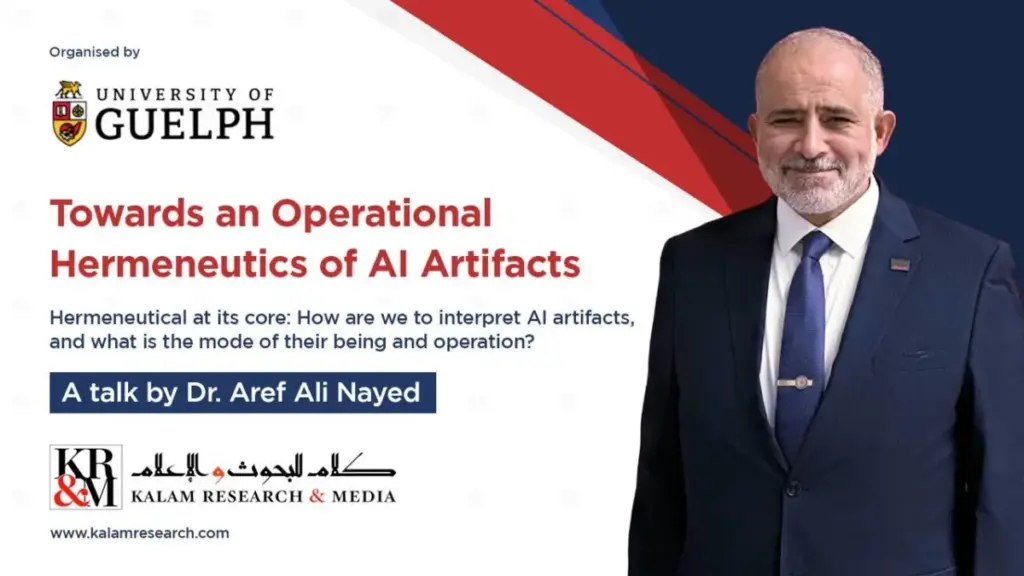
Dr. Aref Ali Nayed, Chairman of Kalam Research & Media (KRM), recently delivered a comprehensive lecture at the University of Guelph, bringing decades of intellectual development full circle. The presentation focused on the critical intersection of hermeneutics, artificial intelligence, and the ethical governance of emerging technologies, examining how human interpretation must guide machine capability in an era of rapid digital transformation.
About the Lecture
The presentation examined how Operational Hermeneutics—a foundational framework Dr. Nayed originally developed in the 1990s during his time at the University of Guelph—provides essential tools for understanding and ethically engaging with AI-generated artifacts. During the lecture, Dr. Nayed discussed the ways in which modern artificial intelligence systems function not merely as computational engines, but as operational artifacts that actively interpret, generate meaning, and shape human understanding.
As artificial intelligence continues to permeate various aspects of daily life, governance, and creative industries, the need for robust interpretive frameworks has never been more urgent. Dr. Nayed explored these themes by demonstrating how traditional philosophical tools of interpretation can be adapted to navigate the complexities of machine-generated outputs. The lecture addressed how society can maintain moral agency and critical oversight when interacting with systems that simulate human reasoning and generate autonomous content.
Watch the Full Lecture
Related Initiatives
This significant academic engagement formed a central part of Dr. Nayed’s broader visit to the Centre for Advancing Responsible and Ethical Artificial Intelligence (CARE-AI) at the University of Guelph. The visit successfully strengthened ongoing collaborations between Kalam Research & Media and prominent Canadian artificial intelligence research institutions that are dedicated to developing comprehensive ethical frameworks for emerging technologies.
Through partnerships with organizations like CARE-AI, researchers are working to bridge the gap between technical innovation and human-centric governance. These cooperative efforts ensure that the deployment of artificial intelligence remains aligned with societal values, human dignity, and transparent accountability.
Read more about Dr. Nayed’s visit to CARE-AI →
Further Reading
In connection with the themes explored during his lecture, Dr. Nayed has recently published a comprehensive academic paper that expands significantly upon the core concepts discussed at the University of Guelph.
The monograph, titled "Towards an Operational Hermeneutics of AI Artifacts," examines the ways in which machine-generated outputs must be understood as operational artifacts that inherently demand active hermeneutical engagement. Rather than passively accepting the outputs of complex algorithms, researchers, policymakers, and everyday users must develop sophisticated interpretive strategies. The paper proposes new theoretical frameworks for interpreting machine-generated content while directly addressing the complex ethical dimensions of human-AI interaction.
About the University of Guelph Partnership
The University of Guelph holds a deeply special significance in Dr. Nayed’s intellectual and academic journey. It was on this very campus during the 1990s that he first formulated the foundational concepts of Operational Hermeneutics during his doctoral research. His return to Guelph represents a true homecoming of ideas, bringing decades of international refinement and practical application back to their birthplace, now adapted to meet the unprecedented challenges of contemporary artificial intelligence ethics.
This academic homecoming underscores the enduring value of foundational philosophical inquiry when applied to cutting-edge technological shifts. KRM’s ongoing partnership with the University of Guelph and CARE-AI is part of a broader, expanding network of collaborations with leading Canadian AI research institutions. These alliances include engagement with major organizations such as the Vector Institute for Artificial Intelligence and the Canadian Institute for Advanced Research (CIFAR), reflecting a shared international commitment to responsible technology development.
KRM’s Artificial Understanding Research
While conventional artificial intelligence research has historically remained heavily focused on raw machine performance, computational speed, and data processing efficiency, Kalam Research & Media has pioneered a distinct path. KRM has advanced research in Artificial Understanding (AU)—a specialized approach that moves beyond mere computation to ask fundamental, foundational questions about comprehension, meaning, and interpretation within artificial systems.
The broader AU research program, deeply rooted in the principles of Operational Hermeneutics, seeks to establish rigorous academic and practical methodologies for evaluating how artificial systems process and represent meaning. By addressing the philosophical underpinnings of machine outputs, KRM aims to ensure that future technological advancements remain thoroughly anchored in human comprehension and ethical responsibility.