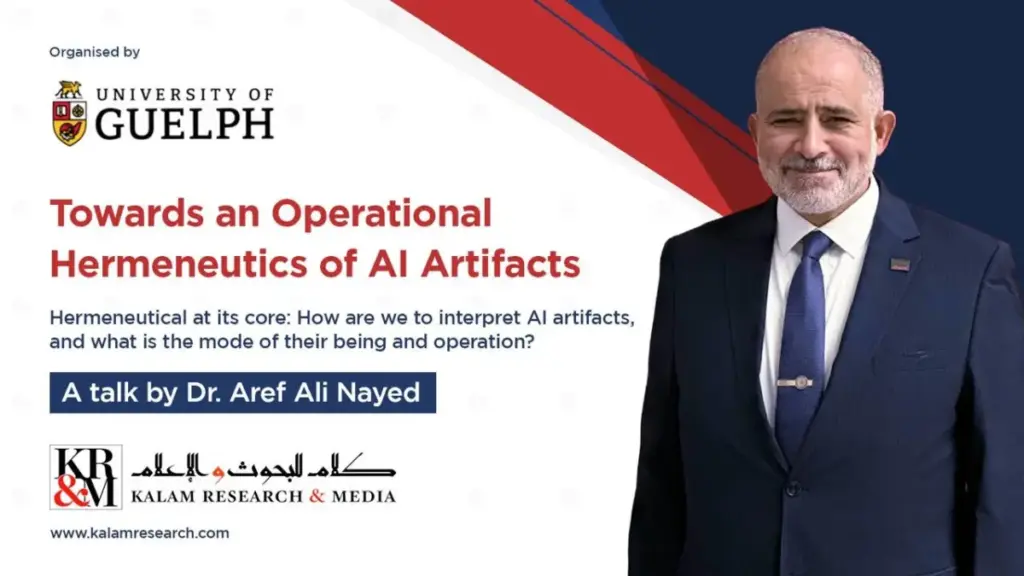
In an intellectual homecoming that bridges decades of philosophical inquiry with the most pressing technological challenges of the twenty-first century, Dr. Aref Ali Nayed, Chairman of Kalam Research & Media (KRM), recently delivered a comprehensive lecture at the University of Guelph. The academic event explored the intricate and rapidly evolving intersection of hermeneutics, artificial intelligence, and the ethical governance of emerging technologies, drawing faculty members, researchers, and students to engage with cutting-edge concepts in machine comprehension.
The presentation focused heavily on how Operational Hermeneutics—a pioneering theoretical framework originally developed by Dr. Nayed during his doctoral research at the University of Guelph in the 1990s—provides essential, foundational tools for understanding and ethically engaging with AI-generated artifacts. As contemporary society grapples with the rapid proliferation of synthetic media, automated decision-making systems, and generative intelligence, Dr. Nayed’s framework offers a robust lens through which to analyze how modern AI systems operate far beyond mere computational engines, functioning instead as operational artifacts that actively interpret, generate meaning, and profoundly shape human understanding.
A Homecoming of Ideas and Intellectual Heritage
The University of Guelph holds profound significance in Dr. Nayed’s extensive intellectual journey. It was within the academic halls of this Canadian institution that he first formulated the core tenets of Operational Hermeneutics, establishing a unique philosophical approach to text, meaning, and interpretation. His return to Guelph represents a powerful homecoming of ideas, bringing decades of theoretical refinement and global application back to their birthplace. Today, those foundational concepts are no longer confined to traditional philosophical texts; instead, they are being actively deployed to address the contemporary complexities and ethical dilemmas inherent in artificial intelligence.
This recent campus visit was deeply integrated into Dr. Nayed’s broader engagement with the Centre for Advancing Responsible and Ethical Artificial Intelligence (CARE-AI) at the University of Guelph. The visit served to significantly strengthen the ongoing research collaboration between KRM and prominent Canadian AI research institutions, all of which share a common commitment to developing rigorous ethical frameworks for the design, deployment, and governance of artificial intelligence systems.
The partnership with the University of Guelph and CARE-AI forms a crucial pillar within a wider network of strategic collaborations that KRM maintains with leading Canadian AI research centers. These include esteemed institutions such as the Vector Institute for Artificial Intelligence and the Canadian Institute for Advanced Research (CIFAR). Through these international and cross-disciplinary linkages, researchers are striving to ensure that technological advancements remain firmly aligned with human values, societal welfare, and ethical responsibility.
Expanding Research into Artificial Understanding
Unlike conventional artificial intelligence research, which has traditionally prioritized raw computational performance, algorithmic efficiency, and pattern recognition, KRM has carved out a distinct path by pioneering research in Artificial Understanding (AU). This innovative approach moves past the mechanics of data processing to ask fundamental, searching questions about true comprehension, meaning-making, and interpretive depth within artificial systems.
The AU research program, deeply rooted in the traditions of Operational Hermeneutics, is designed to pursue core intellectual aims that challenge prevailing technological paradigms. By examining how artificial systems process and represent meaning, KRM’s research agenda seeks to bridge the widening gap between technical capability and human comprehension, ensuring that machine-generated outputs are subjected to rigorous critical and ethical scrutiny.
To expand upon the foundational themes addressed during his University of Guelph lecture, Dr. Nayed has recently published a comprehensive academic monograph. Entitled "Towards an Operational Hermeneutics of AI Artifacts," the publication examines in granular detail how AI-generated outputs must be understood as operational artifacts that actively demand sophisticated hermeneutical engagement. The paper proposes innovative frameworks for interpreting complex machine-generated content and grapples directly with the profound ethical dimensions that characterize contemporary human-AI interaction.
As institutions around the globe race to keep pace with the exponential growth of machine intelligence, the collaborative efforts between Kalam Research & Media, the University of Guelph, and CARE-AI highlight the indispensable role of the humanities and philosophy in shaping our technological future. By wedding the insights of 1990s hermeneutical theory with the pressing demands of modern AI ethics, scholars are laying the groundwork for a more thoughtful, responsible, and human-centric digital age.