By Adnan Ali
Indore: Renowned across India for its exceptional cleanliness, civic discipline, and urban planning, Madhya Pradesh’s commercial capital, Indore, is currently grappling with a very different kind of challenge—one rooted in growing social friction rather than sanitation. In recent weeks, the city has witnessed an unsettling rise in community-level polarization, marked by vocal campaigns, localized boycotts, and open demands for the economic exclusion of Muslims.
This growing unease reflects an increasingly volatile socio-political atmosphere in the region, where economic spaces, traditional marketplaces, and cultural fairs are increasingly becoming flashpoints for identity politics. Observers and civil society members worry that these developments threaten to erode the city’s long-standing reputation for communal harmony and shared cultural traditions.

The latest wave of tension has been catalyzed by prominent right-wing figures and political connections. Eklavya Singh Gaur, a local leader and the son of sitting Bharatiya Janata Party (BJP) MLA Malini Laxman Singh Gaur, has launched a fresh and aggressive public campaign targeting Muslim workers and business owners. Gaur, who previously gained notoriety for his opposition to and targeting of stand-up comedian Munawar Faruqui in Indore, has now turned his focus toward the commercial heart of the city.
Specifically, Gaur has issued a public ultimatum to traders operating within Sitalamata Bazaar, a prominent commercial hub in the city. He has urged merchants to immediately dismiss all Muslim salesmen and has demanded that Muslim tenants occupying commercial spaces in the market vacate their shops within a strict two-month deadline.
To justify these exclusionary demands, Gaur and his supporters have invoked controversial narratives, claiming that the marketplace is being used to promote what they characterize as "love jihad." They have alleged, without providing formal evidence, that Muslim salesmen exploit their professional interactions with customers to obtain the phone numbers of women visiting the market. These unverified claims have been leveraged to drum up localized support for commercial bans.
However, the attempt to impose a blanket boycott has not gone unchallenged within the local business community itself, revealing a complex local dynamic where economic interdependence often resists political polarization. Several traders in Sitalamata Bazaar have openly rejected the allegations and pushed back against the pressure to discriminate against their peers and partners.

Balwant Singh Rathore, a local shopkeeper operating within the market, voiced strong opposition to the boycott calls. Rejecting the divisive rhetoric, Rathore stated, "I believe that no one’s livelihood should be snatched away. My partner is a Muslim, and together we run a shop." Such localized defiance highlights the deep-seated economic integration that has historically sustained Indore’s markets, even as external political pressures mount.
The escalating standoff in Sitalamata Bazaar soon drew statewide political figures into the fray. On September 27, 2025, former Madhya Pradesh Chief Minister and senior Congress Rajya Sabha MP Digvijay Singh attempted to visit Sitalamata Bazaar to assess the situation firsthand and express solidarity with affected traders. However, local authorities and security personnel blocked his entry, citing "security reasons" and the potential for public unrest.
Following the blocked visit, Singh proceeded to the Sarafa Police Station, where he met with Additional DCP (Zone-4 Indore) Dishesh Agrawal. The meeting formed part of a formal intervention by the Congress party, which had earlier submitted an official memorandum regarding the rising climate of intimidation in the city’s markets.
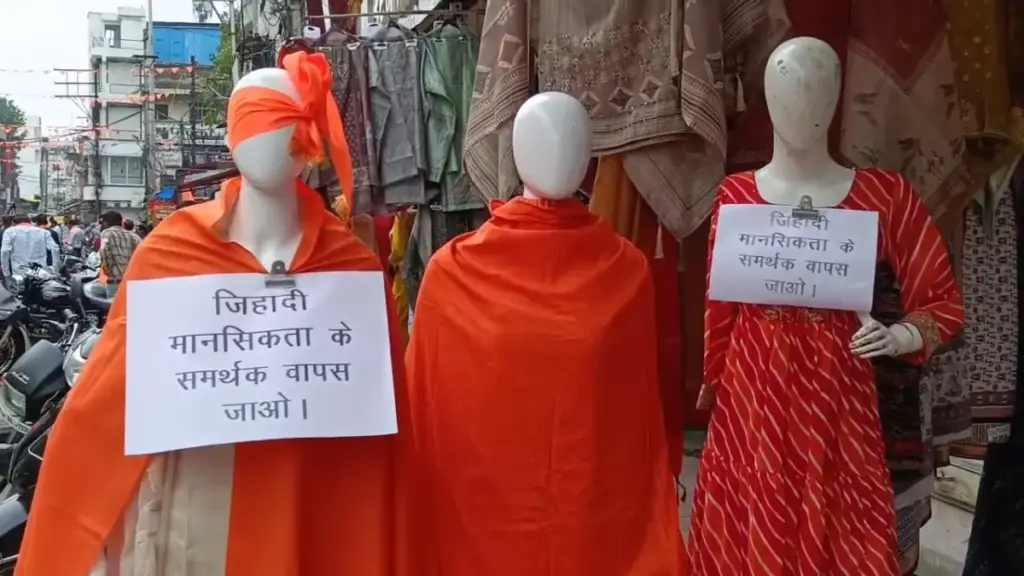
The political friction outside the police station was palpable. As Singh engaged with law enforcement officials inside, Hindutva activists gathered outside the precinct to stage a noisy protest. Demonstrators prominently displayed traditional glass bangles—a gesture intended as a direct political insult—and accused the veteran Congress leader of actively supporting what they termed "jihadis." Meanwhile, within the marketplace itself, the physical environment was rapidly altered: saffron flags were hoisted across prominent thoroughfares, and large posters were put up declaring Sitalamata Bazaar a "jihad-free market."

The Congress party had previously sounded the alarm over Gaur’s activities. On September 15, local Congress representatives submitted a formal memorandum demanding strict legal action and the immediate registration of an First Information Report (FIR) against Gaur. The opposition party argued that his public appeals represented a direct and dangerous assault on Indore’s historical culture of communal pluralism and shared coexistence. Despite these formal complaints, local police and administrative authorities have faced severe criticism from civil society and opposition leaders for their perceived inaction and failure to register a case or curb the escalating harassment.
The climate of exclusion has not remained confined to Sitalamata Bazaar. Similar tensions quickly spread to another major public venue, the Kankeshwari Mela ground, centering on administrative contracts for public fairs and cultural events.
The controversy at the Mela ground began after BJP MLA Ramesh Mendola awarded the official contract for organizing the fair to an individual named Mahesh Paliwal. Paliwal subsequently sublet or handed over operational responsibilities of the fair to a Muslim youth named Firoz. This arrangement immediately triggered sharp objections from hardline groups, most notably the Hindu Jagran Manch, which claimed that the involvement of a Muslim contractor in managing a public fair hurt religious sentiments and demanded immediate punitive intervention.
The situation escalated sharply on September 24, when Jitu Yadav (also known as Jitu Jatav), an expelled BJP councillor and supporter of MLA Mendola, intervened directly at the venue. Articulating the rationale behind the backlash, Yadav remarked, "When contracts related to fairs and such religious and cultural events are given to non-Hindus, it creates resentment in the society, which can never be accepted. Firoz took the contract in the name of Mahesh Paliwal and then gave permission to people belonging to the Muslim community to set up shops and rides in the fair."

Taking matters into their own hands, Yadav and his associates conducted physical checks of identification documents across the fairgrounds. True to their warnings, they forcibly removed shopkeepers belonging to non-Hindu communities, permitting only a small number of Hindu stall owners to retain their spaces. Yadav further confirmed that political and community pressure had forced the original contractor, Mahesh (also known as Guddu), to relinquish the contract entirely.
These back-to-back episodes—spanning the commercial corridors of Sitalamata Bazaar and the public festivities of the Kankeshwari Mela—have sent shockwaves through Indore. For decades, the city has prided itself on being a vibrant economic powerhouse defined by openness, commercial dynamism, and harmonious coexistence among diverse communities.
However, the systematic targeting of Muslim traders, the enforcement of unauthorized identity checks, and open calls for economic boycotts are increasingly viewed by observers as worrying indicators of a deeper social fracture. As these exclusionary practices find increasing public space, community leaders and civil rights advocates fear that the long-term social fabric of Indore is facing an unprecedented test.