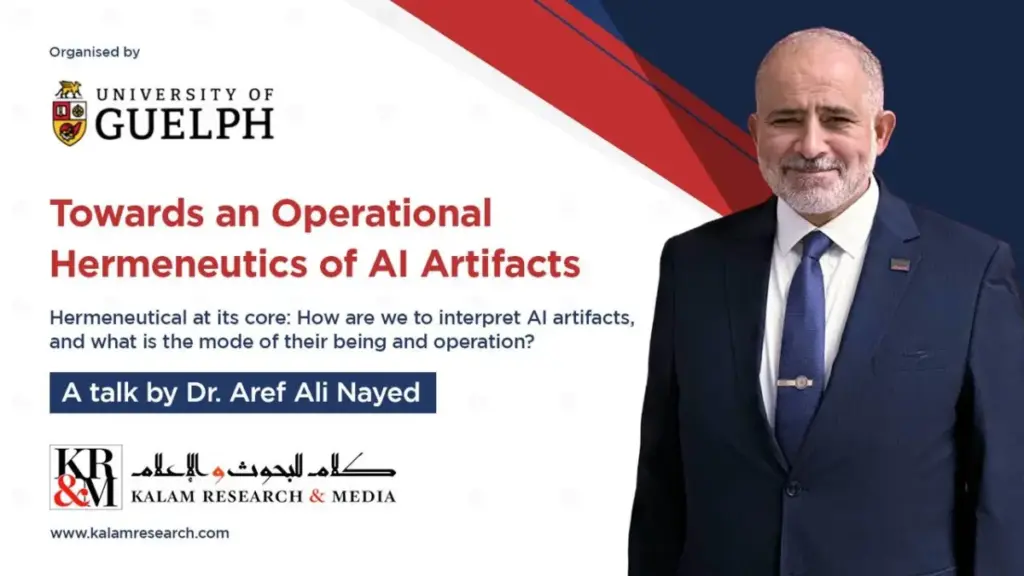
Dr. Aref Ali Nayed, Chairman of Kalam Research & Media (KRM), recently delivered a comprehensive academic lecture at the University of Guelph, exploring the intricate intersection of hermeneutics, artificial intelligence, and the ethical governance of emerging technologies. The presentation drew together decades of philosophical inquiry and contemporary technological challenges, offering academics, researchers, and students a robust framework for understanding how artificial intelligence systems operate within modern society.
About the Lecture
The central focus of the presentation was Operational Hermeneutics—a pioneering theoretical framework that Dr. Nayed originally developed during the 1990s while conducting doctoral research at the University of Guelph. Reintroduced in the context of modern machine learning, this framework provides essential tools for understanding and ethically engaging with AI-generated artifacts. Throughout the lecture, Dr. Nayed detailed how contemporary AI systems function far beyond simple computational tools, operating instead as active operational artifacts that interpret data, generate meaning, and fundamentally shape human understanding and cultural discourse.
The discussion emphasized that as machine-generated content becomes more prevalent across public and private spheres, society requires sophisticated interpretive models. Rather than viewing AI outputs as objective or neutral data points, Dr. Nayed argued that researchers and policymakers must recognize them as interpreted artifacts born from complex algorithmic processes. This perspective invites a deeper philosophical examination of how machines process information and how human users interpret that machine-generated output, bridging a critical gap between technical execution and human meaning-making.
Watch the Full Lecture
For those unable to attend the event in person, the complete presentation has been made available to the public. The recorded lecture captures Dr. Nayed’s detailed breakdown of Operational Hermeneutics and its applications to modern artificial intelligence systems.
Related Initiatives
The lecture formed a central component of Dr. Nayed’s broader academic engagement with the Centre for Advancing Responsible and Ethical Artificial Intelligence (CARE-AI) at the University of Guelph. This ongoing visit served to strengthen institutional ties and foster collaborative efforts between Kalam Research & Media and Canadian AI research institutions. By aligning international philosophical expertise with Canada’s cutting-edge technical research centers, the collaboration aims to advance the development of robust ethical frameworks for artificial intelligence deployment.
Scholars and practitioners interested in learning more about these collaborative efforts can read further about Dr. Nayed’s visit to the Centre for Advancing Responsible and Ethical Artificial Intelligence at the University of Guelph through KRM’s official portal.
Further Reading
To complement the themes introduced during his presentation, Dr. Nayed has recently published a comprehensive academic paper that expands extensively upon the core principles of the lecture.
Titled “Towards an Operational Hermeneutics of AI Artifacts,” the monograph examines the ways in which AI-generated outputs can and should be understood as operational artifacts requiring rigorous hermeneutical engagement. The paper proposes innovative frameworks designed to assist researchers, ethicists, and technologists in interpreting machine-generated content accurately. Furthermore, it tackles the profound ethical dimensions inherent in everyday human-AI interaction, offering practical pathways for responsible technological governance. The full monograph is publicly accessible for researchers seeking a deeper dive into the theoretical underpinnings of the research program.
About the University of Guelph Partnership
The University of Guelph holds profound significance within Dr. Nayed’s intellectual and professional journey. It was on this campus during the 1990s that he first formulated the foundational concepts of Operational Hermeneutics during his doctoral studies. His return to the university represents a true homecoming of ideas, bringing decades of intellectual refinement back to the birthplace of the theory, only now applied to the pressing contemporary challenges of artificial intelligence ethics.
This academic engagement is part of a larger, concerted effort by Kalam Research & Media to build bridges with premier Canadian research ecosystems. KRM’s strategic partnership with the University of Guelph and CARE-AI complements a broader network of collaborations involving other leading Canadian institutions, including the Vector Institute for Artificial Intelligence and the Canadian Institute for Advanced Research (CIFAR). These partnerships collectively seek to address the multifaceted challenges posed by rapid technological advancement through interdisciplinary cooperation.
KRM’s Artificial Understanding Research
While the vast majority of contemporary artificial intelligence research remains narrowly focused on optimizing machine performance, processing speed, and computational efficiency, Kalam Research & Media has charted a distinctly different course. KRM has pioneered dedicated research into Artificial Understanding (AU)—an innovative approach that asks fundamental, foundational questions regarding comprehension, meaning, and true interpretation within artificial systems.
The Artificial Understanding research program, which draws heavily from the principles of Operational Hermeneutics, addresses the limitations of purely statistical or performance-driven AI models. By shifting the scholarly focus from mere data processing to genuine understanding, the initiative seeks to establish new standards for how artificial systems process and convey meaning. This unique program reflects KRM’s ongoing commitment to ensuring that technological innovations are guided by rigorous philosophical principles and deep ethical consideration, safeguarding human values in an increasingly automated world.