By Adeeba Jamal
The narrow lanes of Old Delhi possess an intricate, unyielding life entirely their own. Every twist, turn, and shadowed corner carries a fragment of history—some aspects gleaming with the residual polish of bygone eras, while others fade quietly like old ink on parchment. In the heart of Ballimaran lies Gali Qasim Jan, a name that commands reverence and curiosity even as the sweeping tides of modernity threaten to wash away the physical markers of its storied past.

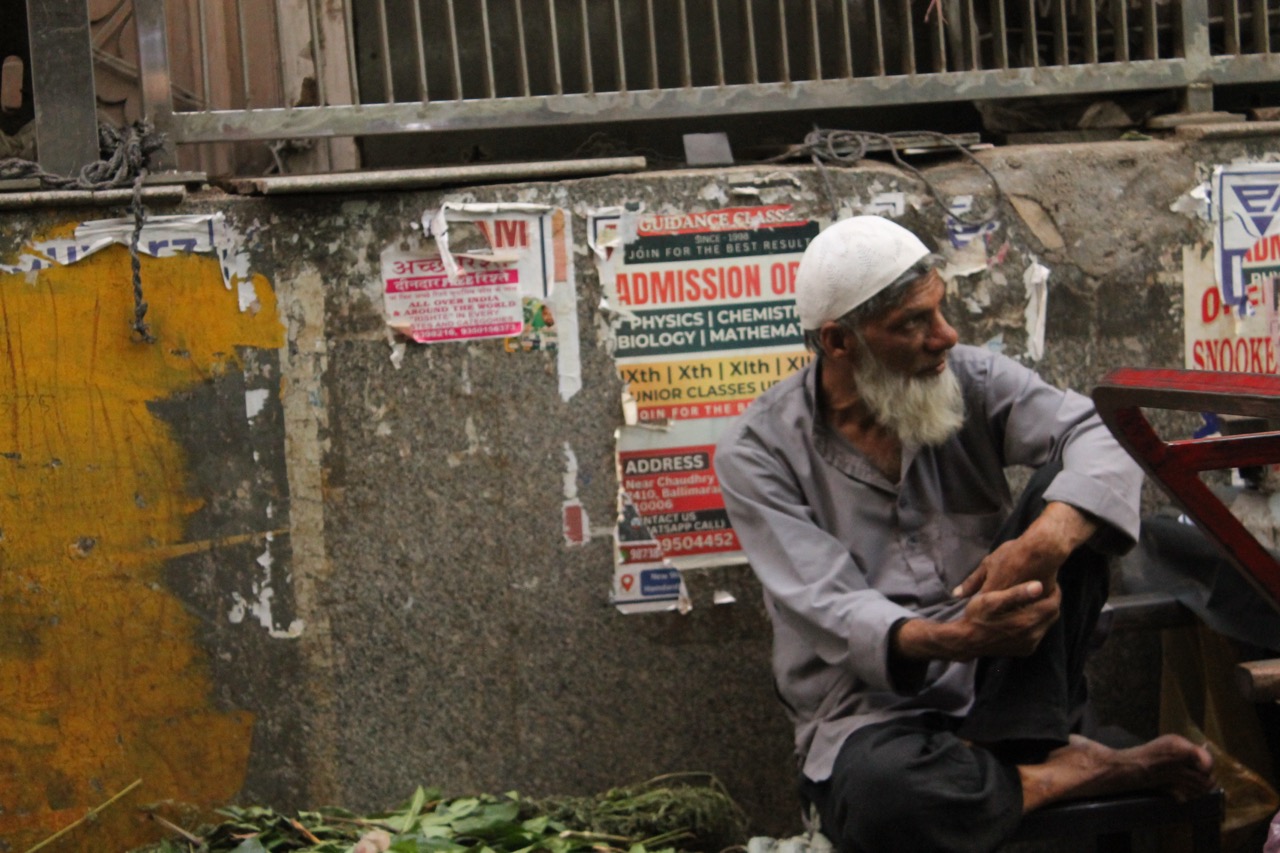
Unlike major historical monuments that demand attention with grand facades, ticketing booths, and multilingual plaques, Gali Qasim Jan makes no explicit announcement of its historical weight. The sensory landscape of the lane is dominated by the present day: the persistent honking of bicycle rickshaws navigating tight spaces, the distant, melodic echo of the azaan calling the faithful to prayer, and the overlapping chatter of neighbours echoing over the metallic clatter of tea glasses in local roadside stalls. Yet, nestled precariously between cracked stone archways and sagging wooden jharokhas—traditional projecting balconies—tangible traces of a magnificent past remain seamlessly woven into the everyday rhythm of contemporary life.
Centuries ago, Nawab Qasim Jan, a prominent noble who served in the royal court of the Mughal Emperor Shah Alam II between 1728 and 1806, constructed his grand haveli in this very area. Over time, the nobleman’s residence became synonymous with the street itself, lending its name to the geography of the neighbourhood. Today, that legacy survives not through formal preservation in institutional textbooks or academic archives, but rather through the collective memory of the residents who continue to call the lane their home, breathing life into history simply by walking its stones.
Syed Shaheed Hassan, a soft-spoken resident in his seventies, has lived in Gali Qasim Jan for his entire life. Reflecting on the origins of the street’s name, he offers a poignant observation about how communities inherit history.
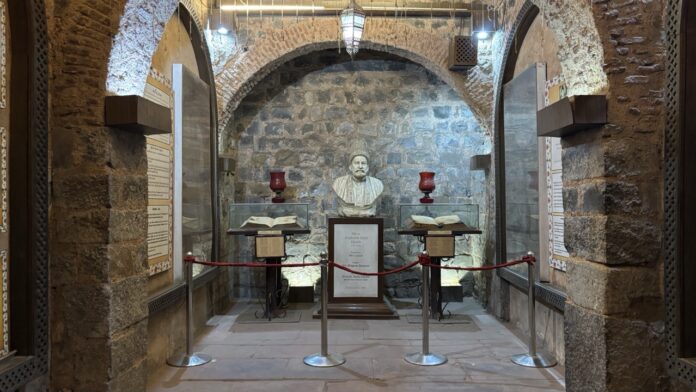
"People don’t really know who Qasim Jan was anymore," Hassan says, leaning against the counter of his modest shop. "But his name… it stayed. We have all grown up hearing it."
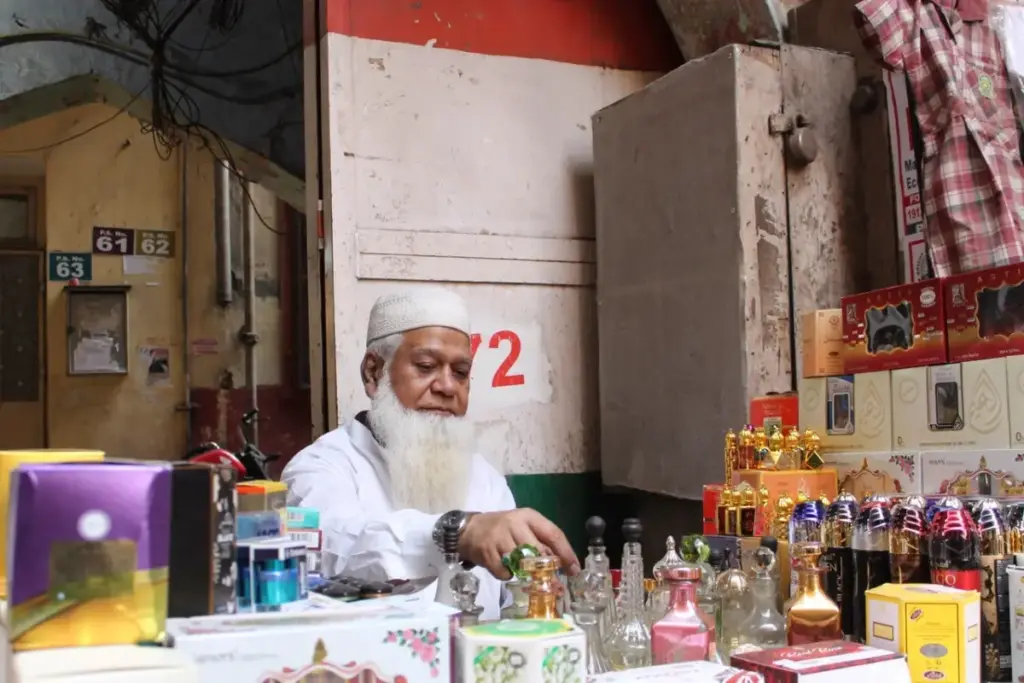
Hassan operates a small attar shop tucked safely into a quiet side nook of the gali. For over four decades, he has been quietly plying his trade, selling traditional, alcohol-free perfume oils infused with the natural essences of gulab (rose), jasmine, and amber. For Hassan, this commercial endeavor is far more than a simple livelihood; it is a direct, sensory link to a vanished era. Opening a tiny, glass vial to release a wave of floral aroma into the humid afternoon air, he remarks that the craft represents much more than commercial goods. "This is not merely fragrance," he explains. "It is Mughal culture in a bottle."
What elevates Gali Qasim Jan from a standard historical relic to a remarkable crossroads of Indian history is the staggering convergence of narratives it has hosted. Within the span of a few short paces, the lane bridges monumental eras defined by royalty, anti-colonial resistance, literary genius, and cinematic history.
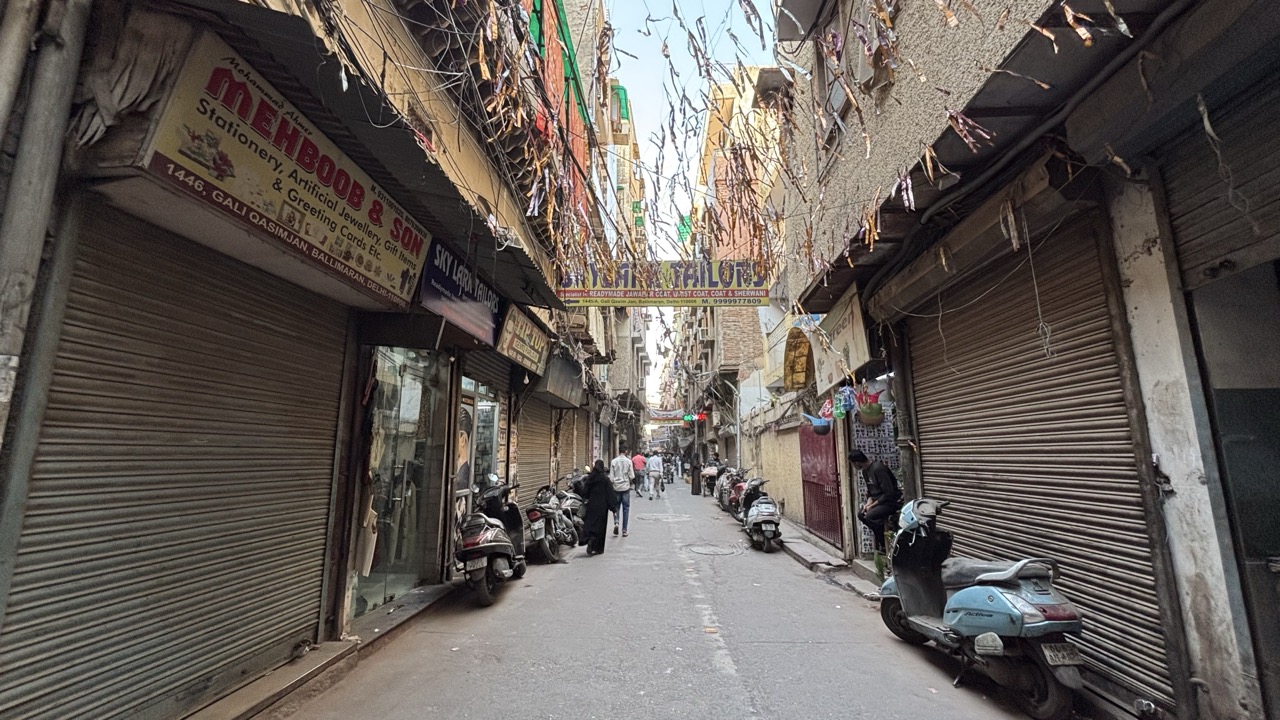
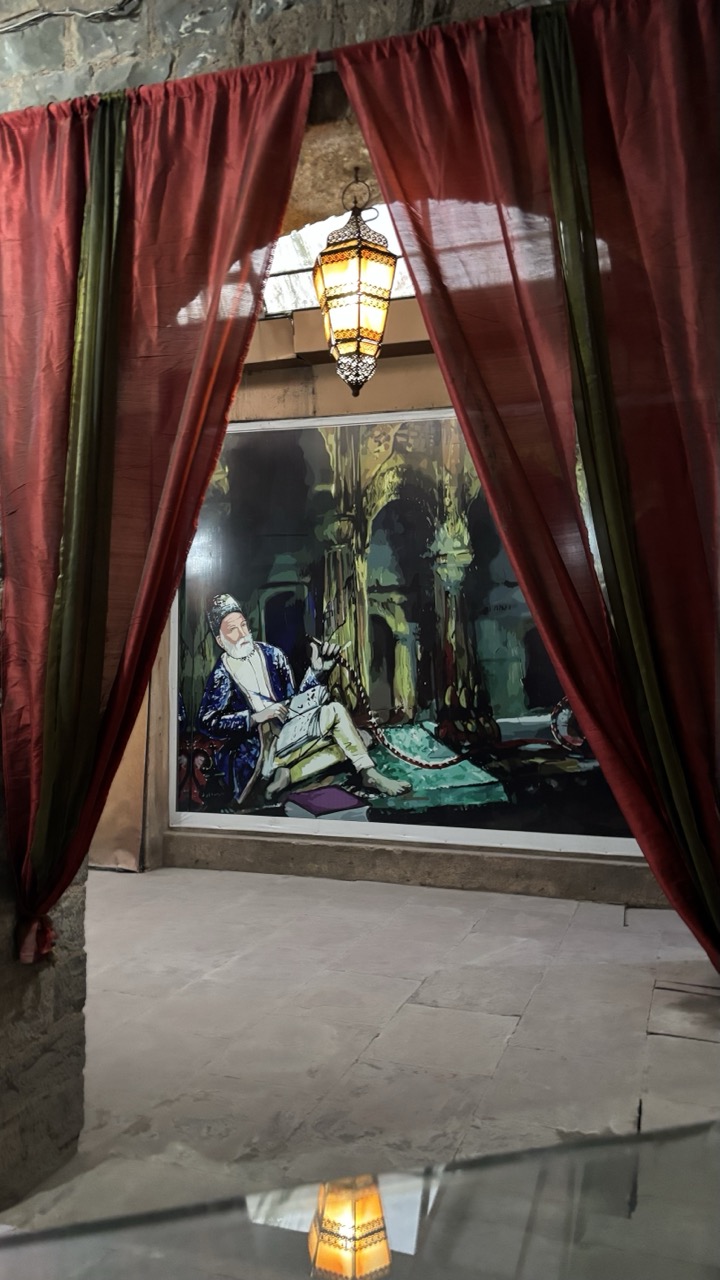
Hassan points out that the famous Urdu poet Mirza Ghalib lived just a few doors down from his current storefront. The cultural lore of the lane holds that Ghalib’s nikah—his Islamic marriage ceremony—took place right within the vicinity. Residents often whisper that the tranquil, contemplative atmosphere of the neighborhood provided Ghalib with a sanctuary of peace, perhaps even inspiring some of the timeless ghazals that continue to define South Asian literary heritage.
Despite the persistent background noise and chaotic bustle of the crowded lane, the structural and cultural walls of Gali Qasim Jan hold secrets that extend far beyond poetry. A closer examination of the lane’s roots reveals that it was also the birthplace of Maulana Qasim Nanautawi, the prominent Islamic scholar who founded the esteemed Darul Uloom Deoband seminary. Nanautawi later played a pivotal, clandestine role in the anti-colonial resistance against British rule, participating actively in historic movements such as the Silk Letter Movement aimed at orchestrating an uprising from within and outside India’s borders.
"We did not have processions here or anything, but minds were shaped in these walls," Shaheed explains, reflecting on the intellectual gravity of his neighborhood. "Big ideas started in small rooms."
The cultural footprint of Gali Qasim Jan even extends into the golden age of Indian cinema. With a gentle twinkle in his eyes, Hassan leans in to share a memory that bridges the gap between historical Old Delhi and the silver screen. He recalls the day the legendary actress Meena Kumari visited the lane during the filming of Kamal Amrohi’s cinematic masterpiece, Pakeezah. A specific scene for the classic film was shot directly within the confines of the gali.
"I remember her sitting in a rickshaw and passing right by my shop, which was once just a decorated table on the street," Hassan recalls with quiet fondness. "It is the kind of memory you do not find in archives."
Yet, among all the royal associations, literary milestones, and cinematic encounters, Hassan notes that his most cherished memory is of a subtler, deeply personal revolution that transformed the social fabric of his community from the ground up. For generations, traditional societal norms meant that young girls in the neighborhood rarely had access to formal education. That paradigm shifted permanently when the Rabea Girls’ Public School opened its doors within the lane.
"There was a time when girls rarely went to school. It was not the norm," Hassan says, his voice carrying the weight of decades of social change. "But then Rabea Girls’ Public School opened here. It changed things. Suddenly, every morning, we would see girls in white uniforms rushing in with their bags… it gave us hope." He pauses momentarily, adding, "In those days, a girl going to school was a big deal."
While the modern world outside the boundaries of Old Delhi races forward at an unrelenting pace, Gali Qasim Jan continues to maintain its own unhurried rhythm. Children kick plastic balls beneath crumbling, sun-bleached balconies, shouting playfully to one another. Elderly women lean across opposing windows to exchange afternoon gossip and news of the neighborhood. Amidst this daily choreography, the distinct, calming scent of jasmine and natural attar drifts softly from Hassan’s shop, carried on the gentle breeze.
Though the physical walls of the lane are weathered by time and the elements, they continue to speak to those willing to listen. Their stories are preserved not through bronze plaques or formal institutional inscriptions, but through living repositories of memory like Syed Shaheed Hassan. In these oral traditions and daily routines, the rich, multifaceted history of Delhi finds a quiet, enduring home.