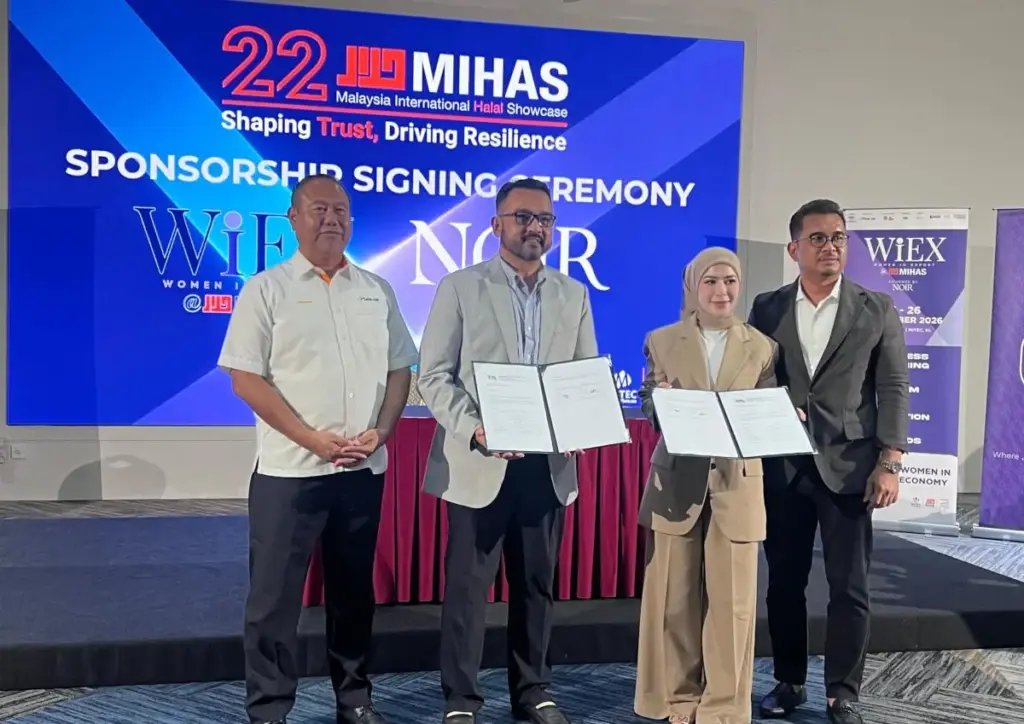
KUALA LUMPUR — The business conversations taking place at the Malaysia International Halal Showcase (MIHAS) 2026 this week are providing a group of women entrepreneurs with something that is frequently much harder to secure than a standard exhibition space: direct, unfiltered access to potential customers and decision-makers in lucrative overseas markets.
Through the Women in Export (WiEX) initiative, 80 women-owned and women-led businesses are taking part in the four-day international trade showcase, which continues its run at the Malaysia International Trade and Exhibition Centre (MITEC) through Saturday. Out of these participating enterprises, 60 are homegrown Malaysian companies, while the remaining 20 represent international exhibitors from various regions looking to forge cross-border partnerships.
Organizers have targeted more than 120 specialized business-matching sessions specifically for Malaysian companies operating within the WiEX Pavilion. This targeted networking effort forms part of a broader, concerted campaign by the Malaysia External Trade Development Corporation (MATRADE) to connect local businesses directly with qualified international buyers. To facilitate these high-value interactions, MATRADE has brought approximately 300 international buyers to MIHAS 2026 through its flagship International Sourcing Programme.
For a small or medium-sized enterprise attempting to cross national borders and break into a foreign market, the significance of these face-to-face meetings can vastly outweigh the general brand exposure generated by a traditional trade-show booth. Brochures and digital catalogs can only convey so much information; overseas buyers, by contrast, demand granular, operational details. They want to sit down and ask questions that cannot easily be answered by marketing materials: How much can the company reliably produce each month? Can its supply chain meet the stringent regulatory requirements of another target market? How quickly can shipments be delivered from manufacturing facilities to international ports? Can the price point remain competitive against regional rivals? And, perhaps most crucially, can the commercial relationship be sustained and nurtured long after the exhibition lights have been turned off?
These are the pivotal questions that will ultimately determine whether the WiEX pavilion becomes much more than just a prominent, highly visible feature of the MIHAS 2026 floor plan.
From Exhibition Space to Export Opportunity
Over the course of several decades, Malaysia has invested heavily in building an enviable international reputation centered around robust halal standards, stringent certification processes, and proactive trade promotion. Consequently, MIHAS has evolved into an indispensable annual meeting place for corporations, SMEs, and entrepreneurs operating across every tier of the global halal ecosystem.
However, navigating the path from a successfully manufactured, halal-certified product to a loyal international customer is rarely a straightforward journey.
For smaller businesses, particularly those that are still in the process of actively building and scaling their export capabilities, finding the right buyers and reliable distributors can prove to be just as challenging as developing the product itself. Complex financial requirements, fluctuating production capacities, intricate market regulations, and unpredictable global logistics can all serve as formidable barriers. Ultimately, these factors determine whether an exciting opportunity initially identified on a bustling trade show floor will actually blossom into a sustainable, long-term commercial relationship.
The WiEX initiative has been meticulously structured with that commercial reality firmly in mind. Rather than merely offering physical floor space, the initiative combines the dedicated WiEX Pavilion with curated business-matching sessions, an insightful industry forum, and the recognition of the Women Economic Warrior Awards. The concurrent forum is actively addressing the pressing issues currently facing women exporters, including strategies for effective market diversification, rapid digitalisation, adapting to changing global trade conditions, and building long-term business resilience in an unpredictable economic climate.
This concentrated focus is exceptionally significant because the modern halal economy has expanded well beyond its traditional, historic association with food and beverages.
MIHAS 2026 successfully brings together enterprises representing a vast array of industries across 14 distinct industry clusters. These include food and beverages, cosmetics and personal care, pharmaceuticals and biotechnology, Muslim-friendly tourism, Islamic finance, halal medical devices, and specialized industrial ingredients. Women-owned businesses are actively participating across this wider, highly diversified landscape. In these competitive sectors, international market success increasingly depends on a sophisticated combination of strict halal compliance, uncompromising product quality, compelling branding, advanced technology integration, accessible financing, and the demonstrated ability to deliver orders consistently and on schedule.
A Test for Malaysia’s Halal Export Ambitions
This targeted initiative also arrives at a critical juncture, coming precisely as Malaysia seeks to significantly increase the economic contribution of halal businesses to the nation’s broader international trade portfolio.
MATRADE has closely tied the WiEX initiative to Malaysia’s ambitious national target of reaching RM80 billion in halal exports by the year 2030. Agency representatives have repeatedly emphasized that the program is purposefully designed to equip women-led businesses with the robust networks, strategic insights, and direct market access required to expand successfully beyond the boundaries of the domestic market.
The wider statistical backdrop surrounding MIHAS clearly illustrates the immense scale of the commercial opportunity at hand. The 2026 exhibition features an expansive 2,400 exhibition booths spread neatly across the 14 specialized industry clusters. According to organizers, the event has already recorded an impressive turnout of 50,340 trade visitors, facilitated over 4,000 formal business meetings, and successfully concluded an astonishing RM6.05 billion in potential deals and transactions.
Yet, these impressive figures also point toward a lingering question that will only become fully apparent as the remainder of the week unfolds.
Just how many of the preliminary conversations taking place across the exhibition halls in Kuala Lumpur will ultimately translate into actual, realized trade?
That particular question carries immense weight, especially for smaller companies operating on tighter margins. While a brief, introductory meeting with an overseas buyer is undeniably useful, it represents merely the initial step of a complex export process. The true commercial value materializes much later, when preliminary discussions successfully transition into physical product samples, formal purchase orders, structured distribution agreements, and dependable repeat business.
For that very reason, the most important legacy of WiEX may ultimately not be counted in the sheer number of women entrepreneurs participating on the exhibition floor, but rather in the enduring quality of the professional connections they manage to forge.
The Outcome Is Still Being Written
As MIHAS 2026 continues its busy schedule, the final, aggregate results of the countless business meetings taking place throughout the exhibition venue remain to be seen.
Nevertheless, what is already abundantly evident to observers is the sheer scale and dedication of the institutional effort aimed at integrating women-led businesses directly into the upper echelons of the international halal trade network.
MATRADE’s renowned International Sourcing Programme is itself built around meticulously pre-arranged meetings connecting capable Malaysian suppliers with vetted overseas buyers. This year’s iteration of the program has successfully attracted enthusiastic interest from commercial buyers hailing from dozens of distinct global economies, with MATRADE targeting substantial export sales as a direct result of the initiative.
By operating in tandem with this framework, WiEX provides the broader national trade promotion agenda with a specialized focus: actively assisting women entrepreneurs as they leverage the global marketplace to build enterprises capable of thriving far beyond Malaysia’s shores.
For the various companies currently showcasing their offerings within the WiEX Pavilion, the immediate priority remains remarkably straightforward. Find the right buyer. Deepen their understanding of the target market. Make the commercial deal work for all parties involved.
At the same time, the longer-term significance of their participation will heavily depend on what happens after those first introductory conversations come to a close.
With MIHAS continuing through Friday and officially drawing to a close on September 26, there remains ample time for those nascent discussions to mature into concrete partnerships. For several of the ambitious women entrepreneurs taking part in the showcase this week, a single well-timed meeting could very well represent their inaugural step into a lucrative international market they have not yet managed to reach.
That represents the true potential sitting quietly behind the WiEX initiative—an opportunity that will ultimately be measured not by the sheer number of exhibition booths filled at MIHAS, but by the resilient businesses that eventually make it far beyond them.