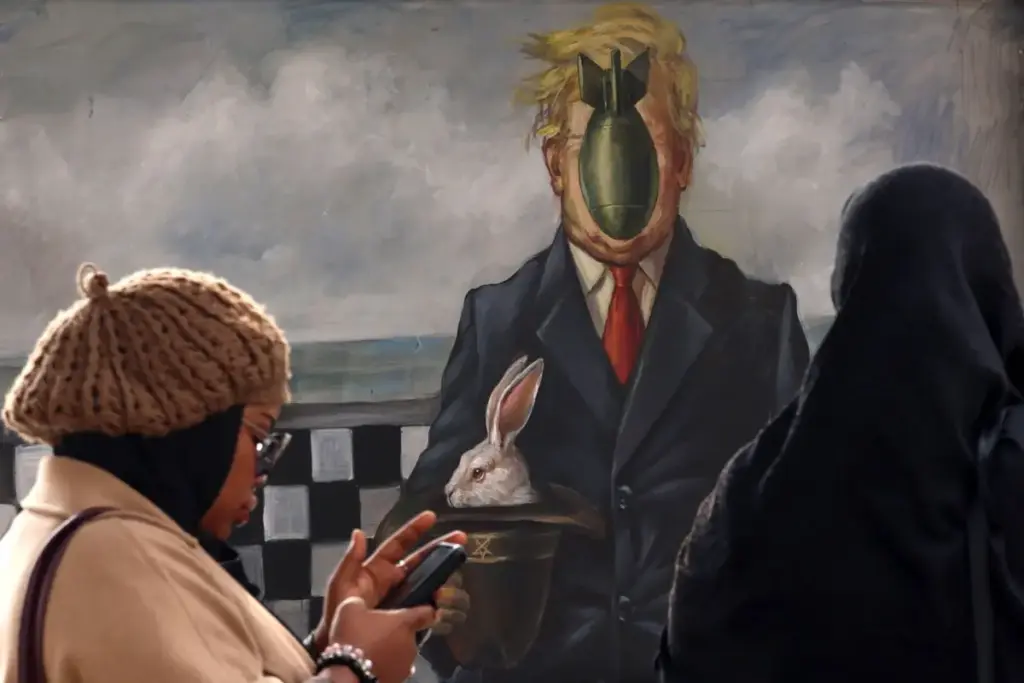
WASHINGTON/TEHRAN — Just hours after President Donald Trump signaled potential diplomatic progress with Tehran, the United States military launched what officials termed "defensive" airstrikes on an Iranian island situated within the strategic Strait of Hormuz, according to U.S. media reports.
The military action, which was first broken by The Wall Street Journal, targeted Qeshm Island. Iranian state media corroborated the reports, confirming that a series of five rapid explosions rocked the area following the strikes. The sudden escalation unfolds against a complex backdrop of high-stakes domestic politics in the U.S., regional diplomatic maneuvering, and an eight-month-old military conflict that has largely settled into a grueling stalemate.
U.S. officials, speaking to the Journal and other news outlets on the condition of anonymity, characterized the Tuesday attacks as strictly defensive maneuvers. The Wall Street Journal reported that the operation was part of a series of undeclared, low-profile strikes deliberately kept out of the public spotlight. The intention behind withholding public announcements was reportedly to avoid giving the impression that Washington intends to resurrect major combat operations in the region. U.S. Central Command did not immediately respond to requests for comment from Agence France-Presse (AFP).
The current military campaign began in late February when the United States and Israel launched surprise joint strikes against Iran. However, the coalition has thus far failed to achieve its primary strategic war aims, and the broader conflict has remained deadlocked for months, inflicting severe economic strain globally and political pressure domestically.
The timing of the latest strike coincides with a critical political juncture in the United States. On Monday, just a day before voters were widely expected to deliver a severe defeat to President Trump’s Republican Party in the midterm elections—fueled in part by voter dissatisfaction with the ongoing war and the resulting inflation—Trump struck a notably optimistic note on social media. Writing on his Truth Social platform, the U.S. president asserted that a comprehensive diplomatic deal with Iran "could happen," adding that Tehran was eager to reach a settlement as soon as possible.
Echoing these diplomatic murmurs, Iranian Foreign Minister Abbas Araghchi confirmed that indirect talks between Washington and Tehran were actively underway. Given the extreme sensitivity and gravity of the current geopolitical situation, Araghchi told Iranian state media that consultations and intensive deliberations are proceeding behind the scenes.
On Tuesday, Mohammad Bagher Ghalibaf, Tehran’s chief negotiator in the discussions with the United States, adopted a firm stance, stating that while Iran remained fully prepared for a resumption of all-out war, it had chosen to provide Washington with a "rational response." Ghalibaf added that the ball was now firmly in America’s court to take the necessary steps to prevent further escalation and war.
The diplomatic signals had an immediate impact on global markets. On Monday, oil prices plunged by more than 7% as investors reacted to growing optimism over a potential end to the prolonged conflict, which has choked vital energy supply lines.
Reopen the Strait
U.S. Vice President J.D. Vance reinforced the administration’s hopeful outlook, telling reporters on Monday that both he and President Trump were optimistic about the prospect of securing a formal agreement.
"We’ve certainly made some progress. We’ll see if we can make some more," Vance told reporters.
International powers have also mobilized around the diplomatic opening. China has renewed its public calls for a swift return to diplomacy, while Iran’s top security chief held high-level discussions regarding the trajectory of the conflict with Russian President Vladimir Putin. These diplomatic channels have seen notable movement in recent days; last week, Axios reported that Vice President Vance had dispatched a direct letter to Iranian National Security Chief Mohsen Rezaei concerning potential new talks, representing the highest-level direct outreach between the two adversaries in months.
In Tehran, however, the overtures were interpreted through a lens of strategic triumph. Iran’s First Vice President, Mohammad Reza Aref, publicly characterized the messages emanating from Washington as a direct acknowledgement of Iranian victory.
Furthermore, a senior Iranian official revealed that Tehran is prepared to fully reopen the Strait of Hormuz—an indispensable chokepoint for global oil and gas shipments—within a remarkably short window of two days. This reopening, however, is strictly conditional upon Washington agreeing to a comprehensive, long-standing list of demands compiled by the Iranian government.
Back in September, Iran formally proposed a seven-day operational plan to clear and reopen the strait. The plan’s prerequisites include a complete end to military hostilities on all fronts, the unfreezing of billions of dollars in Iranian assets held abroad, the total lifting of international oil sanctions, and the immediate cessation of the U.S.-backed counter-blockade against Iranian ports.
"The possibility of implementing this plan in two days is another indication of Iran’s good-faith approach," Iranian Foreign Ministry spokesperson Esmaeil Baghaei told reporters during a press briefing.
‘No Compromises’
Diplomatic efforts continued to swirl away from Washington and Tehran as well. On Monday in Beijing, Chinese officials hosted separate meetings with representatives from both Iran and Saudi Arabia. During talks with Ali Bagheri, the deputy secretary of Iran’s Supreme National Security Council, Chinese Foreign Minister Wang Yi reiterated Beijing’s firm support for Tehran in safeguarding its own national sovereignty and security, according to an official Chinese statement.
Despite the back-channel communications and expressions of cautious optimism, significant hurdles remain. In an interview with Al Jazeera broadcast on Sunday, Foreign Minister Araghchi insisted that Washington must formally accept a new maritime transit route through the Strait of Hormuz mutually agreed upon by Iran and Oman. Furthermore, Araghchi stated that the United States must immediately roll back recently imposed sanctions and significantly reduce its military footprint and troop numbers stationed across the region.
President Trump, meanwhile, has continued to balance diplomatic overtures with pointed military threats. On Sunday, he warned that the United States might ultimately have to give Iran "the hammer" at an unspecified future date if negotiations fail to yield results.
Just days prior, on Saturday, the U.S. leader remarked that he still needed to "take care" of one or two remaining strategic targets inside Iran, specifically pointing to Pickaxe Mountain located in central Iran—a site suspected by Western intelligence of housing nuclear infrastructure, an accusation that Tehran has consistently and vehemently denied.
Mindful of these persistent threats, Iranian military and political authorities have repeatedly warned of wide-ranging and severe retaliation should the United States resume large-scale military operations. Underscoring the volatile atmosphere on the ground, municipal authorities in Tehran hoisted a large, defiant banner in the heart of the capital on Tuesday. Featuring a prominent photograph of the U.S. president, the banner carries a stark message directed at Washington: "We will kill Trump."