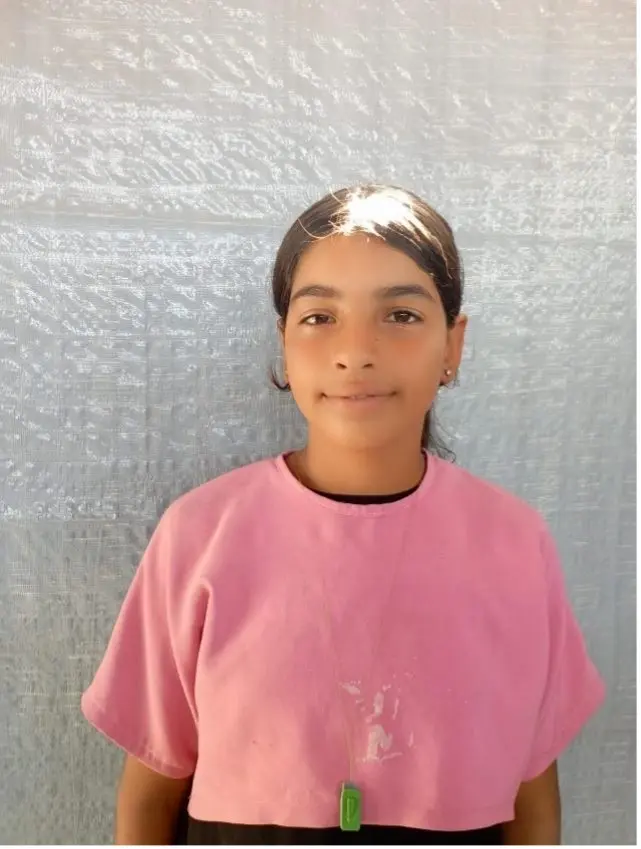
At just 12 years old, Amira has already confronted a lifetime of profound sorrow. She has experienced the agonizing loss of her father, the trauma of violent displacement, and the total destruction of her family home. Yet, despite the catastrophic conditions surrounding her in Gaza, she remains stubbornly devoted to her education, holding fast to a singular, enduring dream: to grow up, become a nurse, and help others.
Amira’s childhood shifted dramatically when she was nine years old and lost her father to cancer. To young Amira, he was far more than a parent; he was an unwavering source of deep love, steadfast safety, and quiet strength. His passing left a permanent mark on her early years, fundamentally altering the trajectory of her life. But just as she and her family were learning to navigate a world without him, the war in Gaza began, plunging them into yet another devastating cycle of loss, uncertainty, and unrelenting fear.
Forced to Leave Everything Behind
Before the conflict uprooted their lives, Amira lived alongside her mother, Manal, and her brothers and sisters in the Al-Salam neighbourhood of Rafah. When the family was ultimately forced to flee under the threat of advancing violence, they had to make agonizing choices about what to carry. Leaving the vast majority of their personal belongings, memories, and lifelong possessions behind, they packed only a few changes of clothes, essential bedding, and a handful of basic kitchen items.
Like countless others who joined the massive waves of displacement, the family held onto a fragile optimism, desperately hoping that the hostilities would subside quickly and that they would soon be able to return to the familiar comfort of their home. Instead, those hopes were shattered when their house was targeted and destroyed. With nowhere else to go and no return possible, the family remained displaced, eventually constructing a makeshift tent to serve as their shelter.
Life inside the tent was an exhausting daily struggle against the elements. The canvas structure offered almost no insulation, becoming suffocatingly hot during the scorching summer months and bitterly, bone-chillingly cold throughout the winter. When heavy seasonal rains arrived, water leaked directly into their living space, turning the dirt ground beneath their feet into thick, clinging mud.
Basic survival became an exhaustive daily routine. Securing clean water and adequate food required monumental effort. The family often spent hours waiting anxiously in long lines to collect water from passing distribution trucks. When they could no longer afford to purchase food from local markets, they had to rely entirely on community kitchens for their daily sustenance, underscoring the deep vulnerability of their situation.
Losing Everything a Second Time
Just when it seemed the family had reached the limits of endurance, catastrophe struck again in a different form. Their tent caught fire, completely destroying what little they had managed to salvage and rebuild.
The flames consumed their remaining clothes, their last pieces of cooking equipment, and the few personal belongings that brought a semblance of normalcy to their harsh daily routine.
“Everything we owned was turned to ashes,” Manal shares, describing the sheer devastation of watching their final safety net vanish in moments. The fire left the family once more stripped of the fundamental items required for basic human dignity and daily survival.
In the wake of the fire, their immediate material needs multiplied drastically. They now require a sturdier, more secure shelter equipped with waterproof coverings to withstand the weather, alongside a functioning bathroom, replacement cooking equipment, and basic clothing and shoes for every family member.
Continuing to Study Despite Displacement
Even under such harrowing and deeply unstable conditions, Amira refuses to let her circumstances completely dictate her future. She works hard to continue her education online and is currently progressing through the seventh grade, determined not to fall behind in her studies.
At home—which is now defined by the walls of a fragile tent—she shares the domestic burden with her mother. Without the convenience of electricity or a washing machine, Amira spends hours washing the family’s clothes entirely by hand. Despite the physical exhaustion of these daily chores and the psychological weight of her displacement, her ambitions remain crystal clear. She dreams of entering the medical field to become a nurse, and she clings to the hope that she will find a way to finish her schooling.
Amira also finds moments of solace in drawing, a creative outlet she deeply enjoys, though she currently lacks the basic art supplies and materials needed to properly practise and develop her talent.
Her immediate and most urgent personal requirements remain grounded in the necessities of the upcoming season: winter clothing, proper undergarments, and shoes to protect her from the cold and damp ground.
Supporting Orphaned Children in Gaza
The hardships faced by Amira and her family reflect a broader, heart-wrenching reality across the region. Islamic Relief has long recognized the acute vulnerability of children caught in such crises, supporting orphaned children in Gaza through its specialized Orphan Sponsorship Programme since 1999.
The programme operates on a personalized, one-to-one sponsorship model. Donors are directly matched with a child, providing a regular monthly financial contribution delivered straight to the child’s guardian. In the context of Gaza, this vital support grants families the flexibility to allocate funds toward the needs they deem most critical at any given moment, whether that means purchasing fresh food, securing warm clothing, accessing healthcare, or funding educational expenses.
As the humanitarian crisis has deepened and expanded, Islamic Relief has scaled up its operations to meet the surging demand. Today, more than 25,000 children across Gaza are actively receiving sponsorship support through the organization. However, the scale of the need remains staggering, with over 5,000 children still lingering on the waiting list, hoping for a sponsor to step forward.
Whenever logistical conditions and access permit, sponsored families also receive essential seasonal relief. This supplementary assistance includes nutritious food parcels distributed during Ramadan and Qurbani, celebratory gifts for Eid, and specialized winter items designed to help families endure the harshest months of the year.
Holding on to Hope
Amira’s story is a poignant testament to the extraordinary resilience—and the immense vulnerability—of children in Gaza who have been forced to navigate the loss of parents, the destruction of homes, and the total stripping away of their physical security.
Yet, despite the ashes of the tent fire and the persistent uncertainty of tomorrow, she continues to crack open her digital textbooks, study her lessons, and dream about what comes next.
Her aspirations remain remarkably modest and grounded: she wants to complete her education, step into a career as a nurse where she can heal others, and ultimately live somewhere safe and permanent with her family.
Through Islamic Relief’s Orphan Sponsorship Programme, individuals around the world have the opportunity to help provide consistent, reliable support to orphaned children and their families in Gaza, offering a tangible lifeline to those trying to rebuild their lives from the ground up.