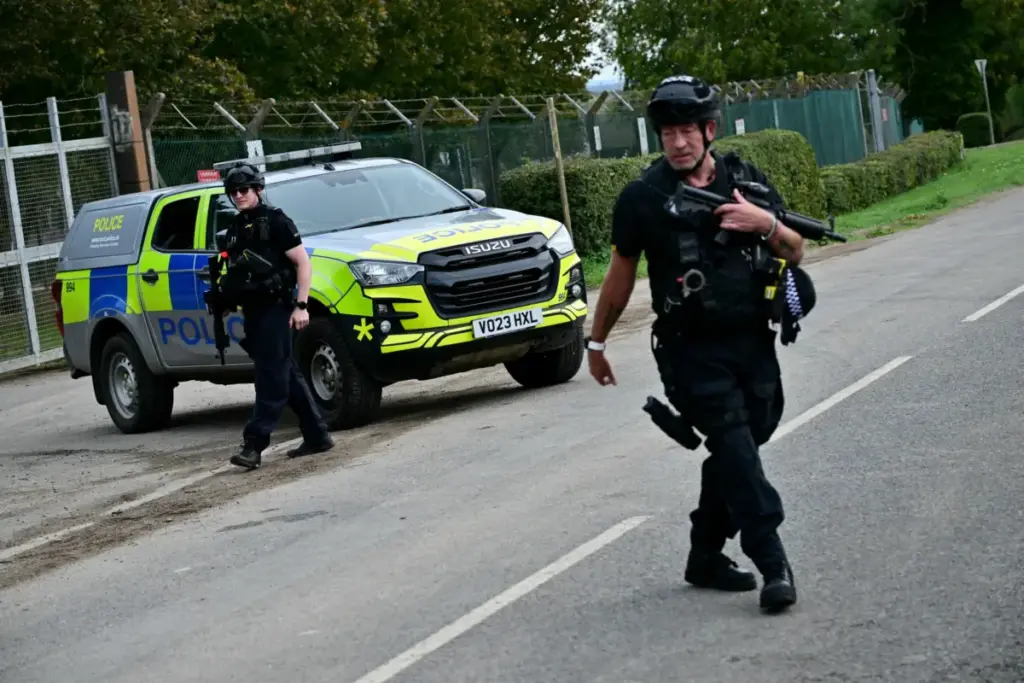
When a Gloucestershire resident returned to her quiet English village in the early hours of a Sunday morning, she expected nothing more than a routine end to her journey. Instead, she found her driveway completely blocked by three suspicious white vans. Acting quickly, she placed an emergency call to the local police, setting off a chain reaction that would swiftly escalate from a localized neighborhood disturbance into a major international security and diplomatic incident.
Within fifteen minutes of her call, armed police officers had swooped on the scene. Concurrently, authorities declared a major incident at the nearby Royal Air Force (RAF) Fairford base—a strategic military installation that has recently been utilized by United States bombers to carry out strikes against Iran. The atmosphere around the rural airfield tightened instantly as emergency services locked down the surrounding area, bracing for what many feared could be an imminent terrorist threat linked to escalating geopolitical conflicts in the Middle East.
The response was massive and immediate. Approximately 85 homes in the vicinity were evacuated as a specialized bomb disposal robot meticulously picked its way between the parked vans to inspect them for potential hazards. Before long, five British men, all in their twenties and hailing from London, were arrested at the scene on suspicion of terrorism and explosive offenses.
As army explosives experts began a forensic examination of the three vehicles and counterterrorism detectives prepared to question the suspects, the ripples of the Gloucestershire incident were felt thousands of miles away. US President Donald Trump, speaking to reporters roughly 5,800 kilometers (3,600 miles) away, was already publicly hailing the arrests. "We had them under view for a long time, and we got them," he declared.
Back in Westminster, however, the official reaction was considerably more measured. United Kingdom Prime Minister Andy Burnham urged members of the public and commentators alike "not to speculate" while investigations were in their absolute infancy. Meanwhile, the Iranian embassy in London issued a sharp statement declaring that it "categorically rejects" any connection to the incident, warning that such wild speculation would only serve to "fuel Iranophobia propaganda in the UK."
The situation grew even more baffling when, by Monday, all five detained men were released on police bail. The swift reversal left President Trump visibly surprised. US Secretary of State Marco Rubio adopted a much harder line, telling reporters that the incident "clearly involves the hands of a foreign actor." Although Rubio refrained from naming a specific nation, he pointedly noted that Iran had "openly threatened to attack American interests globally."
This rapid sequence of arrests, high-level political claims, and subsequent swift releases has painted a deeply confused picture. Security analysts are now left questioning whether British authorities were genuinely tracking the suspects—as President Trump had asserted—or whether the evidentiary basis for the high-stakes arrest was far thinner than Washington’s bold pronouncements suggested. Many intelligence and security experts consulted by reporters agree that the unconditional release of the suspects on bail strongly suggests the UK government possessed little to no concrete evidence that the men were actively plotting a major terrorist attack.
From "World War III" to "Four Lions"
Security analysts examining the Gloucestershire episode argue there were very few indicators pointing toward a sophisticated, professionally executed terror plot. Chris Phillips, the former head of the UK’s National Counter Terrorism Security Office, expressed deep skepticism regarding the initial panic.
"If there had been any trace of explosives found in the vans, or any thoughts that these men were actually terrorists, they would not have been released," Phillips explained, describing how quickly public perception had shifted. "It’s gone from World War III to Four Lions in four hours," he added, alluding to the 2010 British dark comedy film about a group of bumbling, incompetent would-be suicide bombers.
Phillips pointed out that under the British Terrorism Act 2000, law enforcement agencies are granted the legal power to detain suspected terrorists for up to 14 days without charge. If police genuinely believed they had intercepted a network of active attackers, they would have utilized that extended detention window to comb through records, map out contacts, and analyze digital communications.

Afzal Ashraf, a visiting fellow in international relations and security at Loughborough University and a former senior Royal Air Force officer who served in Iraq, echoed those sentiments entirely. "If there had been any explosives, big or small, in those vans, then there is no way on Earth that the police would have released these individuals on bail," he noted.
To date, British police have stopped short of confirming whether any explosives were actually recovered from the vehicles. Assistant Commissioner Laurence Taylor stressed during briefings that the five men "absolutely remain under investigation," maintaining that investigators are keeping an open mind about the underlying motives behind the incident.
Fuel Thieves or "Useful Idiots"?
If the episode was not a sophisticated terrorist cell preparing a catastrophic strike against a vital military installation, investigators and analysts are left searching for plausible alternative explanations.
Scrutiny of the vehicles yielded curious details. One of the intercepted white vans bore the commercial logo "Fuel 2You," though an investigation by BBC Verify found no evidence that any such legitimate enterprise existed. Ashraf suggested a more localized, opportunistic motive: fuel theft. He noted that many rural homes in the British countryside are disconnected from the national mains gas network, forcing residents to rely heavily on heating oil stored in large tanks located in their gardens.
With global energy prices soaring amid the ongoing war involving Iran, those residential heating oil reserves have dramatically increased in financial value. "When you’ve got several hundred litres in gardens, that’s a bit of a killing for somebody," Ashraf said, emphasizing that while it remains an alternative hypothesis rather than a proven fact, it is significantly more plausible than a high-level foreign state terror operation. He added, "There’s absolutely nothing else at all, at the moment, suggesting that there is a link to any foreign government."
Phillips concurred that the location near RAF Fairford may ultimately turn out to be "just a complete fluke." While acknowledging that intelligence agencies undoubtedly track individuals inside the UK who harbor malicious intentions against Western military targets, he questioned whether these five young men fit that dangerous profile.
Yet, not all security experts are prepared to write the incident off as mere coincidence or common criminality. Anthony Glees, emeritus professor of security and intelligence studies at the University of Buckingham, argued that the logistical effort involved in deploying three separate vans suggests a degree of premeditation that goes beyond casual local thievery.
"People do steal fuel, and students do do stupid things, but you wouldn’t go to the trouble and expense of taking three white vans to do so," Glees contended. Instead, he theorizes that the young men may have been acting as "useful idiots" who were "hired at some expense" by a hostile foreign government. In his view, their objective may not have been to successfully execute a devastating attack, but rather to stage a clumsy disruption explicitly designed to embarrass the British government and rattle international security alliances.
Narrative Dominance
The sharp disconnect between Washington’s emphatic assertions and London’s cautious, evidence-driven legal process has raised broader questions about how intelligence is interpreted and weaponized politically. For Ashraf, Washington’s insistence on framing the event through a specific geopolitical lens stems from the current US administration’s approach to the wider conflict with Iran, which relies heavily on what he terms "narrative dominance."
"This particular American administration hasn’t bothered with a strategy, a military strategy, or even a political strategy," Ashraf observed. "What it has worked on is a narrative strategy."

Regarding President Trump’s confident claim that intelligence agencies had the suspects under surveillance for "a long time," Ashraf suspects a bureaucratic or informational mix-up. It is entirely plausible, he suggests, that the US president was briefed on various extremist cells and individuals currently under active monitoring by intelligence services—a standard routine in counterterrorism. Somewhere along the communication chain, that broader intelligence picture may have been conflated with the Gloucestershire van incident, leading the president to mistakenly connect the dots. "Nobody’s going to tell the president he’s got it wrong," Ashraf remarked.
Domestic political actors have also sought to leverage the event. Reform UK leader Nigel Farage, a longtime political ally of Trump, posted remarks on social media arguing that the RAF Fairford incident validated his longstanding warnings regarding Iran and the Islamic Revolutionary Guard Corps (IRGC). Notably, Farage initially attempted to link the suspects to clandestine operatives arriving on small cross-Channel boats, a claim that fell apart once police officially confirmed that all five arrested men were British nationals originating from London.
For analysts examining the political fallout, the factual accuracy of the initial panic may ultimately be secondary to its utility in shaping public perception. Even if the incident is definitively proven to be a low-level criminal offense completely detached from international terrorism, the association has already been forged in the minds of many voters. "That is a hit. That is success as far as they’re concerned," Ashraf noted regarding the amplification of the narrative by political figures.
A "Frightener"
Despite the release of the suspects and the skepticism surrounding a major terror plot, British law enforcement has explicitly stated that foreign state involvement has not been entirely ruled out. Assistant Commissioner Taylor affirmed that investigators are "considering this from every possible angle," which encompasses the possibility of proxy activity or individuals acting—either knowingly or unknowingly—on behalf of a foreign power.
Hostile state actors utilizing cut-outs and proxies for disruptive activities on British soil is an established concern for national security. In October 2025, MI5 Director General Ken McCallum publicly disclosed that the domestic security service had successfully tracked "more than 20 potentially lethal Iran-backed plots" inside the United Kingdom over the span of just twelve months.
Phillips outlined the typical mechanics behind such remote recruitment networks. Intelligence operatives or their intermediaries frequently scour the dark web, posting illicit job offers promising substantial financial payouts—such as 10,000 pounds—to anonymous individuals willing to carry out specific tasks. Consequently, the actual perpetrators on the ground often sit several degrees removed from the foreign intelligence agencies pulling the strings, maintaining zero direct operational contact with Tehran or Moscow.
While Glees believes RAF Fairford fits the structural profile of such proxy-driven probing, placing Iran "in pole position" among suspects, he argues that a genuine, catastrophic attack on the facility would have backfired tremendously on the Iranian regime. "If there had been an attack on RAF Fairford, that would have been an attack on British soil, which would have meant Britain would have to be far more heavily involved in the war against Iran," he explained, adding that Tehran has no strategic interest in drawing London deeper into the conflict.
Instead, Glees characterizes the incident as a potential "frightener"—a psychological operation intended to unnerve British authorities and subtly signal to Washington that its British allies cannot be entirely relied upon to secure vital military assets.
Conversely, Ashraf remains deeply skeptical that Iran would willingly undertake such a high-risk gamble for minimal strategic return. He points out that Tehran’s primary information operations have focused on emphasizing how deeply unpopular the war remains, even within the United States. Staging an amateurish plot that threatened the safety of British or American civilians would directly undermine that carefully cultivated messaging. Had Iran genuinely intended to strike a heavily fortified military installation like RAF Fairford, he concluded, it almost certainly would have deployed a significantly more capable and professional team.