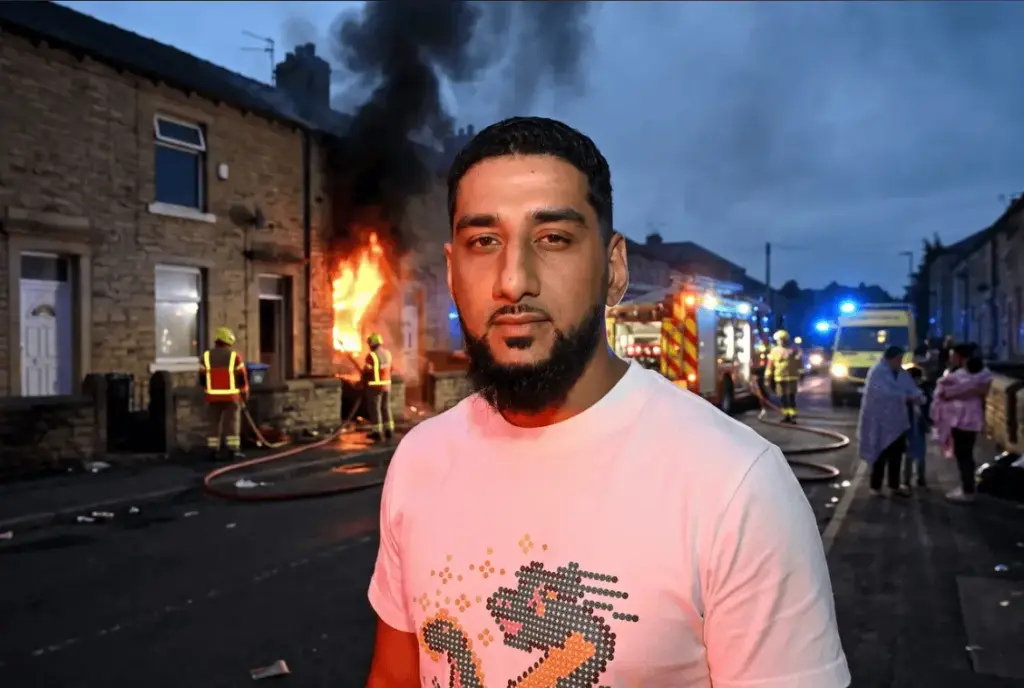
In the quiet, predawn hours when most of the neighborhood was fast asleep, Ans Javid found himself at the center of a life-or-death situation. Racing against time to tend to an urgent family matter, Javid’s journey was suddenly interrupted by a sight that demanded immediate intervention: thick, billowing black smoke cutting through the darkness and rising from a residential property.
Without hesitation, and with no prior connection to the area or the people dwelling inside, Javid diverted from his path. What followed was a swift, instinctive response that ultimately prevented a potential tragedy, waking sleeping residents and ensuring they could escape the encroaching flames before emergency services arrived. Yet, true to his humble character, once the immediate danger had passed and firefighters stepped in to secure the scene, Javid quietly faded into the background. He did not wait for a thank-you, nor did he seek public recognition, choosing instead to quietly resume his journey to his family emergency before heading onward to work.
Recalling the tension of those pivotal moments, Javid rejects the label of a hero, framing his actions instead as a natural human reflex to a crisis. Placed into what he describes as an involuntary state of heightened awareness, his primary focus was solely on preservation and safety.

"It was fight-or-flight mode. I just had to think fast," Javid recounted, reflecting on the urgency that gripped him when he first spotted the hazard. "I didn’t stay around for a thank you, I just carried on to where I needed to be."
The incident highlights the fragile margin between safety and disaster in everyday life. As Javid later contemplated the sequence of events, he noted that the outcome could have been drastically different had he driven past instead of stopping. In the dead of night, when early detection systems can fail and occupants are deeply asleep, the presence of an observant passerby often spells the difference between survival and catastrophe.
"If I wasn’t there, I don’t know what could have potentially happened," he noted, underscoring the unpredictable nature of emergencies and the critical role that ordinary individuals can play when they happen to be in the right place at the right time.
Beyond the immediate relief of saving lives, Javid hopes that sharing his experience will serve as a quiet reminder to the wider public about the inherent value of individual presence and civic responsibility. In a society where people frequently underestimate their own agency, Javid believes that even the smallest, most spontaneous acts of assistance can alter the course of someone else’s life. Too often, individuals second-guess their ability to help or assume that someone else will handle an emerging problem, but Javid’s experience demonstrates that conscious awareness and a willingness to act are powerful tools for community protection.

He suggests that modern media landscapes, which are frequently dominated by distressing or overwhelmingly negative reports, can sometimes obscure the everyday capacity for human kindness and intervention. By highlighting stories of ordinary people stepping up during critical moments, Javid hopes to inspire a cultural shift toward greater attentiveness and mutual support among neighbors and strangers alike.
"People don’t value what they’re worth. They don’t realise that their presence can make a huge difference in a situation," Javid observed, pointing to a broader societal tendency toward self-doubt when confronted with unexpected challenges. He elaborated further on this sentiment, expressing a desire to encourage proactive compassion rather than passive observation.
"There are so many negative stories around. If this encourages someone to help when somebody needs it, then that’s a good thing. Sometimes just being there can make all the difference," he added.
For Javid, the episode concluded as unceremoniously as it began. After alerting the households, placing the necessary calls to emergency personnel, and confirming that help was on the way, he left the unfolding scene behind to manage the personal family emergency that had originally called him out into the night. It was only afterward, as life resumed its normal rhythm, that the true weight of the early morning’s events settled in.

By refusing to capitalize on his actions for personal praise or recognition, Javid’s story remains a testament to quiet heroism—an example of altruism driven purely by the immediate necessity of saving human lives, executed without the expectation of reward, and left behind in the quiet hours of the morning as he continued onward with his day.