More than two weeks after unprecedented, catastrophic floods swept through northern Nepal, rescue and relief operations remain in high gear. The disaster, which has left a trail of widespread destruction, has triggered a severe displacement crisis and raised profound concerns over long-term food security, public health, and infrastructural stability across the country.
Search and rescue teams continue to scour disaster zones, with operations heavily concentrated around critical infrastructure, including hydropower facilities and underground tunnels. Authorities and rescue personnel believe that a number of individuals may still be trapped within these debris-choked structures. Despite the immense challenges posed by blocked roads and damaged terrain, concerted efforts by national and international responders have successfully rescued more than 13,000 people since the disaster first struck.
However, the scale of the unfolding catastrophe continues to overwhelm local capacities. According to the latest figures released by Nepal’s National Disaster Risk Reduction and Management Authority (NDRRMA), the human toll of the floods is devastating. Confirmed fatalities have risen to 1,367, while a staggering 5,100 people remain missing, leaving families in a painful state of uncertainty as search efforts press forward under difficult conditions.
The disaster’s reach is vast. Estimates suggest that more than 1.6 million people have been impacted in some capacity by the torrential waters and subsequent landslides, with approximately 84,000 individuals currently categorized as being in urgent need of humanitarian assistance.
A Worsening Displacement Crisis
As floodwaters recede in some areas, thousands of survivors are confronting the reality that their homes have been entirely swept away or rendered uninhabitable. Deprived of their properties and traditional livelihoods, many have been forced to relocate to temporary sites.
Data indicates that more than 3,600 people are currently sheltering across 37 formal displacement camps and holding centres established in the wake of the disaster. Meanwhile, countless other survivors have sought refuge with host communities, extended family members, or through alternative temporary arrangements, placing a heavy socio-economic strain on communities that escaped the worst of the direct impact.
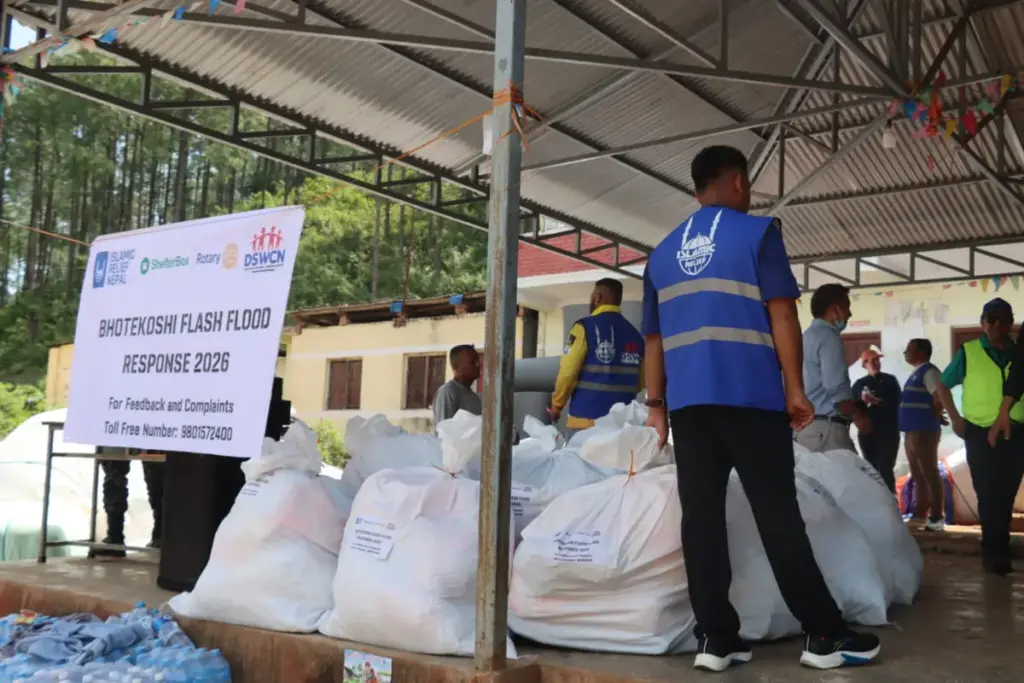
In response to the acute shelter shortage, humanitarian organizations have mobilized to provide vital assistance. Islamic Relief, working in coordination with local partners such as Shelter Box, has stepped up relief efforts on the ground. To date, the organization has successfully delivered close to 1,500 emergency shelter kits to displaced families situated in the heavily affected Rasuwa and Nuwakot districts, including communities within Bidur Municipality.
Each distributed shelter kit is meticulously designed to meet the immediate, fundamental needs of households left out in the open. The kits contain essential survival items, including durable tarpaulins, sturdy rope, warm blankets, pillows, and foam mattresses, providing a baseline of comfort and protection against the elements as families grapple with the loss of their homes.
An Unprecedented Disaster Impacting Infrastructure and Livelihoods
The agricultural and economic sectors have sustained catastrophic blows that threaten to ripple across Nepal for months, if not years, to come. The NDRRMA reports that over 11,000 hectares of vital agricultural land have been severely damaged or washed away. In addition, approximately 292,000 livestock have been directly affected by the floods.
Agricultural experts note that the destruction of arable land and the loss of livestock will have severe, long-term implications for household food security and rural livelihoods, making economic recovery an uphill battle for vulnerable farming communities.
Physical infrastructure has also suffered crippling damage. Collapsed bridges and washed-out roads continue to severely hamper transport networks, leaving many remote mountainous communities entirely isolated from major supply lines. This isolation has significantly complicated the delivery of heavy equipment, medical supplies, and food rations to populations cut off from the main hubs.
Public health concerns are mounting as well. The disaster has severely compromised basic utilities, with damage reported to at least 46 separate water supply systems across the affected regions. The destruction of these critical water networks has left countless families without reliable access to safe, clean drinking water, raising the latent threat of waterborne diseases if sanitation infrastructure cannot be swiftly repaired.
More than two weeks after the initial downpours triggered the catastrophe, the humanitarian situation across northern Nepal remains profoundly critical. The combination of widespread homelessness, crippled agricultural output, disrupted water supplies, and isolated communities underscores the urgent requirement for sustained, coordinated international and domestic support.
Humanitarian agencies continue to appeal for public backing to scale up operations, urging donors to contribute to emergency relief funds to ensure that life-saving aid can reach the thousands of families whose lives have been upended by the disaster.