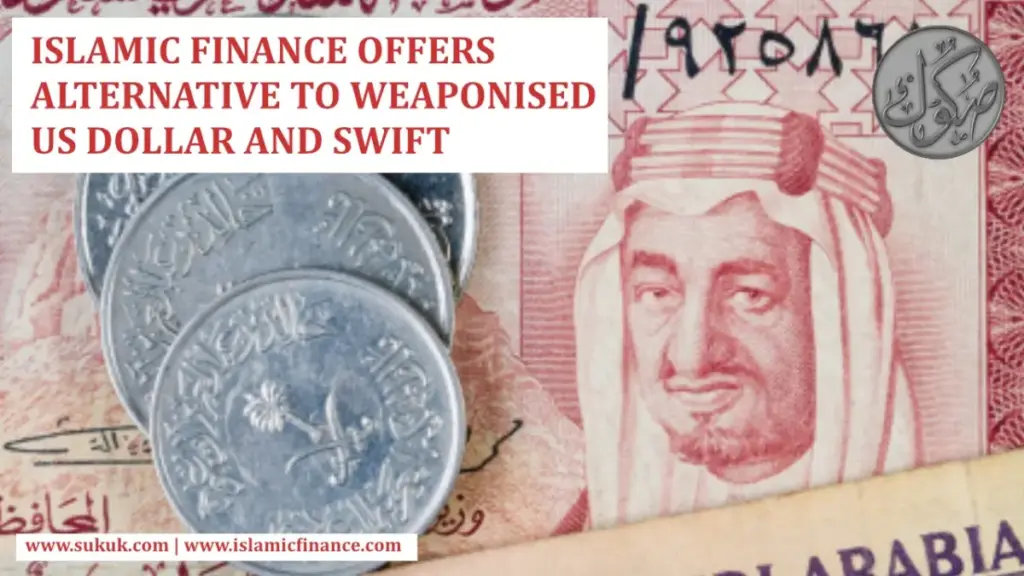
The growing trend of utilizing the United States dollar and the SWIFT international payment system as geopolitical leverage has accelerated a global search for alternative financial architectures. As trust in the greenback and its associated payment infrastructures wanes among nations subjected to economic penalties and restrictions, international leaders are increasingly looking toward regional mechanisms, national currencies, and traditional assets to safeguard their economic sovereignty.
This friction has prompted concerted efforts from emerging economies to reduce their reliance on Washington-dominated financial networks. The weaponization of financial systems has ultimately catalyzed a paradigm shift, compelling nations to reevaluate how international commerce is settled and prompting high-level discussions on how to bypass traditional Western-centric financial bottlenecks entirely.
Islamic Finance Instruments Can Replace US Dollar in Trade
In response to these escalating geopolitical tensions and financial pressures, Turkish President Recep Tayyip Erdogan has emerged as a vocal proponent of integrating Islamic finance principles into modern international commerce. Highlighting the pressing need to adapt to a changing global economic landscape, President Erdogan has emphasized that settling trade in national currencies has transitioned from a preference to an urgent necessity.
During regional dialogues, the Turkish leader urged partner nations to place the mechanics of Islamic finance firmly on the international agenda. This position aligns with his previous public appeals for the global community to dismantle the long-standing monopoly of the dollar in international trade—a monopoly that grants Washington unilateral oversight over cross-border transactions and liquidity flows.
The implications of these shifting attitudes have not gone unnoticed by Western financial authorities. Former US Treasury Secretary Steve Mnuchin publicly acknowledged the risks associated with the aggressive application of economic sanctions, noting that if policymakers are not careful, international actors will actively look at utilizing alternative currencies and payment channels to circumvent American jurisdiction. This admission underscored growing anxiety within Western financial circles that over-reliance on coercive economic measures could permanently erode the global dominance of the US dollar.
Iranian Banks Removed from SWIFT
The catalyst for many of these defensive maneuvers stems from specific, high-profile enforcement actions involving the Society for Worldwide Interbank Financial Telecommunication, commonly known as SWIFT. Operating as the primary messaging network for international banking, SWIFT has increasingly become a geopolitical battleground.
Under sweeping United States sanctions, major Iranian banks were systematically disconnected from the SWIFT payment network. This unprecedented move effectively crippled Iran’s ability to conduct normal foreign trade, locking the nation out of conventional international liquidity and disrupting its export-driven economy.
The repercussions of these actions have extended far beyond the Middle East. Similar secondary sanctions and regulatory pressures have impacted European and international firms, including companies involved in vital infrastructure projects such as the construction of the Russian-German energy pipeline. These disruptions served as a stark warning to other sovereign states that participation in Western-dominated financial networks carries inherent political vulnerabilities.
Consequently, major economic powers have accelerated efforts to decouple their bilateral commerce from vulnerable infrastructure. Notably, Russia and China moved decisively to establish their own independent payment systems, designed specifically to facilitate direct bilateral trade and completely avoid reliance on the US dollar and its associated clearance mechanisms.
Increased Use of Gold and Local Currencies
Parallel to these bilateral initiatives, broader multilateral coalitions have begun reshaping their monetary strategies. The Shanghai Cooperation Organization (SCO), an eight-nation regional security and economic bloc that includes major global players such as China, Pakistan, and Russia, accounts for nearly a quarter of the global Gross Domestic Product.
Over recent years, member states of the SCO have methodically increased their collective gold and foreign exchange reserves, which now amount to nearly four trillion US dollars. This massive accumulation of hard assets provides a robust financial buffer against external economic shocks and currency fluctuations.
The momentum toward financial independence reached a concrete milestone during a high-profile finance ministers meeting held in Moscow. At the gathering, SCO member states formally decided to conduct an increasing share of their bilateral trade and investment portfolios using local currencies rather than routing transactions through the US dollar. By settling accounts in national currencies, these nations aim to insulate their domestic economies from the extraterritorial reach of Washington’s financial policies and reduce transaction costs associated with currency conversions.
Use of Gold in Islamic Cultures
Beyond fiat alternatives, hard assets—particularly gold—have re-emerged as a foundational element in trade discussions, deeply rooted in the cultural and economic traditions of Asian and Middle Eastern societies. Gold has long remained an attractive asset class and a trusted store of wealth, passed down through generations in these regions as a hedge against inflation and political instability.
In recent years, countries such as Turkey and Malaysia have positioned themselves at the forefront of Islamic financial gold banking and the development of gold-backed currency systems. These nations have sought to merge traditional Islamic economic principles with modern financial technology to create secure, stable mediums of exchange.
Within Malaysia, state-level initiatives have demonstrated the practical viability of these concepts. The Malaysian states of Kelantan and Perak introduced gold dinar and silver dirham coins as alternative means of payment and mediums for trade, reviving historical Islamic monetary units to facilitate localized commerce.
Simultaneously, the private and commercial banking sectors in Turkey have embraced gold-backed financial innovation. Turkish Islamic bank Kuveyt Türk, also known as Kuwait Turkish Bank, initiated a pioneering gold banking program in 2007. Through this innovative mechanism, the institution successfully collected over 26 tons of physical gold from savers and investors—valued at approximately 1.2 billion US dollars as of July 2019—and seamlessly integrated those bullion assets back into the broader Turkish economy.
Building upon the success of physical gold banking, current financial initiatives are exploring the integration of Islamic finance with digital assets. Proponents are developing Islamic finance gold-based cryptocurrencies designed to better facilitate secure, transparent, and efficient cross-border trade without relying on traditional correspondent banking networks.
Islamic Finance Gold Standard
The growing legitimacy and institutionalization of gold within Islamic finance received a major international endorsement in 2016. During that year, the World Gold Council, in collaboration with the Accounting and Auditing Organisation for Islamic Financial Institutions (AAOIFI), formally approved a comprehensive sharia standard for gold-based products.
The primary objective of establishing this standardized framework was to significantly increase the utilization of physical bullion within the Islamic finance sector and pave the way for the creation of sophisticated, Sharia-compliant financial instruments. The newly formulated standard provided definitive regulatory clarity regarding complex financial transactions, addressing vital operational aspects such as the proper use of collateral, as well as the execution of gold exchanges in both immediate spot transactions and deferred delivery agreements.
By establishing internationally recognized guidelines for gold-backed financial products, the collaboration between the World Gold Council and AAOIFI has provided a solid foundation for market participants. This regulatory backing not only enhances market confidence but also accelerates the development of alternative financial instruments capable of supporting sustainable, non-dollar-dependent trade networks across the Islamic world and beyond.