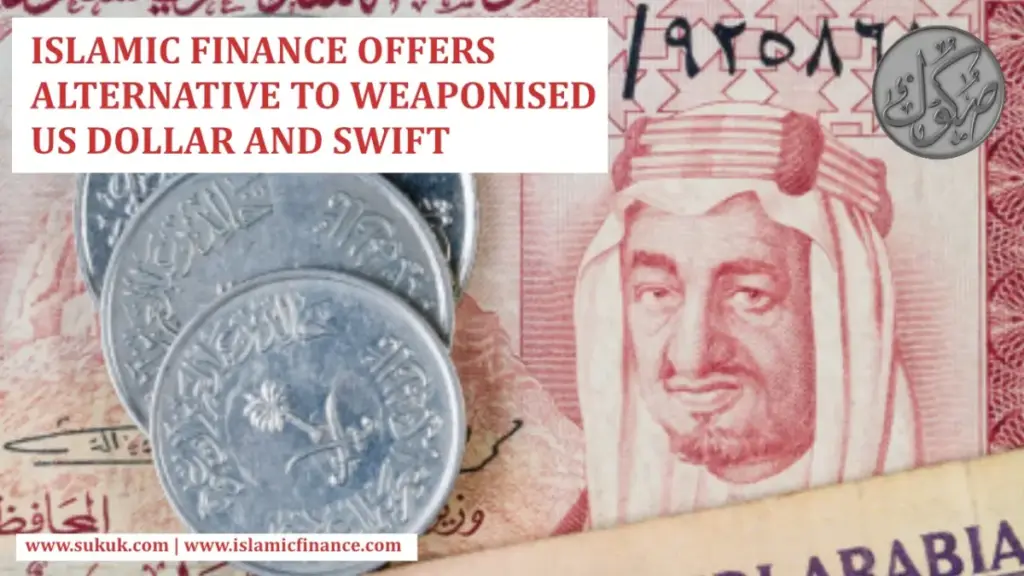
The growing weaponization of the US dollar and the international payment architecture centered around the Society for Worldwide Interbank Financial Telecommunication (SWIFT) has triggered a profound shift in global commerce. As trust in the greenback and traditional Western-dominated payment systems steadily wanes, a broad-based international push is underway to identify viable alternatives. Nations increasingly view heavy reliance on a single currency as a strategic vulnerability, prompting a search for decentralized and resilient financial mechanisms.
In response to these mounting geopolitical pressures, Turkish President Recep Tayyip Erdogan has strongly advocated for the adoption of Islamic finance principles, emphasizing that conducting commerce in national currencies has transitioned from a theoretical preference to an urgent necessity. During recent international engagements, the Turkish leader stressed the need to prioritize alternative financial architectures, declaring that the global community must place the issue of Islamic finance firmly on the international agenda.
President Erdogan has previously leveled sharp criticisms against the prevailing global economic order, calling on other nations to join forces to dismantle what he terms the "monopoly" of the dollar in international trade. These concerns are not confined to developing economies or nations facing sanctions; even high-ranking Western officials have acknowledged the risks associated with over-relying on a single currency. Former US Treasury Secretary Steve Mnuchin candidly admitted that if policymakers are not careful, international actors will increasingly look for alternative currencies to bypass Washington-dominated financial networks, recognizing the long-term threat to the dollar’s global supremacy.
Iranian Banks Removed from SWIFT
The vulnerability of the current global financial infrastructure has been laid bare by the aggressive use of unilateral economic sanctions. The deployment of US restrictive measures has resulted in the systematic removal of Iranian financial institutions from the SWIFT payment network, effectively cutting the nation off from the global banking grid and crippling its ability to conduct ordinary foreign trade. This heavy-handed exclusion serves as a stark warning to other emerging economies regarding the degree of control Western powers maintain over international monetary flows.
Similar restrictive measures have already begun to impact European corporate interests, notably affecting German firms that were actively working on the construction of the major Russian-German natural gas pipeline. These extraterritorial economic pressures have accelerated strategic countermeasures among targeted nations. In an effort to insulate their economies from future disruptions, major geopolitical players have begun establishing autonomous financial channels. Notably, Russia and China have successfully set up their independent bilateral payment systems, allowing them to trade directly with one another while completely avoiding the use of the US dollar.
Increased Use of Gold and Local Currencies
The momentum away from the greenback extends far beyond bilateral arrangements, taking root within major multilateral institutions. The Shanghai Cooperation Organization (SCO), an influential eight-nation security and economic bloc that includes key global players such as China, Pakistan, and Russia, accounts for nearly a quarter of the entire global Gross Domestic Product. Recognizing their collective economic weight, SCO member states have systematically increased their gold holdings and foreign exchange reserves, which now accumulate to an impressive total of nearly four trillion US dollars.
This accumulation of robust reserves serves as the financial backbone for a broader strategic pivot. During a high-level finance ministers meeting held in Moscow, the SCO formally reached a decisive consensus to conduct future bilateral trade and investment activities directly in local currencies, effectively bypassing the greenback for intra-bloc transactions. By fostering deeper financial integration among member states, the SCO is steadily constructing a resilient economic shield designed to withstand external financial shocks and political pressures emanating from Washington.
Use of Gold in Islamic Cultures
Beyond local currency invoicing, precious metals—particularly gold—are experiencing a profound renaissance as attractive asset classes and trusted stores of wealth. This traditional affinity for gold has deep historical roots, having been passed down through generations across various Asian cultures. In the modern era, Turkey and Malaysia have emerged at the forefront of pioneering Islamic financial gold banking and spearheading the development of gold-based currencies designed to facilitate seamless cross-border transactions.
Practical implementations of these concepts are already visible in Southeast Asia. The Malaysian states of Kelantan and Perak notably introduced modern gold dinar and silver dirham coins as a complementary means of payment and medium for trade, reviving historical Islamic monetary traditions within contemporary legal frameworks. Meanwhile, in the banking sector, Turkish Islamic financial institutions have made significant strides. Kuveyt Türk, a prominent Turkish Islamic bank also known as Kuwait Turkish Bank, initiated comprehensive gold banking services in 2007. Through innovative retail and commercial products, the institution successfully collected over 26 tons of gold—valued at approximately 1.2 billion US dollars as of July 2019—effectively integrating dormant private wealth directly into the formal Turkish economy. Building upon these foundations, current financial initiatives are exploring the creation of Islamic finance gold-based cryptocurrencies to better facilitate efficient cross-border trade in the digital age.
Islamic Finance Gold Standard
The integration of precious metals into modern Islamic finance received a major institutional boost in 2016, when the World Gold Council and the Accounting and Auditing Organisation for Islamic Financial Institutions (AAOIFI) jointly approved a comprehensive Sharia standard for gold-based products. The primary objective of this regulatory milestone was to substantially increase the utilization of physical bullion within Islamic finance and pave the way for the creation of sophisticated new financial instruments compliant with religious jurisprudence.
This standardized framework successfully addressed complex financial considerations, including the strict rules governing the use of gold as collateral, as well as the precise mechanisms required for the exchange of gold in both spot and deferred transactions. By establishing clear, internationally recognized guidelines, the AAOIFI standard has provided the necessary legal and religious certainty for financial institutions to expand their gold-backed product offerings, thereby reinforcing the broader movement toward alternative financial instruments in global commerce.