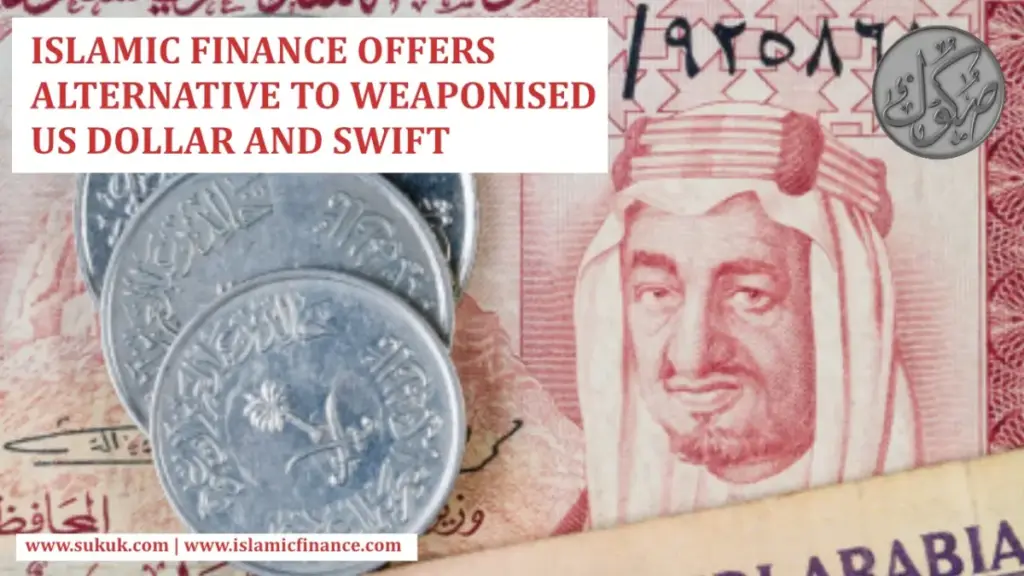
The growing weaponization of the United States dollar and the international payment messaging system of SWIFT has triggered a profound shift in global finance. As trust steadily diminishes in the greenback and the Western-dominated financial infrastructure that supports it, nations around the world are actively seeking viable alternatives to conduct international commerce.
This friction has exposed the vulnerabilities of an asymmetric global financial system where a single nation can dictate terms of trade and enforce extraterritorial sanctions. In response to these mounting pressures, leaders across emerging markets and the developing world are looking toward regional currencies, precious metals, and innovative financial frameworks to safeguard their economic sovereignty.
Islamic Finance Instruments Can Replace US Dollar in Trade
At the forefront of this pushback is Turkish President Recep Tayyip Erdogan, who has strongly advocated for the broader adoption of Islamic finance principles to circumvent traditional Western payment chokepoints. Addressing the urgent need for financial diversification, President Erdogan has emphasized that conducting trade in national currencies has transitioned from a preference to an urgent necessity. He has urged international partners to place the expansion of Islamic finance mechanisms firmly on the global agenda.
The Turkish leader has repeatedly called on other nations to dismantle the historic "monopoly" that the US dollar has maintained over global trade for decades. This sentiment is not entirely lost on Western financial authorities. Former US Treasury Secretary Steve Mnuchin previously acknowledged the inherent risks of this overreach, conceding that if policymakers are not careful, international actors will increasingly look toward alternative currencies and payment systems to insulate themselves from geopolitical pressure.
Iranian Banks Removed from SWIFT and the Rise of Alternative Networks
The catalyst for many of these defensive economic maneuvers involves the aggressive deployment of unilateral US sanctions. By removing Iranian banks from the Society for Worldwide Interbank Financial Telecommunication (SWIFT) network, Washington effectively crippled Iran’s ability to conduct normal foreign trade, locking the nation out of conventional international banking channels. Similar secondary sanctions and regulatory threats have also directly impacted European enterprises, notably disrupting German firms working on the construction of the major Russian-German energy pipeline projects.
Realizing that traditional Western-managed payment rails can be turned off at a moment’s notice, major economic powers have begun engineering parallel systems. Most notably, Russia and China have established their own independent bilateral payment systems designed to facilitate direct trade between the two nations while completely avoiding exposure to the US dollar and Western regulatory oversight.
Increased Use of Gold and Local Currencies in Regional Blocs
The movement away from the greenback extends well beyond individual bilateral arrangements, taking root within major international organizations. The Shanghai Cooperation Organization (SCO), an eight-nation regional security and economic bloc that includes founding members China, Russia, and Pakistan, currently represents nearly a quarter of global Gross Domestic Product.
Over recent years, member states of the SCO have systematically increased their sovereign gold holdings and foreign exchange reserves, which now accumulate to a staggering total of nearly four trillion US dollars. Demonstrating a clear commitment to de-dollarization, delegates at a crucial finance ministers meeting in Moscow formally decided that the bloc would conduct its future bilateral trade and investment portfolios entirely in local currencies, reducing reliance on Western financial clearinghouses.
Use of Gold in Islamic Cultures and Modern Banking Innovations
Gold has long maintained a powerful position as an attractive asset class and an enduring store of wealth, passed down through generations across various Asian and Middle Eastern cultures. In contemporary times, nations such as Turkey and Malaysia have positioned themselves at the forefront of Islamic financial gold banking and the development of gold-backed currency models.
As part of these grassroots monetary experiments, the Malaysian states of Kelantan and Perak introduced physical gold dinar and silver dirham coins as an alternative medium of exchange and for local trade. Meanwhile, the Turkish Islamic bank Kuveyt Türk, known as Kuwait Turkish Bank, pioneered major commercial gold banking initiatives beginning in 2007. By July 2019, the institution had successfully collected over 26 tons of physical gold, valued at approximately 1.2 billion US dollars, integrating these bullion reserves directly into the broader Turkish economy.
Building upon these successful physical banking models, current financial initiatives are exploring the creation of Islamic finance gold-based cryptocurrencies. These digital assets aim to bridge traditional precious metal reserves with modern technological capabilities to better facilitate seamless cross-border trade without relying on conventional correspondent banking networks.
Islamic Finance Gold Standard and Sharia Compliance
A major milestone in formalizing these alternative economic structures occurred in 2016, when the World Gold Council and the Accounting and Auditing Organisation for Islamic Financial Institutions (AAOIFI) jointly approved a comprehensive sharia standard for gold-based products. The explicit objective of this regulatory framework was to significantly increase the utilization of physical bullion within Islamic finance and pave the way for the creation of sophisticated new financial instruments.
This standardized approach successfully addressed complex legal and religious questions surrounding the use of gold as collateral, as well as the specific mechanics required for the exchange of gold in both immediate spot transactions and deferred delivery contracts. By establishing clear, universally recognized guidelines under Islamic jurisprudence, this development has provided the necessary regulatory foundation for banks, governments, and institutional investors to expand gold-backed financial products safely and transparently on the global stage.