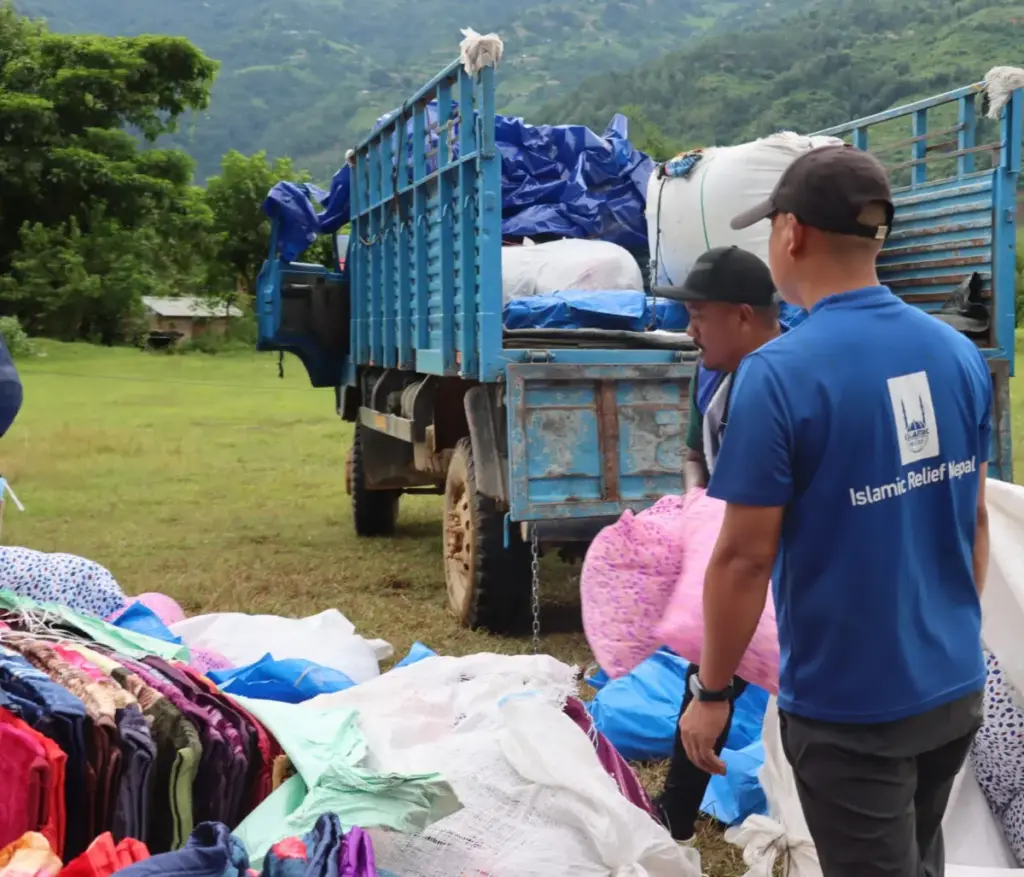
Islamic Relief’s emergency response to the devastating floods that struck northern Nepal in August 2026 has now reached 8,000 people, providing vital life-saving assistance to communities upended by one of the worst natural disasters to hit the region in recent years.
Emergency shelter kits, which include essential survival items such as durable tarpaulins, heavy-duty rope, blankets, pillows, and foam mattresses, have been successfully delivered to displaced families scattered across the hardest-hit Rasuwa and Nuwakot districts. These distributions have offered a measure of security and comfort to households that lost their roofs, belongings, and livelihoods overnight when torrential monsoon rains triggered catastrophic flooding, landslides, and widespread devastation.
Building on this initial wave of aid, humanitarian workers are scaling up their operations on the ground. Over the next two weeks, Islamic Relief is planning to deliver comprehensive food packs to 550 affected families, ensuring they have reliable access to nutrition while local markets remain disrupted. In addition, shelter kits will be distributed to a further 950 families who are still living out in the open or in precarious, makeshift conditions.
With three weeks having already passed since the initial disaster struck the Himalayan nation, the focus on the ground is now gradually shifting from immediate, short-term emergency assistance towards longer-term recovery and resilience support. To facilitate this complex transition, Islamic Relief has developed a comprehensive three-year Response and Recovery Strategy.
The organization’s strategic focus in the coming months and years will center on providing transitional shelters to replace temporary setups, restoring critically important water and sanitation services to prevent disease outbreaks, and helping communities rebuild their shattered livelihoods so families can regain their financial independence.
The situation remains critical
Despite the arrival of humanitarian aid and the tireless efforts of rescue workers, the situation on the ground remains critical. Displaced families continue to face exceptionally difficult living conditions, characterized by limited access to safe drinking water, inadequate sanitation facilities, and a near-total lack of essential services. Countless residents remain unable to safely return to their homes, as their properties have either been completely destroyed, buried under mudslides, or left structurally unsound by the raging waters.
The human toll of the disaster has been staggering. The national death toll in Nepal has now reached 1,399, while an estimated 5,179 people are still reported missing. Coordinated search and rescue operations are still actively underway in remote and severely affected regions, though challenging terrain and blocked roads continue to hamper access for emergency crews. Across the country, more than 84,000 people have been left in urgent need of some form of humanitarian assistance to survive the aftermath.
Currently, 2,150 people are taking shelter across 30 separate displacement camps or holding centers established in safer zones. However, stability remains elusive for many. As unstable land, ongoing river erosion, and damaged settlements continue to pose severe safety challenges, many of those who have already been displaced once may soon need to be relocated yet again to alternative, safer locations.
The economic fallout matches the human tragedy. Nepalese preliminary assessments have estimated that the floods have caused the equivalent of $2.70 billion worth of damage to infrastructure, agriculture, homes, and public utilities, setting back regional development by years.
With so many challenges still ahead and thousands of people continuing to suffer in the wake of the catastrophe, much more resources are urgently needed. Humanitarian organizations are appealing to the global community to give generously to help reach vulnerable families in Nepal with vital, life-saving assistance. Donations can be directed toward the ongoing relief efforts through the official Nepal Floods Emergency Appeal channels.