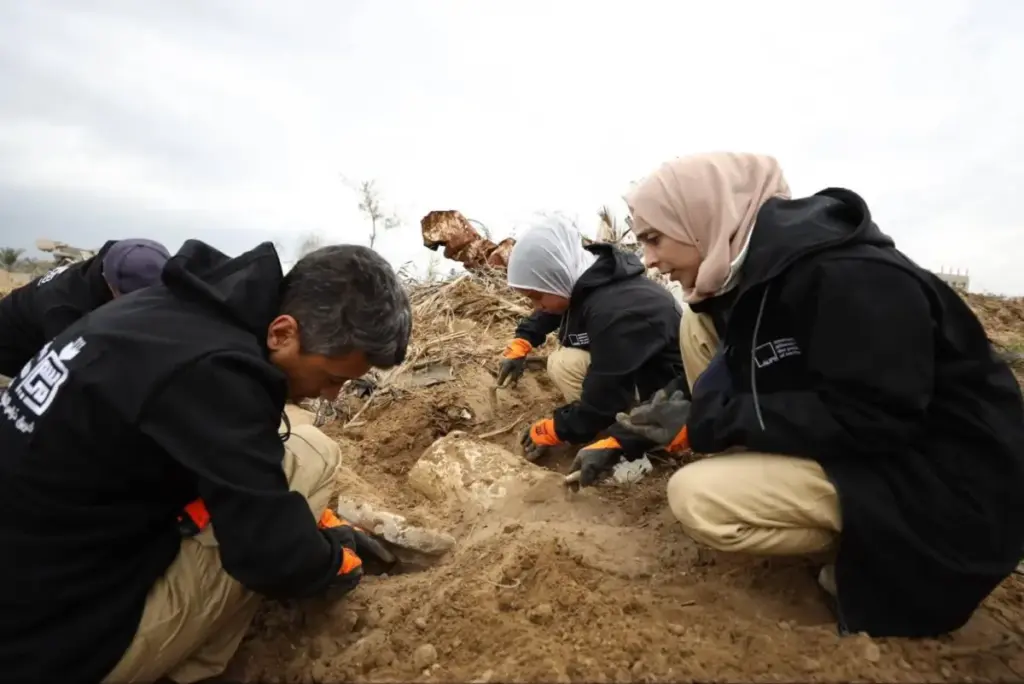
Amid the ongoing devastation and immense human toll of the Israeli military campaign in the Gaza Strip, a quiet, desperate race is unfolding to rescue the Palestinian enclave’s ancient and irreplaceable cultural heritage. According to data compiled by UNESCO, at least 164 cultural sites across Gaza have suffered varying degrees of damage since military operations escalated in October 2023. From multi-layered historical landmarks that bear witness to millennia of human civilization to local private collections buried under tons of concrete, the physical remnants of a rich, diverse history are disappearing at an alarming rate.
Among the ancient architectural landmarks heavily impacted by waves of continuous bombardment are the historic Great Omari Mosque, the centuries-old Hamam al-Sammara, Qasr al-Basha located in the heart of Gaza’s Old City, and the al-Qarara Cultural Museum situated near Khan Younis. Beneath the sprawling fields of grey rubble lie shattered precious artefacts, Roman-era pottery, traditional metalwork, and classical antiquities. These items physically embody Gaza’s unique historical role as a vibrant crossroads of multiple ancient empires, civilizations, and peoples over thousands of years.
The scale of the destruction is profound. With at least 74,022 Palestinians killed during the course of the conflict and approximately 84 percent of all structures in the enclave damaged or obliterated, the physical infrastructure safeguarding history has been systematically unraveled. In response to this existential threat to regional memory, a local initiative known as the "Guardians of Heritage"—operating under the Mayasem Association for Culture and Arts—has stepped forward. Working tirelessly under extreme duress, the team is racing against time to locate, recover, and stabilize historical artefacts that face an imminent risk of total deterioration, permanent loss, or looting.
Working From the Margins: Emergency Operations in al-Mawasi
Shaimaa Mohammad al-Natour, the assistant coordinator of the "Guardians of Heritage" programme, explained the heavy burden facing her team in an interview with Al Jazeera. Despite the overwhelming destruction surrounding them, the field team has successfully rescued more than 1,700 historical pieces from four distinct museum collections since their operations began.
Today, the team operates primarily out of a temporary storage tent pitched in the al-Mawasi area of Khan Younis, an already overcrowded coastal zone hosting vast numbers of displaced families. What started as a self-initiated response by concerned citizens has evolved into a critical, organized field operation carrying the immense responsibility of preserving a 5,000-year-old historical timeline.
The initiative conducts wide-ranging field surveys across the southern and central sectors of the Gaza Strip, systematically documenting the extent of the damage inflicted on both public and private institutional collections. It is widely recognized as the first organized local effort of its kind to systematically address the wartime catastrophe facing Gaza’s historical landmarks. Rather than working in isolation, the team relies heavily on grassroots intelligence, maintaining close communication with local residents and displaced civilians who stumble upon ancient fragments while navigating the debris that blankets the territory.

"We handle notifications by first filling out a comprehensive survey containing the informant’s details, the artefact’s location, and its condition," al-Natour said. "The team then heads to the site to rescue the items, after which the processing stages begin: cleaning, archiving and photography."
Severe Risks and the Shadow of the "Yellow Line"
Despite their dedication, the Guardians of Heritage face extraordinary operational hurdles that threaten to halt their mission entirely. Chief among these challenges are ongoing military restrictions, severe shortages of specialized restoration equipment, and the constant threat of renewed displacement. Furthermore, many critical museum collections and archaeological caches remain trapped in zones that are virtually unreachable due to active hostilities and military demarcations.
A primary danger involves retrieval operations near the so-called "Yellow Line," a heavily controlled dividing zone where the Israeli military maintains complete operational control. According to figures tracking the post-ceasefire security environment since October 2025, at least 196 Palestinians have been killed within this volatile boundary area as of April.
"The nature of the areas used to be manageable, but their current locations are completely inaccessible," al-Natour noted, highlighting the immense physical hazards her colleagues confront. "The main difficulty in continuing our work with these collections is their location behind the ‘Yellow Line,’ which poses a grave risk to the team. One of our core principles is: human life comes first."
Compounding these dangers is the reality of working inside a makeshift tent on the coast. The volatile coastal weather, coupled with high humidity, temperature fluctuations, and the presence of insects and rodents, poses an ongoing environmental hazard to the salvaged materials. Wooden storage crates are vulnerable to rot and mold growth, which can silently compromise the fragile organic and inorganic contents inside. Moreover, the daily jostling and transport of crates through densely crowded displacement camps expose fragile, fractured ceramics and glass to constant mechanical shocks and vibrations.
Protocol, Documentation, and Triage in a Conflict Zone
When artefacts are successfully retrieved from a site, the team adheres to a strict documentation protocol designed to ensure that every individual piece retains its spatial and historical context. The objective is to prevent any permanent loss of data by assigning each item a distinct digital identity before it is placed into storage.

"After rescuing the pieces from their locations, the documentation and archiving process begins. We try as much as possible not to bring any artefact into storage without a record and basic information to help us identify its origin," al-Natour explained. "We start by logging the location and photographing it from multiple angles and link the images to a unique number or code for the artefact to prevent any mix-up."
Due to the lack of advanced digital infrastructure and specialized technology, the team relies on basic tools, utilizing mobile phones for high-resolution photography and parallel paper documentation to safeguard against the risk of digital file loss from primary spreadsheet databases. Identification tags bearing unique numbers are attached to the items, which are then temporarily housed in basic wooden crates lined with soft packing materials. Using soft brushes, specialists gently clear away surface dust and dirt from delicate pottery without scraping or compromising original surface markings.
When dealing with items that have suffered severe physical stress from explosions and collapsing building walls—such as cracked ancient pottery and brittle glassware—the team implements a strict policy of minimal intervention. Rather than attempting permanent restorations that could cause irreversible chemical or structural damage, specialists perform stabilization and conservation "first aid."
"In times of war, sometimes the greatest achievement is simply halting the deterioration of an artefact and keeping it intact as much as possible until suitable conditions for specialised treatment become available," al-Natour observed.
Looking forward, the team hopes to transition from emergency rescue operations to long-term professional conservation. Their primary operational goals include establishing a stable, climate-controlled storage environment with regulated temperature, humidity, lighting, and ventilation. They also require specialized preservation packaging materials and advanced environmental monitoring devices, alongside comprehensive professional training in preventive conservation, emergency collection management, damage assessment, and database administration.
Beyond the Stones: Building Community Guardianship
The impact of the Guardians of Heritage initiative extends well beyond the physical recovery of ancient stone vessels and ceramic shards. A central pillar of their ongoing mission is fostering a deep sense of community awareness, empowering local residents and displaced individuals to view themselves as active protectors of their own shared culture, oral history, and heritage.

To achieve this, the team organizes simplified educational workshops, field activities, and community programs tailored for children, youth, women, and displaced families. These sessions tie historical antiquities and traditional Palestinian crafts to living oral histories, encouraging participants to ask questions, share memories, and document the stories connected to their native towns and familiar landmarks.
"Through our activities with children, youth, women and displaced residents, we organise simplified educational and field activities, workshops, and programmes linked to antiquities, traditional crafts and oral history. We encourage participants to ask questions and document stories tied to places and artefacts," al-Natour said.
The physical act of rescue itself has organically transformed into an instructional narrative for the broader public. Watching field workers labor under immense hardship to extract a piece of shared history from beneath the rubble helps shift public perception, reframing heritage not as a dispensable luxury during a humanitarian catastrophe, but as an essential element of collective survival and identity.
"The rescue process itself has become an educational tool—when people see a team working under these conditions to extract a historical piece from beneath the rubble, they begin to view heritage as something worth protecting rather than something dispensable in times of crisis," al-Natour concluded. "We firmly believe that community awareness is one of the most vital lines of defence."