During a curatorial research fellowship at the Victoria and Albert Museum (V&A) in London, an ongoing exploration of the institution’s vast and historic collection of photographs has yielded a fascinating focus: images capturing women at work. While the initial search began simply with the broad concept of labor, the research repeatedly gravitated toward photographs featuring women performing various tasks across time, geography, and social contexts.
What began as a targeted archival search soon evolved into a deeper inquiry regarding the very nature of labor and how it is visually communicated. When modern society contemplates a workplace, the imagination typically conjures up spaces explicitly designed and designated for commercial or industrial output. Traditional workspaces such as factories, structured workshops, or corporate offices immediately come to mind. These conventional settings are certainly present within many historical prints housed in the V&A archive. However, a closer examination reveals a compelling reality: women’s work has historically refused to remain confined within these predictable physical boundaries.
Instead, the historical record preserved in photography demonstrates that women’s labor has frequently spilled far beyond traditional walls. It has taken place seamlessly within domestic homes, across sprawling agricultural fields, along bustling public streets, inside crowded traditional markets, and quietly interwoven into the fabric of everyday life. These are spaces that are traditionally much less clearly defined or demarcated as formal workspaces, challenging conventional architectural and sociological boundaries of labor.

The photographs selected throughout this ongoing curatorial research journey move fluidly between vastly different ways of seeing and understanding people at work. Rather than attempting to compile an exhaustive catalog or exhaustive representation of every conceivable profession or task historically undertaken by women, these images provoke a much more fundamental and thought-provoking question: how do viewers actually identify work within the frozen frame of a photograph?
While some archival images present labor as an undeniable, immediate reality—particularly those captured within industrial factory environments where towering machinery dominates the visual field and leaves no doubt about the subjects’ economic roles—others require a much more deliberate, patient form of observation. In these quieter, less conventional images, the presence of work reveals itself slowly. It becomes visible only upon closer inspection through subtle visual cues: the precise positioning of a human hand, the way a body leans into a task, an adjacent tool resting nearby, raw materials gathered close at hand, or a fleeting commercial exchange unfolding directly in front of the camera lens.
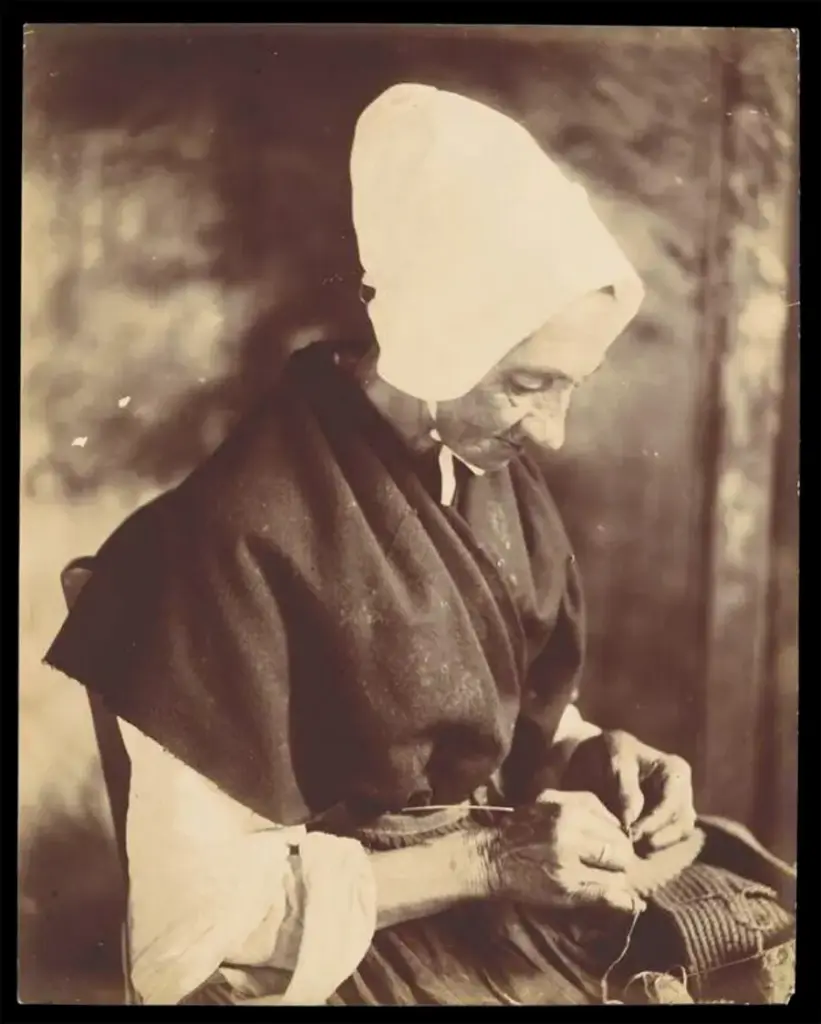
Among the historical works that first catalyzed this line of inquiry is Émile Fréchon’s poignant photograph, Elderly woman weaving, captured around 1900 and preserved in the museum’s collection under the museum number RPS.2050-2024. In this striking image, there are no massive industrial machines, nor is there a distinct, purpose-built architectural workshop surrounding the subject. Instead, the viewer comes to understand the labor entirely through the woman’s focused physical actions. Her capable hands, the specialized material resting immediately before her, and the deliberate posture of her body collectively draw the eye toward the rhythmic, concentrated act of weaving.

It is an inherently quiet and contemplative image. Because of its understated nature, it encourages the modern viewer to look more slowly and deeply at the composition. The work depicted does not appear detached or segregated from everyday life; rather, it sits comfortably and intrinsically within it. Even though the surrounding physical space is entirely ordinary and lacks any hallmark of a typical modern workplace setting, the labor itself remains undeniably skilled, demanding high levels of concentration and expertise.
A strikingly similar visual dynamic emerges in George Bunzl’s mid-century photograph, Mexico – Girl Spinning, created around 1965 and designated with the museum number RPS.1320-2023. Textile-related practices—encompassing spinning, sewing, weaving, and numerous allied domestic and artisanal crafts—are frequently characterized by repetitive, minute physical movements. Because these gestures are performed with such frequency and familiarity, they can easily assume an appearance of the mundane, running the risk of being overlooked or undervalued by casual observers. Furthermore, in the traditional hierarchy of cultural collection and display, the final textile product is usually the object that ultimately gets preserved, exhibited, and admired. Photographs such as Bunzl’s serve a vital curatorial purpose by forcibly pulling the viewer’s attention away from the inanimate object and redirecting it back toward the human subject, the physical gesture, and the intricate process behind creation.
Agricultural labor provides yet another lens through which to examine the documentation of women’s work. In another compelling photograph by Émile Fréchon, titled Two women dig up potatoes, possibly in the Pas de Calais (dating from around 1900, museum number RPS.2012-2024), the open agricultural field itself functions as the primary workplace. In this expansive outdoor setting, there are no walls, no desks, and no machinery. Instead, the two women are captured with their bodies deeply inclined toward the damp earth. Their physical posture, the strain in their muscles, and the purposeful movement of their arms unmistakably reveal the heavy physical labor taking place. Here, labor is recognized purely and powerfully through human action embedded in the landscape.

Shifting geographic and cultural contexts further broaden this visual vocabulary. Pamela Bone’s Flower Seller Udaipur, captured between 1981 and 1992 (museum number PH.760-2024), transports the viewer to a vibrant public space in India. In this compelling photograph, work is communicated neither through industrial machinery nor solitary domestic craftsmanship, but through a dynamic social exchange unfolding in the public sphere. While the descriptive title immediately informs the viewer that the subject is a flower vendor, the visual composition supplies independent clues: two figures leaning intimately toward one another, their hands meeting near the exact center of the photographic frame, delicate botanical materials bridging the physical gap between them, and the suspended tension of a transaction in progress. The workplace is not architecturally marked; instead, it materializes ephemerally through human encounter.
In sharp contrast, Eric Freeborn’s Women at work in a factory, photographed around 1937 to 1938 (museum number RPS.1898-2024), offers a visual experience that feels simultaneously distinct from and deeply familiar within the broader history of labor documentation. In this industrial interior, massive machinery immediately dominates the entire visual field. There is no need for the viewer to search for subtle signs of a workspace or interpret ambiguous physical postures. The heavy, industrialized setting announces unequivocally that this is a designated place of commercial production and that women are integral agents within that mechanized system.
Reflecting upon this diverse collection of photographic works underscores the vast spectrum of how human labor can manifest within visual culture. While a heavy factory machine renders one specific category of industrial toil instantly recognizable, a humble spindle, a loose piece of cloth, an open agricultural field, or a quiet commercial exchange in a crowded street market demands that the viewer pause, observe closely, and engage more deeply to comprehend the work at hand.

Minute visual details—the angle of a hand, the slump or tension of a posture, nearby tools, raw materials, repetitive physical movements, and the unpretentious spaces surrounding these women—serve as powerful narrative devices. Remarkably, these subtle visual cues frequently communicate comprehensive information regarding labor, skill, and socioeconomic context long before any archival caption is read.
Taken together, these historical photographs function as an enduring reminder that work does not always require a formalized setting or an institutional badge. Frequently, labor sits quietly, almost invisibly, embedded within the rhythms of everyday life, running the risk of going unnoticed by passing eyes. It is precisely this nuance that proves most compelling when navigating archival collections: not merely identifying static photographs of women engaged in labor, but recognizing the multifaceted, often subtle ways in which work becomes visible, and how those visual representations ultimately shape broader cultural understandings of labor, gender, and the modern workplace.