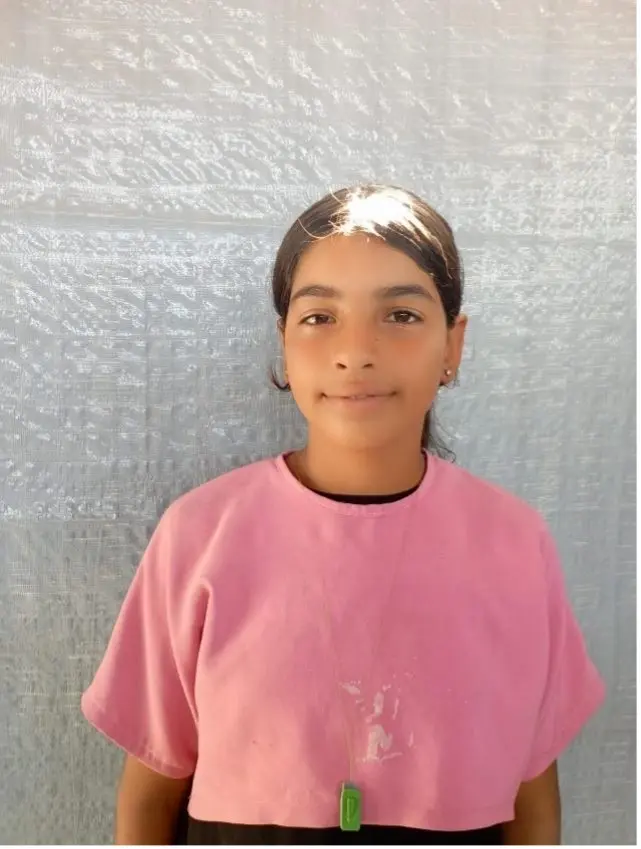
At just 12 years old, Amira has already borne a lifetime of extraordinary grief and upheaval. Having faced the devastating loss of her father to cancer, she has subsequently endured the profound trauma of displacement and the complete destruction of her family home amid the ongoing conflict in Gaza. Yet, despite the punishing daily hardships, the scarcity of basic resources, and the collapse of her childhood environment, Amira refuses to surrender her future. She continues her education under grueling conditions and firmly holds onto a steadfast dream: to one day become a nurse and heal others.
Amira’s world shifted irrevocably when she was just nine years old and lost her father to cancer. She remembers him not merely as a parent, but as a bedrock of love, safety, and unwavering strength in her life. His passing fundamentally altered the trajectory of her early years, introducing an acute sense of vulnerability. That foundational sorrow was later compounded exponentially when the war in Gaza began, plunging Amira and her loved ones into an unrelenting cycle of fear, uncertainty, and continuous displacement.
Forced to Leave Everything Behind
Before the conflict uprooted their lives, Amira lived harmoniously with her mother, Manal, and her siblings in the Al-Salam neighbourhood of Rafah. When the security situation deteriorated to the point of immediate peril and the family was forced to flee for their lives, they had to make heartbreaking choices about what to carry. Leaving behind the majority of their worldly possessions, they managed to take only a few changes of clothing, essential bedding, and a handful of basic kitchen items.
Like countless other displaced families, they initially harbored desperate hopes that the hostilities would subside quickly and that they would soon be able to return to the familiarity of their home. Instead, those hopes were shattered when their house was systematically destroyed. With no possibility of return, the family remained displaced, eventually finding themselves with no alternative other than setting up a makeshift tent in an attempt to forge a temporary sanctuary.
Life within the confines of the tent proved to be an exhausting, daily endurance test. The shelter offered little protection against the elements, becoming stiflingly hot during the scorching summer months and bitterly, bone-chillingly cold throughout the winter. When storms arrived, rainwater leaked directly through the fabric, while the surrounding earth routinely dissolved into treacherous, thick mud that made basic movement arduous.
Beyond the structural inadequacies of the tent, the family faced severe, systemic challenges in securing the fundamental necessities of human survival. Access to clean water and adequate food was a constant, exhausting struggle. Amira and her family members were frequently forced to spend agonizing hours waiting in long lines to collect water from passing delivery trucks. When financial resources were completely depleted and they could no longer afford to purchase food, they had to rely entirely on community kitchens, a lifeline shared by many similarly distressed families in the area.
Losing Everything All Over Again
Just when the family believed they had reached the absolute threshold of endurance, they suffered yet another catastrophic setback. Their precarious tent caught fire and burned down completely, wiping out the pitiful remainder of their possessions.
The sparse collection of clothes they had managed to salvage, their remaining cooking equipment, and all other personal belongings were reduced to cinders in a matter of moments. “Everything we owned was turned to ashes,” Manal shares, recounting the devastating fire that stripped them of their last vestiges of normalcy. The incident left the family once more entirely destitute, lacking even the most basic items required to navigate the daily routines of life.
In the wake of the fire, their immediate material needs multiplied drastically. They now require a significantly stronger, more durable shelter equipped with waterproof coverings to withstand changing weather conditions. Furthermore, they urgently need basic infrastructure like a functioning bathroom, replacement cooking equipment, and adequate clothing and shoes for all family members to protect them from the elements.
Continuing to Study Despite Displacement
Despite the crushing weight of these dire living conditions and the continuous disruption to their environment, Amira remains deeply committed to her education. Adapting to the realities of a fractured educational landscape, she continues her studies online and has successfully advanced to the seventh grade.
Her responsibilities extend far beyond her textbooks. Living without electricity or the convenience of a washing machine, Amira actively contributes to the household by washing clothes entirely by hand, absorbing adult responsibilities at a remarkably young age. Amidst these heavy burdens, her ambition remains remarkably clear: she dreams of becoming a nurse, a calling born from her desire to alleviate suffering, and she harbors an unyielding hope that she will be permitted to see her education through to the end.
In her rare moments of quiet, Amira enjoys drawing, finding a measure of solace in artistic expression, though she lacks the fundamental materials required to properly practice and nurture her talent. Her immediate, tangible needs remain basic yet critical, centering on winter clothing, proper underwear, and durable shoes to help her navigate the harsh seasonal shifts.
Supporting Orphaned Children in Gaza
The profound vulnerabilities experienced by children like Amira are met with targeted interventions by international humanitarian organizations working on the ground. Islamic Relief has a long-standing history of supporting orphaned children in Gaza, a commitment it has maintained through its dedicated Orphan Sponsorship Programme since 1999.
The structure of the programme relies on a one-to-one sponsorship model, directly matching an individual donor with a child. Through this arrangement, the child’s guardian receives a regular monthly financial disbursement. In the specific context of Gaza, families are given the flexibility to utilize this vital support for the needs they deem most urgent at any given time, whether that encompasses purchasing nutritious food, securing appropriate clothing, accessing essential healthcare, or covering educational expenses.
Recognizing the unprecedented scale of need generated by the current crisis, Islamic Relief has significantly expanded the reach of the programme. More than 25,000 children across Gaza are currently receiving regular sponsorship support, acting as a crucial safety net for families who have lost primary breadwinners. Nevertheless, the immense depth of the crisis is underscored by the reality that over 5,000 children still remain on the waiting list, eagerly awaiting a sponsor.
Where logistical access and circumstances permit, sponsored families also receive supplementary seasonal support. This includes the distribution of Ramadan and Qurbani food parcels designed to provide sustenance during significant religious periods, alongside Eid gifts for the children and essential winter items to help families cope with dropping temperatures.
Holding on to Hope
Amira’s poignant story reflects the harrowing, difficult reality confronting an entire generation of children in Gaza. Many have experienced the profound trauma of losing parents, the destruction of their homes, and the complete erosion of physical and psychological security.
Yet, remarkably, Amira continues to study, to strive, and to project her thoughts toward a constructive future rather than succumbing to despair. Her aspirations are remarkably grounded and simple: she wishes to continue her education without interruption, to train as a nurse, and ultimately to live somewhere safe and peaceful alongside her family.
Through initiatives like Islamic Relief’s Orphan Sponsorship Programme, individuals have the tangible opportunity to help provide regular, dependable support to vulnerable orphaned children and their families enduring unimaginable hardships in Gaza.