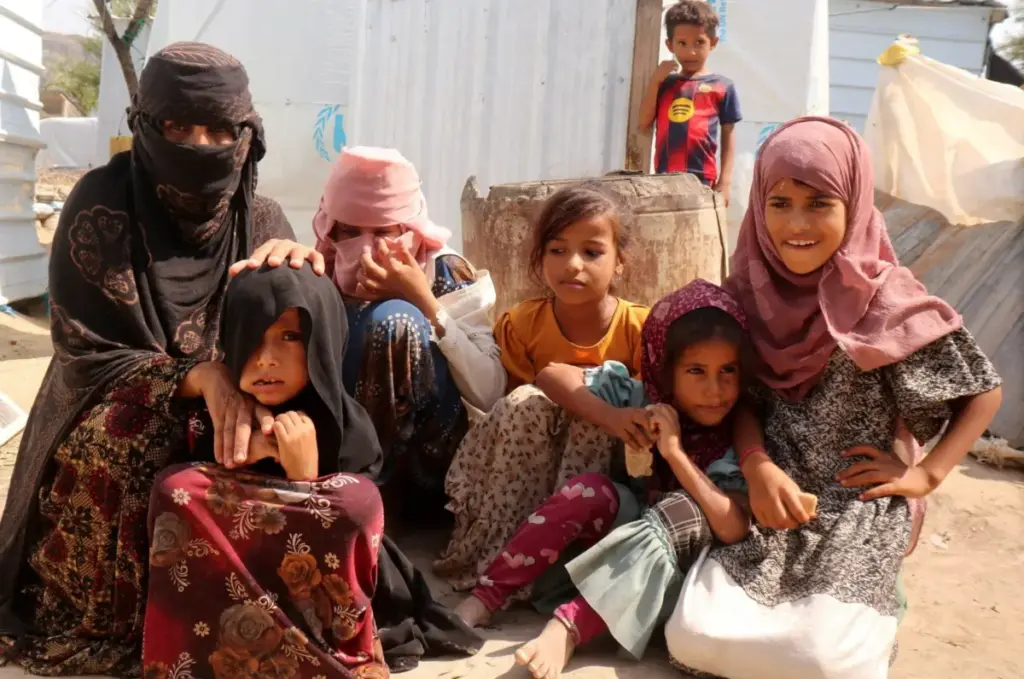
Taiz, Yemen — At the break of dawn, as the first rays of sunlight illuminate the rugged landscape of the Wadi Bani Khawlan area in Taiz governorate’s Jabal Habashi district, 12-year-old Ahmed wakes up beneath the thin canvas roof of a displacement tent. His morning routine no longer involves packing his books, lacing up his shoes, or walking the familiar dirt paths to his village school. Instead, his days are spent aimlessly playing with other displaced children or retreating to the cramped interior of the tent to lie down, overwhelmed by a crushing sense of monotony.
This has been Ahmed’s reality for the past two weeks. It was then that heavy artillery and advancing front lines forced him and his family to flee their home in al-Ashroh, a village located west of the contested city of Taiz. Life in the makeshift camp, he admits, is profoundly "boring." He misses everything about his former life, but his heart aches most for the simple routines of his education—his lost school bag and the morning walk to his classroom.
"I left my school bag in the house as we fled the clashes, and I do not know if I will carry it again and go back to my classroom and meet my teachers and classmates," Ahmed told Al Jazeera, reflecting a heartbreak shared by tens of thousands of children across the war-torn country.
There is no school at the displacement camp for Ahmed to attend. Even if he were miraculously able to return home to al-Ashroh, his local school stands abandoned and closed. Across conflict-affected parts of Yemen, hundreds of educational institutions have been forced to suspend classes entirely. According to figures from UNICEF, this widespread shutdown has severely disrupted the education of more than 137,000 students, plunging an already vulnerable generation further into uncertainty.
The United Nations agency reported that more than 57,000 children were newly displaced as a direct result of fierce fighting across Yemen during just the first two weeks of September. Humanitarian officials note that this staggering figure is bound to climb even higher as armed hostilities persist.
The surge in violence marks a devastating turning point after four years of relative calm. Armed clashes between pro-government forces and Houthi fighters intensified sharply through August and September, dealing a severe new blow to Yemeni educational infrastructure and students alike. The escalation has deepened an already catastrophic education crisis that has left the futures of millions of children hanging in the balance.
Survival over education
Upon arriving at the crowded displacement camp, Ahmed’s family faced immediate, non-negotiable priorities: securing a rudimentary shelter and finding reliable access to food and clean water. Long-term goals, such as schooling, were instantly eclipsed by the sheer struggle for daily survival.
"Before the war reached my house and school, my family would care if I completed my school homework," Ahmed said, his voice carrying a maturity forced upon him by circumstance. "Today, no one cares about education in the camp. Families’ focus shifted to tents, food, and water."
Meeting those fundamental needs remains an uphill battle for humanitarian organizations operating in the region. On October 2, the United Nations announced that more than 150,000 people had been displaced by the renewed conflict waves, a total that continues to tick upward. This new influx compounds a historic displacement crisis, adding to the more than five million Yemenis who were already uprooted from their homes since the war began with the Houthi takeover of the capital, Sanaa, in 2014.
Mohammed Radman, a displacement coordinator with the Executive Unit for IDP Camp Management in Jabal Habashi district, explained to Al Jazeera that thousands of displaced students have been forced to push their schooling completely aside. He characterized the conditions under which these children live as "horrific."
"These students do not have options," Radman said, detailing the systemic failure of local infrastructure. "All schools near the front lines are closed. And even if these students wanted to travel several kilometres every day to reach functioning schools, those schools are already crowded. So, the displaced students cannot be accommodated."
Radman categorized the current state of schools in conflict-affected regions into three grim categories: educational facilities repurposed to shelter the newly displaced, severely overcrowded institutions struggling to manage baseline capacity, and schools situated directly on or near active front lines.
"This creates a real challenge for society, the Yemeni government, and international organisations," he added.
‘Homelessness and begging await them’
Even before this latest military escalation, Yemen’s educational landscape was already in a state of emergency. UNICEF data indicates that 3.2 million children were already out of school across the country, denied their fundamental right to learn by years of systemic conflict and economic collapse.
Now, with this fresh and ongoing wave of displacement, the ordeal facing Yemeni children is poised to deteriorate rapidly, according to Tawfiq al-Humaidi, the president of the SAM Organization for Rights and Liberties.
"This war leaves them vulnerable to homelessness, begging, and potentially forced recruitment," al-Humaidi warned. "So, alternatives available to children outside the classroom are not safe."
While displaced families naturally cling to the hope that their stay in the camps will be temporary, al-Humaidi cautioned that the disruption to education caused by sudden displacement often casts a long shadow. Extended stays in makeshift camps fundamentally alter a child’s daily routine and psychological well-being, creating immense barriers to an eventual return to the classroom.
"The repercussions extend beyond deprivation and the loss of educational lessons to the loss of the social and psychological protection provided by schools," al-Humaidi said. "When schools close, children become more vulnerable to violence, exploitation, recruitment, and child labour."
Finding a way back to school
Rebuilding an educational framework amidst active hostilities presents an extraordinary challenge for educators on the ground. Abdulkarim, a teacher in Taiz who spoke on the condition of anonymity, emphasized the psychological toll the conflict takes on his students.
"When students hear explosions, fear bullets, and stay in shaky tents, education cannot happen. I saw how little children cry when they hear the sounds of heavy gunfire," he said.
For Abdulkarim, establishing a secure environment must precede any attempt at formal learning. "Once that is achieved, we can try to accommodate students in functioning schools or create alternative centres so that students can continue to receive education," he noted.
Afrah al-Humaiqani, a sociologist based in Aden, warned that the recent escalation of hostilities across various regions of Yemen risks depriving thousands of students of academic access entirely. She cautioned that this systemic failure threatens to foster a "new illiterate generation" within the country.
Despite the monumental scale of the crisis, al-Humaiqani maintains that its devastating impacts can be mitigated through coordinated action between the Yemeni government and international relief organizations.
"There is a need for safe camps where students can feel secure," she told Al Jazeera. "This can be followed by the provision of teachers and textbooks, programmes to address learning loss, and provide psychosocial support for children."