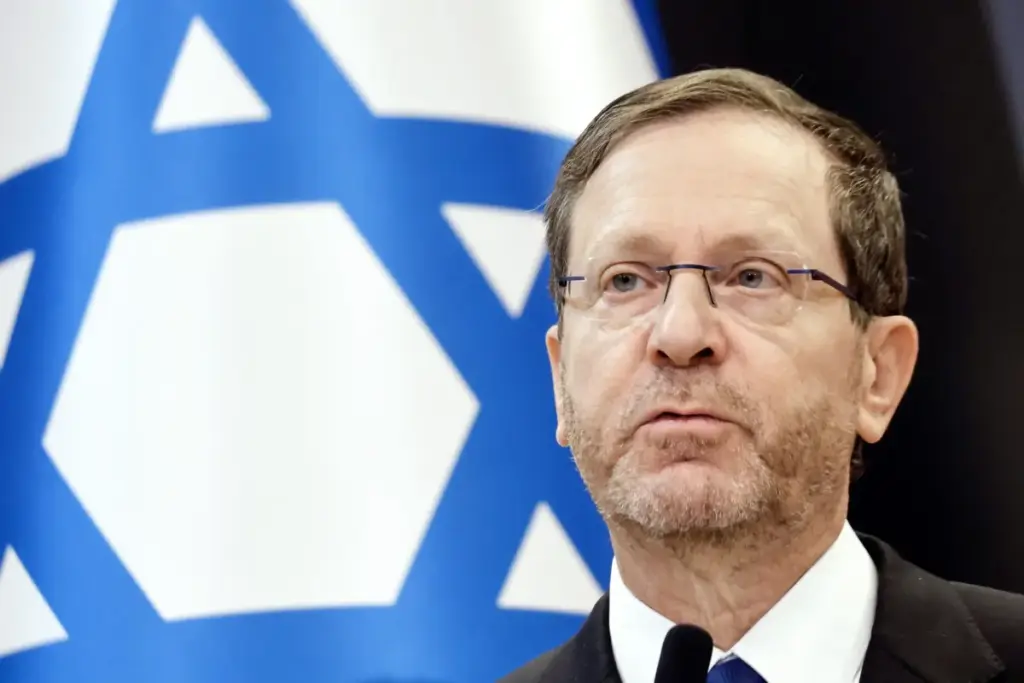
JERUSALEM — Israeli President Isaac Herzog has announced that he will officially designate a candidate to form the country’s next governing coalition by Sunday. The decision comes after a majority of newly elected lawmakers threw their support behind opposition leader Gadi Eisenkot, outstripping incumbent Prime Minister Benjamin Netanyahu in a critical round of parliamentary consultations.
The presidential announcement, delivered on Thursday, followed two days of intensive, marathon talks between President Herzog and the leaders of the various political parties elected to the 120-seat Knesset during the country’s October 27 legislative elections. The resulting tally revealed that roughly 67 lawmakers endorsed Eisenkot, a former military chief of staff who leads the centrist Yashar party. In contrast, only 46 lawmakers backed Netanyahu, leaving the longtime conservative leader facing a steep uphill battle to retain power.
Speaking in a televised address at the conclusion of the consultations, President Herzog acknowledged that while the raw numbers from the recommendation process might make the outcome appear straightforward, the political reality inside the Knesset remains deeply fragmented. He pointed to persistent "mutual vetoes between the blocs and within the blocs themselves," noting that these entrenched political divisions make it exceptionally difficult to predict definitively which candidate ultimately possesses the strongest path toward assembling a durable governing coalition.
To navigate these complexities, Herzog indicated he would spend the remainder of the Israeli weekend—which runs from Friday to Saturday—conducting personal, closed-door talks with key party leaders before making his final, binding selection on Sunday.
The political impasse stems from the inconclusive outcome of the October 27 election, which left neither Netanyahu nor Eisenkot with an immediate, clear-cut path to a parliamentary majority. The national vote once again underscored a deeply polarized Israeli electorate. Netanyahu’s right-wing Likud party managed to secure 27 seats, making it the largest single party in the Knesset. However, his broader religious-nationalist political bloc fell short of a majority, mustering only 53 seats in total across its allied factions.
On the other side of the political aisle, Gadi Eisenkot’s diverse alliance of four Jewish-led parties—spanning the political spectrum from the centre-left to the right—demonstrated surprising resilience, capturing 48 seats despite pre-election polling that had projected a much tighter contest. Meanwhile, two distinct political factions representing Israel’s Palestinian minority achieved a historic milestone by winning a combined total of 19 seats in the legislature.
Although both Eisenkot and Netanyahu publicly ruled out the possibility of forming a governing coalition with the Arab-led parties during the campaign, both minority-representing factions ultimately chose to recommend Eisenkot for the premiership. This decisive backing from the Arab-led parties propelled Eisenkot’s recommendation total to 67, granting him the formal support of a comfortable majority within the 120-seat parliament.
"We want to do things that we did not do in the past in order to remove this criminal government," said Ahmad Tibi, a senior lawmaker and prominent member of the Joint List, explaining the bloc’s decision to support Eisenkot during statements to The Associated Press news agency.
Following the consultation phase, Eisenkot’s party, Yashar, released a statement highlighting that his tally of 67 recommendations represents the largest number of endorsements secured by any prospective prime ministerial candidate in Israel since 2015. The party forcefully urged President Herzog to hand down the official mandate to form a government "as soon as possible," arguing that the nation urgently requires a stable national emergency government.

Netanyahu, meanwhile, absorbed a significant political blow on Thursday when United Torah Judaism, one of the two principal ultra-Orthodox parties and a historically reliable ally of the prime minister, broke ranks and declined to recommend any candidate to the president. According to reports from The Times of Israel, the ultra-Orthodox faction severed its immediate alignment with Netanyahu due to mounting frustrations over the outgoing coalition’s failure to successfully pass legislation that would officially exempt ultra-Orthodox men from mandatory military service.
Yariv Oppenheimer, a member of the Democrats party—which forms part of Eisenkot’s broader electoral alliance—expressed confidence in the opposition’s prospects during an interview with Al Jazeera. Oppenheimer asserted that he saw "no reason" why President Herzog would bypass Eisenkot on Sunday. He further suggested that United Torah Judaism’s refusal to back Netanyahu signalled that the party’s political support could potentially be secured by the opposition through strategic negotiations, which could ultimately solidify the numbers Eisenkot needs to govern.
"It’s very clear that Netanyahu doesn’t have a chance to establish a government at all," Oppenheimer added.
Under Israeli law, once President Herzog officially nominates a candidate on Sunday, that individual will be granted a 28-day window to successfully forge a governing coalition. If additional time is required, the president possesses the authority to grant a single 14-day extension. Throughout this coalition-building period, Netanyahu will continue to serve as prime minister heading a caretaker government. If the designated candidate ultimately fails to assemble a workable government within the allotted timeframe, Israel would be forced to return to the polls for yet another legislative election.
As the political drama unfolds, Netanyahu—facing the very real prospect of being unseated after years in power—has seized upon an ongoing investigation by election officials into alleged vote-tampering irregularities. The prime minister has sought to cast public doubt on the legitimacy of the electoral outcome, publicly accusing Arab-led parties of engaging in vote theft.
These allegations have been strongly condemned by critics, who accuse Netanyahu and his political allies of attempting to undermine democratic institutions and delegitimize the election results. Netanyahu has consistently denied these accusations.
Providing a stark institutional counterweight to the political rhetoric, Israel’s Central Election Committee affirmed on Wednesday that the overall integrity of the legislative election had remained uncompromised. The head of the committee, Supreme Court Justice Noam Sohlberg, made a direct public appeal to Israel’s elected officials, urging them to prioritize safeguarding public trust in democratic processes rather than eroding it.
"This is a real danger. One of the foundations of democracy is the peaceful transfer of power," Justice Sohlberg told President Herzog during a formal meeting at the president’s official residence on Wednesday, adding that high voter turnout across all segments of society, including robust participation from the Arab minority, should be viewed as a positive civic achievement rather than a point of contention.
Despite the election committee’s reassurances, tensions remain exceptionally high. Hardline allies of the prime minister on the far-right, including National Security Minister Itamar Ben-Gvir, have aggressively pushed back against the election results, publicly calling for the immediate arrest and formal interrogation of Arab party leaders in the wake of the vote.