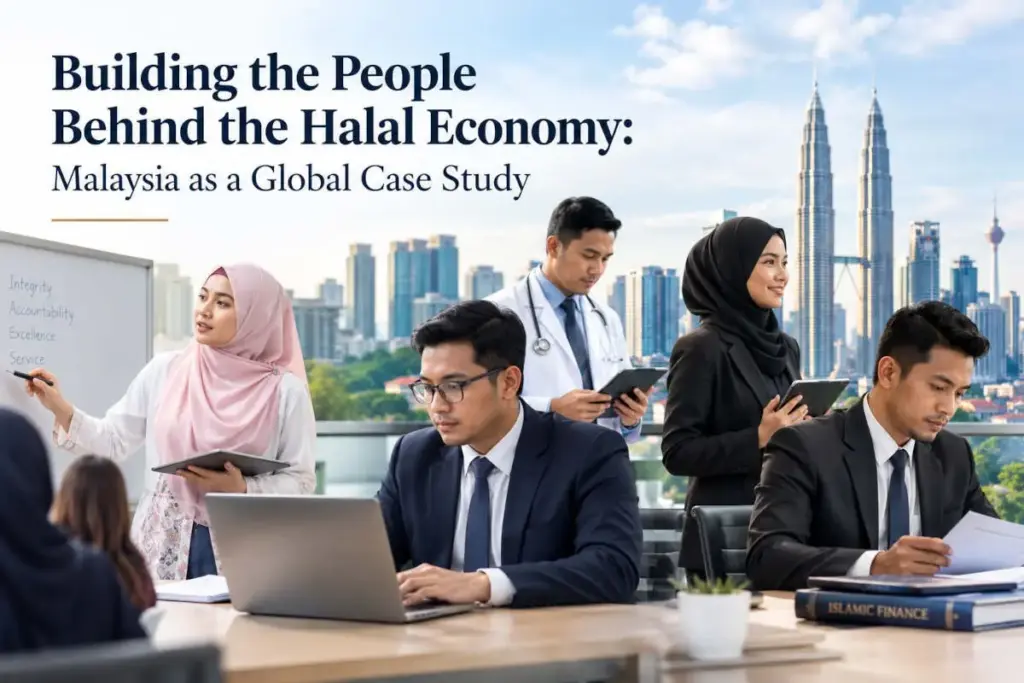
The global halal economy is rapidly entering an unprecedented new phase of expansion. What was once predominantly associated with dietary food products and basic religious certification has blossomed into a sweeping, sophisticated economic ecosystem. Today, this massive market spans pharmaceuticals, cosmetics, modest fashion, Muslim-friendly travel, media, recreation, and advanced Islamic finance.
According to the State of the Global Islamic Economy Report 2025/26, Muslim consumer spending across six major consumer sectors reached an astonishing US$2.60 trillion in 2024. Furthermore, that figure is projected to skyrocket to US$3.56 trillion by 2029. This explosive trajectory is accompanied by a broader structural shift toward stronger halal value chains, digital trust infrastructure, localized production, and highly resilient economic systems. Yet, this remarkable growth forces a critical, overarching question onto the global stage: as the halal economy becomes larger and far more complex, who will actually possess the specialized skills and knowledge required to manage it?
A successful and resilient halal economy cannot be built through certification stamps alone. Behind every certified product lies an intricate network of individuals responsible for global sourcing, production, rigorous quality assurance, auditing, regulatory compliance, logistics, targeted marketing, and overarching organizational governance. As halal commodities increasingly traverse international borders and penetrate highly complex scientific sectors, the modern demand is not simply for a larger workforce. Rather, the market urgently requires competent halal professionals who possess the unique ability to seamlessly translate abstract religious standards and ethical principles into concrete, everyday operational practices.
Malaysia: Building More Than a Certification System
Malaysia provides a compelling and instructive case study for this global evolution. The nation has successfully maintained its premier position at the top of the Global Islamic Economy Indicator for the 2025/26 edition, a testament to the enduring strength of its comprehensive Islamic economic ecosystem. Simultaneously, Malaysia’s trade metrics demonstrate that its halal economy extends far beyond domestic administrative approvals.
According to the Malaysia Halal Exports 2025 data released by the Halal Development Corporation (HDC), the country recorded a monumental US$16.82 billion—equivalent to RM68.52 billion—in halal exports in 2025. This achievement represents a robust 10.9% year-on-year increase. Within this thriving trade environment, the total number of halal-certified companies reached 10,638, while the count of active halal exporters stood at 1,563.
The underlying composition of these exports reveals the profound diversification of the modern market. Food and beverages unsurprisingly led the categories, accounting for US$9.05 billion (RM36.86 billion), closely followed by halal ingredients at US$5.25 billion (RM21.39 billion). Other significant export drivers included palm oil derivatives at US$1.12 billion (RM4.57 billion), cosmetics and personal care products at US$903.29 million (RM3.68 billion), pharmaceuticals at US$274.91 million (RM1.12 billion), and industrial chemicals at US$220.91 million (RM0.90 billion).
This multifaceted sectoral breakdown highlights a fundamental reality: halal is no longer merely a question of whether a food item contains permissible ingredients. Increasingly, it involves complex scientific inquiries into pharmaceutical formulations, chemical processing, personal care chemistry, advanced supply-chain management, traceability systems, and large-scale industrial manufacturing. Consequently, these developments fundamentally alter talent requirements across the board.
A professional working within a food manufacturing plant must understand intricate halal assurance systems, ingredient control protocols, and internal auditing mechanisms. Meanwhile, a professional operating in the pharmaceutical sector faces entirely different technical and regulatory hurdles. Similarly, a cosmetics manufacturer requires expertise that sits precisely at the intersection of Shariah law, chemical engineering, manufacturing standards, and shifting consumer expectations. In short, the rapid expansion of the global halal economy is simultaneously an expansion of the specialized knowledge required to sustain it.
The Institutional Architecture of Halal Talent Development
In Malaysia, the architecture of halal talent development begins long before a worker steps into a classroom. It originates within the regulatory framework that dictates strict organizational compliance, flowing seamlessly through the institutions tasked with transforming those legal requirements into practical workplace skills.
At the center of this national system stands the Department of Islamic Development Malaysia, commonly known as JAKIM. The Manual Procedure for Malaysia Halal Certification provides the procedural backbone for the nation’s certification framework, while JAKIM collaborates closely with State Islamic Religious Departments and State Islamic Religious Councils to administer certification matters locally.
At a broader strategic level, Malaysia is steering toward a unified national policy direction via the Dasar Halal Negara 2025–2035 framework. This national policy is designed to serve as a strategic compass for building a more inclusive, planned, and sustainable halal ecosystem, while carefully preserving the foundational authority of JAKIM and state religious bodies. Complementing this policy is a targeted 2025–2030 Action Plan, reflecting a concerted national effort to strengthen enforcement, refine certification pathways, enhance international recognition agreements, and systematically develop the broader halal industry.
However, government regulation alone is insufficient. Once an organization secures halal certification, dedicated personnel must interpret the requirements, maintain compliance systems, and ensure that operational controls function continuously. This necessity birthed Malaysia’s structured approach to human capital.
The establishment of the Halal Professional Board in 2014 marked a milestone in cultivating specialized professionals. Through this structure, the Halal Executive Programme offers a formal training pathway for individuals tasked with managing compliance inside their organizations, delivered primarily through a recognized network of Halal Training Providers.
The mechanics of this framework operate as a deliberate chain: JAKIM establishes the regulatory direction, the Halal Professional Board provides the professional training structure, approved training providers deliver the coursework, and certified trainers transfer the knowledge. Ultimately, Halal Executives take that expertise directly into the workplace. Yet, the long-term strength of this entire apparatus depends heavily on how harmoniously these various components interact.
As of March 2026, JAKIM’s official registry counts 40 recognized Halal Training Providers, encompassing universities, higher education institutions, and specialized academies. This extensive network provides a vital institutional foundation. Nevertheless, a larger training network does not automatically guarantee the production of the right talent in exact quantities or with the precise competencies demanded by modern enterprises. The paramount challenge remains ensuring that training supply continuously mirrors the evolving needs of global industries.
When an Established System Meets a Changing Industry
Malaysia has spent decades painstakingly constructing the institutional bedrock necessary to support a credible halal ecosystem. Regulatory frameworks are deeply entrenched, certification processes are standardized, professional training is institutionalized, and a robust network of educators surrounds the Halal Executive Programme. Yet, this established apparatus must now operate in an increasingly dynamic and volatile global environment.
The contemporary halal industry is vastly broader, more international, and infinitely more complex than it was when these foundational institutions were first conceived. Discussions of halal now routinely pierce the boardrooms of multinational pharmaceutical firms, global logistics conglomerates, and high-tech manufacturing plants.
This operational shift introduces unique hurdles. Companies operating across multiple international jurisdictions frequently encounter conflicting standards, diverse regulatory expectations, and distinct market demands. What satisfies compliance parameters in one regional market may prove inadequate in another, creating operational friction for businesses and compliance officers alike.
Rather than rendering legacy regulatory systems obsolete, this complexity makes a strong foundational framework more critical than ever. The primary hurdle is keeping the workforce equipped to navigate continuous change. Obtaining a halal certificate is merely an initial milestone; maintaining that status requires relentless internal vigilance, meticulous documentation management, and rapid adaptation to shifting global benchmarks. Consequently, a highly competent halal workforce functions as the ultimate operational infrastructure safeguarding certification credibility.
Furthermore, the very definition of a halal professional is undergoing a profound transformation. Today’s practitioners must sit comfortably at the crossroads of religious jurisprudence, national regulation, complex business operations, and advanced technical sciences. They are expected to comprehend procurement, manufacturing quality systems, and supply chain logistics without losing sight of underlying Shariah compliance. This reality demands educational models that go far beyond rote memorization. Professionals must understand the underlying rationale of regulations, how they apply across diverse operational settings, and how to troubleshoot novel situations as they arise.
Cultivating the Next Generation of Halal Talent
To remain competitive, Malaysia’s next generation of halal talent must be measured by operational capability rather than mere headcounts. Professionals operating within food processing plants, pharmaceutical laboratories, cosmetics lines, and logistics hubs face vastly different daily realities, yet all bear equal responsibility for preserving absolute halal integrity.
Consequently, talent development strategies must prioritize practical competence and deep industry relevance. Training curricula must bridge the gap between theoretical knowledge and the chaotic realities of industrial implementation. Moreover, the accelerating digitalization of global trade—spanning electronic documentation, blockchain-enabled traceability, and digital quality assurance—means that future halal professionals must possess strong digital literacy and data awareness.
Simultaneously, the standard of instruction must remain exceptionally high. Continuous professional development cannot be restricted to corporate executives; it must extend directly to the trainers and educators who form the backbone of the learning ecosystem. Regular professional upgrading ensures that educators remain synchronized with shifting international standards, technological leaps, and emerging market demands.
From Capacity Building to a Sustainable Talent Ecosystem
Ultimately, developing capable halal professionals requires moving past traditional capacity-building models that focus solely on training numbers. It demands a fully integrated ecosystem where knowledge flows fluidly between regulators, academic institutions, training providers, corporate enterprises, and frontline practitioners.
Industry participation is indispensable in this holistic model. Private enterprises should not be viewed merely as passive consumers of trained talent; they must actively contribute by offering workplace immersion, practical internships, and real-world insights into operational challenges. In return, training providers must remain agile, continuously updating their syllabi to reflect the realities of modern manufacturing and international trade.
By fostering continuous learning, robust data visibility, and cross-sector collaboration, nations can ensure that their halal talent systems do not stagnate. Malaysia’s extensive journey offers a profound blueprint for the global community: credible halal economies cannot rely on certification logos alone. They require enduring institutional support, rigorous professional training, and, above all, the dedicated people capable of translating principles into practice. For countries looking toward the future of the multi-trillion-dollar halal economy, the ultimate lesson is clear—build the standards, build the institutions, and build the markets, but most importantly, invest heavily in the people who make the entire system work.