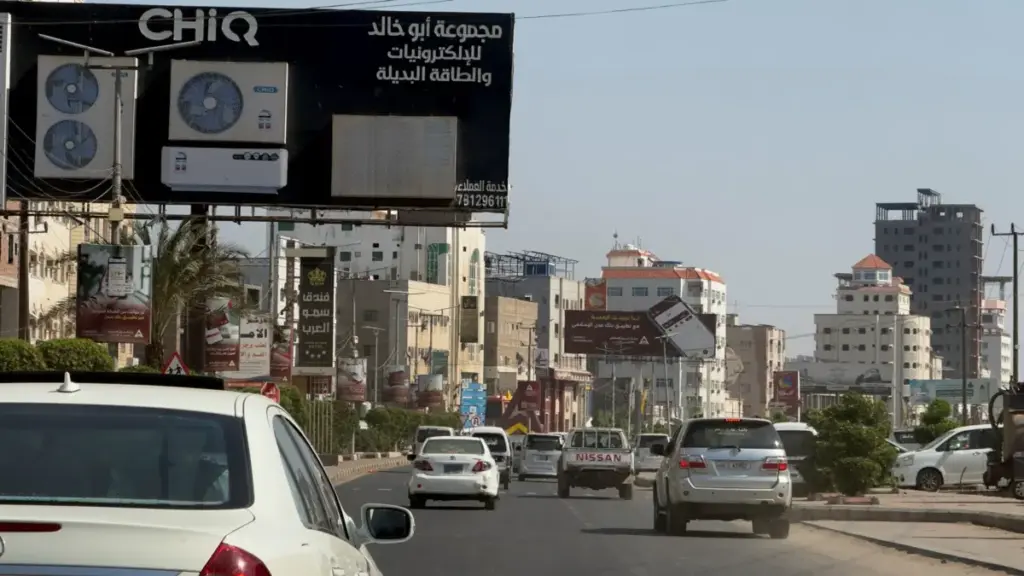
For Mohammed Abdul Malik, the powerful explosions that have reverberated through Yemen’s southern port city of Aden over the past month are more than just tactical strikes—they are an ominous warning of darker days ahead.
For months, the southern hub had maintained an uneasy semblance of peace, serving as a vital sanctuary for thousands of families displaced by years of conflict elsewhere in the country. But that fragile calm has been shattered by a wave of coordinated missile and drone attacks launched by the Houthi movement. The group has claimed responsibility for strikes targeting critical infrastructure across Aden, including the international airport, military installations, the city’s primary port, and the presidential palace, which functions as the administrative base for Yemen’s internationally recognized government.
Fearing that the city could once again descend into the kind of widespread, devastating violence that characterized the early years of the civil war, Abdul Malik has proactively begun taking precautions. He has started stockpiling essential food items and meticulously preparing his vehicle for a potential long-distance journey should the security situation rapidly deteriorate.
"I’ll tell you about myself and my close friends: We’ve started buying and stockpiling basic provisions, like sugar and other staples," Abdul Malik told Al Jazeera, capturing the palpable anxiety spreading quietly through neighborhoods and workplaces across the city.
If the security situation collapses further and state institutions fail to hold the line, Abdul Malik’s contingency plan is clear: pack up his family and flee Aden, seeking refuge further east in Shabwa or Hadramout.
"We’ve mapped out an exit route from the city. I’ve prepared my car, checked it over, and set aside an emergency supply of fuel. I’m ready to pack up my family and head out at a moment’s notice," he explained, illustrating the heavy psychological burden carried by ordinary residents who feel compelled to prepare for sudden displacement.
Daily Life Disrupted
The renewed volatility in Aden does not happen in a vacuum; it is the direct spillover of a broader escalation in Yemen’s war. After roughly four years of relative quiet, the conflict reignited significantly in early September, when the Houthis launched a major offensive aimed at seizing government-held territories in the western part of the country. Their primary target was the Saudi-backed, pro-government National Resistance Forces (NRF).
Within a single week, the Iran-backed armed group—formally known as Ansar Allah, or Supporters of God—succeeded in capturing critical districts across Hodeidah and Taiz provinces. Among their strategic gains was the vital port city of Mocha, a long-standing stronghold of the NRF, as well as the economically crucial Bab al-Mandeb strait overlooking vital international shipping lanes.
While a government counteroffensive launched in early October achieved limited territorial gains along the Red Sea coast, it failed to halt the Houthi momentum. Instead, the Houthis tightened their chokehold and siege on Taiz, Yemen’s third-largest city, shortly after capturing a vital highway that physically linked Taiz to Aden.
For years, Aden had remained relatively sheltered from the worst of the fierce ground fighting seen in other provinces, evolving into a bustling refuge for families fleeing frontline violence. However, the recent cascade of Houthi missile and drone strikes this month has abruptly shattered that illusion of safety, sparking widespread anxiety that Aden itself might be the ultimate target of a broader Houthi offensive.
These mounting fears are heavily compounded by grim accounts from friends and relatives who managed to escape Taiz. There, a tightening siege and relentless fighting have caused consumer prices to skyrocket and utterly disrupted the supply of basic goods, creating a humanitarian pinch that residents in Aden are desperate to avoid repeating.
"Prices in Taiz have already doubled, and the same could easily happen in Aden. If the Aden port were to be struck, prices would skyrocket," Abdul Malik warned. "At work, my colleagues and I talk about what we should buy, what food we ought to store, what our contingency plan is, and where we would go if we had to leave."
The psychological strain has fundamentally altered daily routines. Families are increasingly restricting their movements, particularly after dark, when the threat of sudden strikes feels most acute.
Abdul Malik described an unsettling scene from one of the recent attacks: "When the first missile explosion occurred, one of my colleagues went to the school to pick up her son and found the students frightened and gathered together in one place. We go to work and take our children to school, but there is a sense of anxiety and tension."
Airport Attacks
As Yemen’s busiest operational aviation hub, Aden International Airport has borne the brunt of the recent Houthi missile and drone campaigns. The recurring strikes have repeatedly paralyzed air travel, forcing commercial airlines to abruptly cancel or delay flights, or divert incoming planes to alternative domestic and international airports.
For families residing in the immediate vicinity of the airport, the frequency of the strikes has taken a severe toll on mental health, compelling some to weigh the difficult choice of relocating to safer neighborhoods either within Aden or further afield. Ahmed Awadh, who lives with ten family members in Aden’s Khor Maksar district close to the airport complex, noted that the explosions have left young children grappling with acute fear and chronic anxiety.
"An explosion jolts the children awake in terror, leaving them unable to sleep for the rest of the night. Even the sound of an ordinary airplane now strikes fear into my family," Awadh told Al Jazeera.
The disruptions have rippled through local schools and commercial enterprises. Some parents, paralyzed by worry, have chosen to keep their children home from school, while families with greater financial flexibility have sent vulnerable relatives—such as the elderly and young children—to stay with relatives in neighboring Lahj and Abyan provinces, or have rented alternative housing far away from the flight path and airport perimeter.
Within his own household, Awadh and his relatives have adopted defensive habits, ensuring children stay well away from windows during alerts. Furthermore, Awadh and his immediate neighbors have established a local WhatsApp network to quickly check on one another’s safety immediately following the sound of any blast.
"The Aden airport, which serves the civilian population, as well as other civilian infrastructure and residential areas, must not be targeted," Awadh emphasized, voicing a plea shared by thousands of civilians caught in the crossfire.
Aden Remains Vulnerable
As Yemen’s second-most significant urban center—eclipsed only by the Houthi-held capital of Sanaa—Aden is no stranger to catastrophic violence. The city suffered catastrophic infrastructural destruction in early 2015 during intense battles between Houthi combatants and local resistance fighters, compounded by heavy air strikes from the Saudi-led military coalition.
Even after Houthi forces were successfully expelled from the city later that year, Aden continued to suffer from recurring bouts of instability, marked by sporadic, deadly clashes between rival anti-Houthi factions competing for political and territorial control.
Adeeb al-Shatri, a professor of journalism at both Aden and Hadramout universities, observed that this latest wave of Houthi missile attacks has only deepened the suffering of a population already worn down by chronic lawlessness and economic insecurity. He sharply questioned why Yemen’s internationally recognized government had seemingly left its temporary capital and administrative seat entirely exposed to Houthi projectiles without deploying adequate air defense batteries capable of intercepting incoming drones and missiles.
"Aden is currently the capital, housing both major and minor state institutions. Therefore, the legitimate government must protect it," al-Shatri told Al Jazeera.
While the Yemeni military has maintained that it possesses active air defense units in the city—pointing to instances where hostile drones were allegedly intercepted before reaching populated zones—official transparency has been limited. Yemen’s Information Minister, Moammar al-Eryani, did not respond to Al Jazeera’s requests for comment regarding public criticism over the adequacy of Aden’s defensive umbrella.
At the same time, al-Shatri pointed out a stark socioeconomic divide in how residents are able to respond to the crisis. While a privileged fraction of wealthy citizens can afford to stockpile food and fuel, the vast majority of Aden’s population lives hand-to-mouth and is already struggling under the weight of hyperinflation and economic collapse.
"In Europe and other stable Arab countries, people stockpile food during crises, but in Aden, people need three times their current salaries just to live a simple life," he noted.
Nevertheless, al-Shatri pushed back against the narrative that Houthi aggression has brought education and commerce to a complete halt, emphasizing the resilient, if exhausting, daily routine required simply to survive.
"People’s movement in the city returned to normal just an hour after the explosion because they have to keep moving to earn money and secure their daily bread," he said. "If work were to stop, it would lead to a financial crisis, and they would be unable to provide food for themselves."