
For the September edition of the Look What I Found series at the V&A East Storehouse, visitors and staff were joined by multimedia artist, creative practitioner, and researcher Remiiya Badru. The collaborative session marked a pivotal moment in Badru’s micro-residency at V&A East, where she spent intensive time navigating the museum’s vast and varied collections. Her research directly informed her upcoming exhibition, "Common Threads," hosted at Cody Dock in Canning Town.
As an Assistant Curator based at the V&A East Storehouse, support for Badru’s research was provided by facilitating direct access to object stores, alongside formal "Order an Object" appointments managed by the V&A Collections Access team. Following her deep dive into the archives, Badru presented the objects and research she had uncovered during a free, public show-and-tell event. This initiative highlighted key object stories and thematic connections that emerged from her time in the stores, specifically centering on her broader academic and artistic inquiries into calico and Prussian blue dyes in relation to the River Lea.
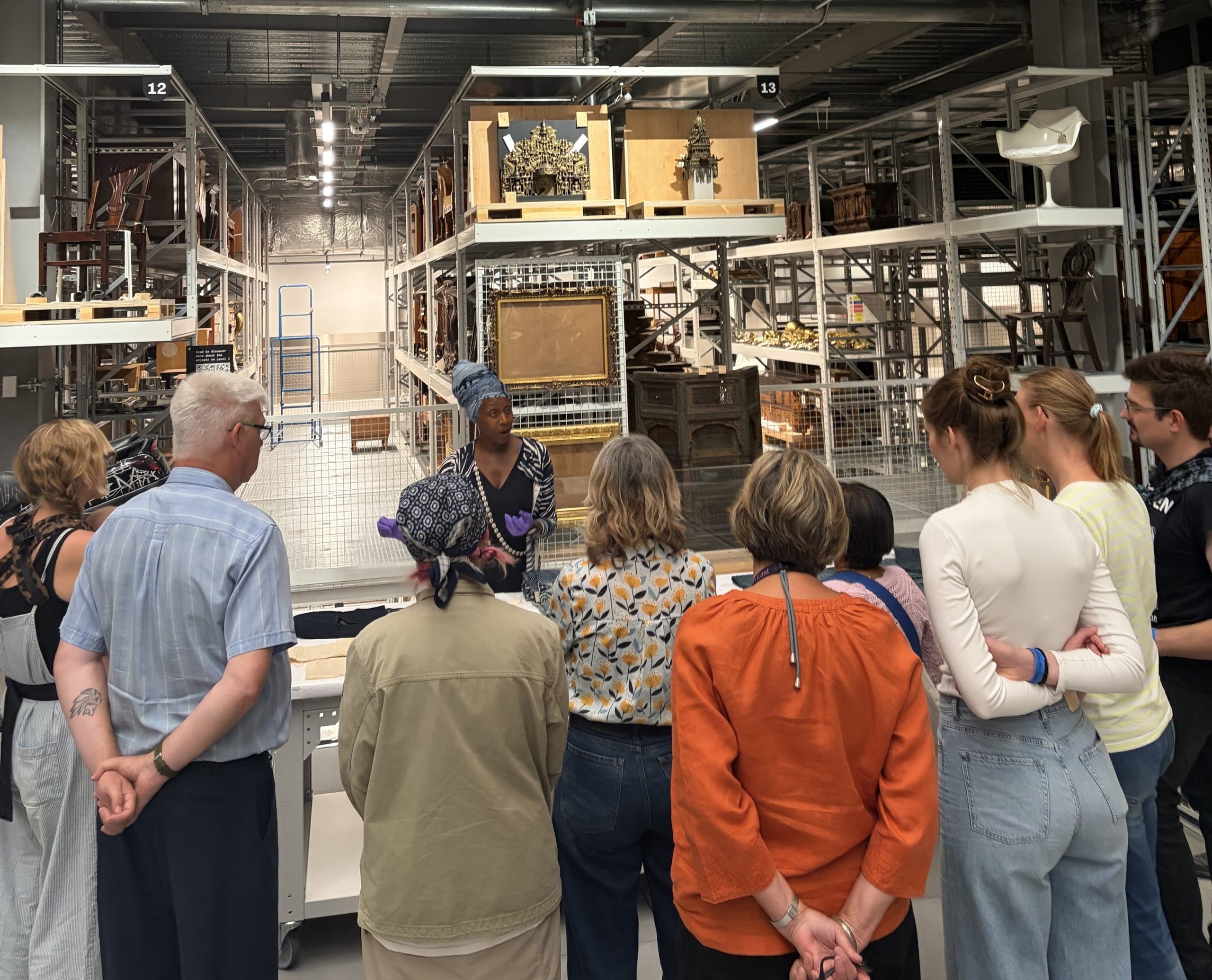
Badru is well-known as an avid walker, listener, and practitioner who explores textiles, dyes, and making histories across diverse geographies and time periods. Her work maps global connections across material culture through collaborations with institutions such as the University of Leicester, Royal Museums Greenwich, Museum X, and the Museum of London Docklands. Drawing from her extensive explorations of rivers and waterways, Badru developed a signature creative process known as "Rhumblines"—a metaphorical device that threads complex river-related and interwoven stories together. This conceptual framework allows her to navigate the frequently hidden histories and silences embedded within specific people and places. As a keen witness to infrastructural change and flux in her local environment, she investigates these juxtapositions through the lingering memories of (post)colonialism, pre- and post-industrial transformations, cultural heritage, and the interplay between natural and man-made environments.
Badru’s previous artistic investigations surrounding the River Thames and broader water histories naturally led to her year-long artist residency at Cody Dock. Situated in east London, Cody Dock operates as a community-led social enterprise dedicated to conserving the banks of the River Lea, preserving its industrial heritage, and delivering vibrant cultural and educational programs. The organization maintains a core focus on community engagement and harnessing the power of collective making to foster social bonds and healing within a rapidly changing, bustling part of the London Borough of Newham.

Bromley Hall
As a central component of her residency at Cody Dock, Badru has focused heavily on investigating the rich textile production histories of Bromley Hall in Bromley-by-Bow. Recognized as one of the oldest surviving brick houses in London that was frequented by Henry VIII, Bromley Hall is currently owned and undergoing careful restoration by Leaside Regeneration as part of broader efforts to revitalize the River Lea corridor. Historically, the site served as a hub for calico printing beginning in the 1740s, operated by the Talwin and Foster families throughout the late 18th century. These printers utilized sophisticated copperplate printing techniques to produce furnishings featuring intricate patterns inspired by Chinese motifs and Indian chintz.
In 1955, the Calico Printers’ Association generously donated a historic pattern book originating from Bromley Hall to the V&A’s collection. Uncovering this vital link to her ongoing research, Badru visited the Prints and Drawings Study Room in South Kensington to examine the pattern book firsthand before discovering many of the exact same printed fabrics from Bromley Hall at the V&A East Storehouse, including a striking peacock and hen design. These Asian-inspired textiles speak directly to the wider migration of designs and manufacturing methods during the 1700s and 1800s—an era when both the River Lea and the River Thames functioned as critical aquatic arteries connecting Great Britain to its global colonies.

In past projects, Badru has created responsive works addressing narratives of enslavement and the maritime journeys of ships traveling between Britain and its colonies, concentrating heavily on the histories of cotton production and manufacture. Drawing inspiration from this foundational work, Badru began to investigate calico and indigo-related objects within the V&A’s collections, aiming to unearth deeper global connections linking Bromley Hall printers, international trade, and the River Lea.
Calico
Badru’s archival investigation began with historic calico specimens housed at the V&A East Storehouse, where she encountered a cut piece of white cotton originating from Varanasi, Uttar Pradesh, manufactured around 1855. While studying the close weave of this coarse cotton, Badru discovered that the fabric had actually been cut during the production of John Forbes Watson’s monumental 1866 publication, The Textile Manufactures of India. Watson’s multi-volume work—which he frequently described as "mini-museums"—consisted of material sample books sent directly to textile producers across Britain and colonial India. The initiative was designed to educate local manufacturers on how to replicate South Asian textiles themselves.

In the introduction to these foundational volumes, Watson outlined the commercial ambition of the enterprise, noting that a population of roughly two hundred million souls inhabited India. He observed that while the garments of the vast majority might be scant, fulfilling an order to clothe them all would severely test the manufacturing resources of the greatest industrial nation on earth, identifying India as a magnificent prospective customer.
By teaching the intricacies of Indian textiles and their production methods, Watson’s writings illustrated how imperial Britain sought to assert tight economic control over its colonial markets, ultimately manufacturing and reselling imitated textiles back to their original makers. Through these porous and fluctuating global exchanges of production and export, Badru developed a keen interest in understanding how water not only shapes the physical transit of raw materials but also profoundly influences the making practices, traditional knowledge, and dynamic markets surrounding textile production.

Ankara
In addition to historic calico, Badru explored objects dyed with both natural and synthetic indigo, including an English dress fabric produced around 1960, commonly recognized as ankara—a wildly popular printed textile worn extensively across West Africa. She was particularly drawn to the complex history of ankara, which emerged from Dutch industrial attempts to recreate traditional Indonesian batik without the labor-intensive and intricate hand techniques required for wax-resist dyeing. Facilitated by Dutch colonial rule in Indonesia and the subsequent European "scramble for Africa," ankara developed through entangled global exchanges characterized by the European appropriation of indigenous textile traditions. Despite its entrenched colonial roots, ankara eventually transformed into a powerful, recognizable symbol representing African self-sovereignty and cultural empowerment.
Yet, while European dominance over ankara production via cheaper roller-printing technologies enabled nations like the Netherlands and Britain to establish captive markets dependent on imported textiles across the African continent, Badru remained fascinated by this specific object’s deliberate imitation of adinkra. Adinkra cloths are traditional block-printed fabrics utilizing plant-based dyes, originating from the Asante and Bono peoples across regions that now encompass Ghana and Côte d’Ivoire. These distinct visual symbols, also known as adinkra, function as conceptual and storytelling forms embedded deeply within Ghanaian and Ivorian fabrics, pottery, and architecture.

As Badru observed this persistent historical pattern wherein European manufacturers reproduced indigenous making techniques to control colonial markets through cotton and indigo-dyed goods, she and her curator colleagues opened a nearby storage drawer to examine an àdìrẹ́ cloth. This provided a fascinating comparative study of a Yoruba textile tradition that likewise employs sophisticated resist-dyeing methods. Such serendipitous discoveries highlight the dynamic nature of archival research at the Storehouse, where the physical process of navigating storage facilities frequently uncovers unexpected objects that redirect ongoing research in exciting new directions.
Àdìrẹ́ Cloth
The textile examined in the drawer was an example of àdìrẹ́ alẹ̀kalà, representing a mid-20th-century innovation within traditional àdìrẹ́ dyeing techniques. This method involves painting a thin layer of cassava starch onto cotton fabric using a metal stencil to produce intricate, detailed patterns via resist-dyeing. By directly comparing the English-produced ankara with the traditional Yoruba àdìrẹ́, Badru focused on the often-overlooked material intelligence of indigenous makers—qualities that cheaper mass-produced European imitations could never truly replicate.

These persistent inquiries regarding indigo-dyed cotton, manufacturing processes, and localized labor eventually led Badru to examine entirely different objects within the collection originating from contrasting geographical regions yet utilizing remarkably similar materials.
Sashiko
Among the items studied were a jacket and hood set worn by a firefighter in Japan during the mid-to-late 19th century. The garments exemplify a traditional stitching technique known as sashiko. While sashiko is traditionally deployed for general mending, in this instance, it was utilized to quilt multiple layers of cotton together, constructing a heavily reinforced fabric designed to provide superior protection against open flames. Before entering a burning building, firefighters would thoroughly douse the outfit in water, creating an effective thermal barrier against extreme heat. Furthermore, the accompanying hood featured specialized padding added to the crown, offering additional cushioning against falling debris. For Badru, this early historical example of functional, fire-retardant clothing underscored how textile production across global cultures has continually adapted and innovated through sheer necessity, binding together the daily practices of laborers across time.

Boro
Continuing her exploration of utilitarian workwear and textile innovation born of economic necessity, Badru studied a traditional Japanese work coat, or noragi, which represents a distinctive category of textiles known as boro, or rags. This particular coat was likely worn by an agricultural worker and meticulously repaired by its owner using patches of recycled, indigo-dyed cotton. Beyond demonstrating how discarded and recycled fabrics have historically been utilized to mend garments—thereby reducing costs and dramatically improving durability—Badru recognized the garment as a profound testament to the inherent beauty of sustainable, circular textile practices.
The intricate, hand-stitched lines trace the undeniable care, time, and thoughtfulness invested by the wearer and maker who maintained the utilitarian garment. Viewers can readily visualize the hands that applied the patches, the physical exertion that imbued the fabric with the stories of arduous labor, and the eyes that strained over each individual stitch by candlelight to ensure the coat would withstand another season of use. These intimate details render the bodies of both the original wearer and maker visible across a span of more than 150 years, granting researchers like Badru a rare opportunity to recover their otherwise hidden voices through the medium of textile.

Patchworking Community
Because Badru’s artistic practice frequently incorporates creative arts facilitation and community engagement, she wanted visitors and staff at the V&A East Storehouse to participate directly by creating their own decorative patches to be integrated into her display at Cody Dock.
During her public show-and-tell event at the Storehouse, Badru invited attendees to share personal narratives by designing unique patches fashioned from discarded denim and scrap materials sourced directly from the Storehouse Creative Studios. Facilitated with the support of Honey Birch, Creative Studio Practitioner for V&A East, the drop-in workshop proved immensely popular with both visiting members of the public and museum staff.

Drawing inspiration from the high-visibility vests worn as a standardized uniform by volunteers and workers at Cody Dock, Badru encouraged workshop participants to pin their finished patches onto a base garment that would ultimately form a central feature of her exhibition. The collaborative artwork serves as a heartfelt homage to the diverse individuals and communities that constitute both Cody Dock and V&A East.
Remiiya Badru’s completed installation, including the community patch jacket and the broader "Common Threads" project, remains on public view at The Boathouse at Cody Dock in Canning Town through November 6, 2026. Project realization was made possible through the support of Remiiya Badru, Bella Quirin, the Cody Dock team and volunteers, alongside Derya Adiman, Sally Barton, and the V&A East Creative Studios team.