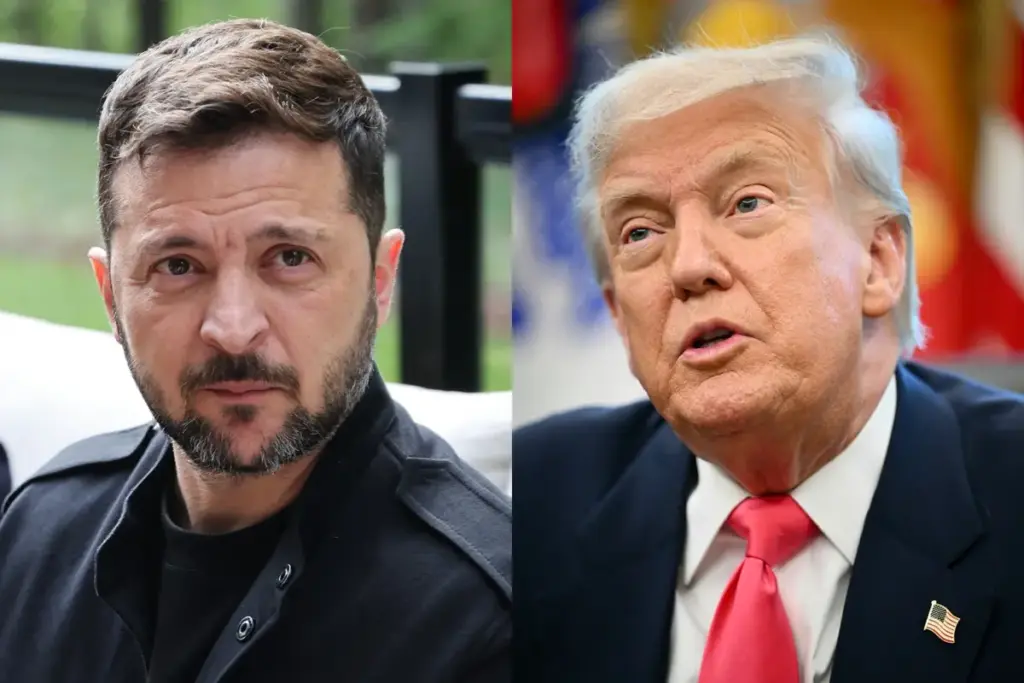
United States President Donald Trump has called for the removal of Ukrainian President Volodymyr Zelenskyy, escalating a bitter public feud after blaming the Ukrainian leader for rising global diesel prices. The sharp rhetoric from the White House comes as the Republican Party faces mounting political pressure over energy costs ahead of the critical November midterm elections.
The public rebuke on Saturday highlights a deepening rift in bilateral relations, arriving just after the Trump administration announced a controversial diesel supply agreement with Russia. The move marks a dramatic pivot in Washington’s foreign policy, reversing years of stringent pressure and economic isolation directed at Moscow following its full-scale invasion of Ukraine.
“I think it’s time for Ukraine to get a new president,” Trump told reporters gathered at the White House on Saturday. He asserted that Zelenskyy had severely disrupted global diesel supplies through a sustained campaign of drone and missile strikes targeting critical Russian oil refineries.
“He wants to make problems for our farmers, our ranchers with diesel fuel because Russia supplies a large portion of the diesel fuel throughout the world,” Trump added, linking Ukraine’s military tactics directly to the economic strain felt by American agricultural producers and consumers at the pump.
Zelenskyy forcefully pushed back against the criticism, vowing that Kyiv would maintain its military strategy against Russian energy infrastructure unless Moscow altered its own operational behavior. Writing on the social media platform X on Sunday, the Ukrainian leader outlined the conditions under which strikes might cease.
“Ukraine will be ready to stop striking Russian oil refineries if Russia stops striking our energy infrastructure,” Zelenskyy wrote. “It is possible to stop strikes on energy infrastructure as early as today, but [Russian President Vladimir] Putin does not want to do so.”
Zelenskyy also warned that every additional billion dollars Russia earns from energy exports directly subsidizes its war machine, funding weapons components, drone upgrades, missile manufacturing, and the recruitment of foreign mercenaries. He maintained that Moscow would only be compelled to negotiate seriously when its military capacity and financial resources were substantially diminished.
The escalating dispute marks the latest chapter in a notoriously tense relationship between the two leaders that dates back to Trump’s first term in the White House. That initial friction famously centered on a 2019 phone call in which Trump pressured Zelenskyy to investigate his political rival, Joe Biden, and his son, Hunter Biden, while the administration temporarily withheld millions of dollars in congressionally approved security assistance.
A History of Friction and Confrontation
The modern diplomatic collision is built upon a foundation of recurring public disagreements and policy clashes. A chronological examination of the relationship reveals deep-seated divisions over peace negotiations, territorial integrity, and military strategy.
In October 2026, speaking from the White House, Trump openly criticized Zelenskyy for an alleged unwillingness to pursue a negotiated peace deal while angrily demanding an immediate halt to Ukrainian strikes on Russian energy facilities.
“I said to him, ‘Do what you want. Don’t hit refineries. There’s plenty of targets. Don’t hit refineries,’” Trump recounted to reporters. “And he went out and he hit. He better damn well stop. I suggest they get a new leader who can make a deal because he could have made many deals, but for some reason, he never does.”
Trump’s frustration culminated on Friday when he finalized a bilateral agreement with Russian President Vladimir Putin to purchase diesel fuel from Moscow. The policy reversal is intended to stabilize domestic energy markets and alleviate high fuel prices ahead of the midterm elections, directly contradicting years of bipartisan consensus in Washington regarding economic sanctions against Russia.
The broader arc of tension has been marked by repeated public rebukes from the White House. In April 2025, Trump criticized Zelenskyy and implied that Kyiv bore responsibility for provoking the conflict with its larger neighbor. On April 15, 2025, Trump remarked that the Ukrainian leader was “always looking to purchase” American missiles, adding, “You don’t start a war against someone 20 times your size and hope people give you some missiles.”
Just over a week later, on April 23, 2025, Trump lashed out at Zelenskyy for making statements he characterized as “very harmful” to peace negotiations. The controversy erupted after the Ukrainian president rejected the notion of ceding the occupied Crimean Peninsula to Russia as part of a potential diplomatic settlement.
“There is nothing to talk about – it is our land, the land of the Ukrainian people,” Zelenskyy declared, ruling out any territorial concessions.
In response, Trump accused Zelenskyy on social media of stoking tensions by boasting that Kyiv would never legally recognize the annexation of Crimea, which Russia seized in 2014 without a shot being fired.
“It’s inflammatory statements like Zelenskyy’s that makes it so difficult to settle this war,” Trump wrote at the time, warning, “He can have peace or, he can fight for another three years before losing the whole country.”
Despite the fierce rhetoric, the two leaders attempted to bridge their differences during a private meeting at the Vatican on April 26, 2025, held on the sidelines of Pope Francis’s funeral. However, the temporary diplomatic truce did little to resolve the fundamental divergence in their strategic visions.
The friction reached a dramatic boiling point during an Oval Office meeting on February 28, 2025. Trump and Vice President JD Vance engaged in a heated confrontation with Zelenskyy regarding rare earth mineral agreements, long-term security assurances, and the framework for ending the war.
According to accounts of the meeting, Trump issued a blunt ultimatum, warning Zelenskyy that Ukraine must commit to a negotiated settlement or face the total withdrawal of American support. Trump accused the Ukrainian leader of disrespecting the United States and overplaying his hand. The encounter quickly devolved into a shouting match, and Zelenskyy departed the White House abruptly without completing the scheduled itinerary.
Just weeks earlier, on February 19, 2025, roughly a month after returning to power for a second term, Trump leveled unprecedented personal attacks against the Ukrainian head of state. In a lengthy post on Truth Social, Trump branded Zelenskyy a “dictator without elections” and accused him of attempting to preserve a financial “gravy train” of US military assistance while Washington pursued a negotiated end to the hostilities.
Trump amplified these remarks during an address at an investment summit in Miami hosted by the Future Investment Initiative Institute. He asserted that Zelenskyy had mismanaged the country, leaving it shattered with millions of unnecessary casualties.
“A dictator without elections. Zelenskyy better move fast or he’s not going to have a country left,” Trump told the audience. “Gotta move. Gotta move fast cause that war’s going in the wrong direction. In the meantime, we’re successfully negotiating an end to the war with Russia. Something I’ll admit that only Trump is going to be able to do and the Trump administration – we’re going to be able to do it. I think Putin even admitted that.”
Throughout the 2024 presidential campaign trail, Trump regularly attacked the Ukrainian government’s refusal to compromise. At a rally in North Carolina in September 2024, he argued that accepting even an unfavorable deal or relinquishing minor territory was preferable to ongoing devastation.
This skepticism of foreign aid contrasted sharply with the policies of the Biden administration, whose financial and military backing Trump frequently denounced. While Trump initially claimed during his campaign that he could end the conflict within 24 hours of taking office, he later characterized that assertion as sarcastic.
As the political landscape shifts toward the November midterms, the intersection of domestic economic pressures, the new US-Russia diesel arrangement, and the ongoing war in Eastern Europe ensures that the relationship between Washington and Kyiv remains profoundly strained. With Zelenskyy refusing to alter his military strategy against Russian energy assets and Trump demanding new leadership in Kyiv, the diplomatic standoff shows no signs of abating.