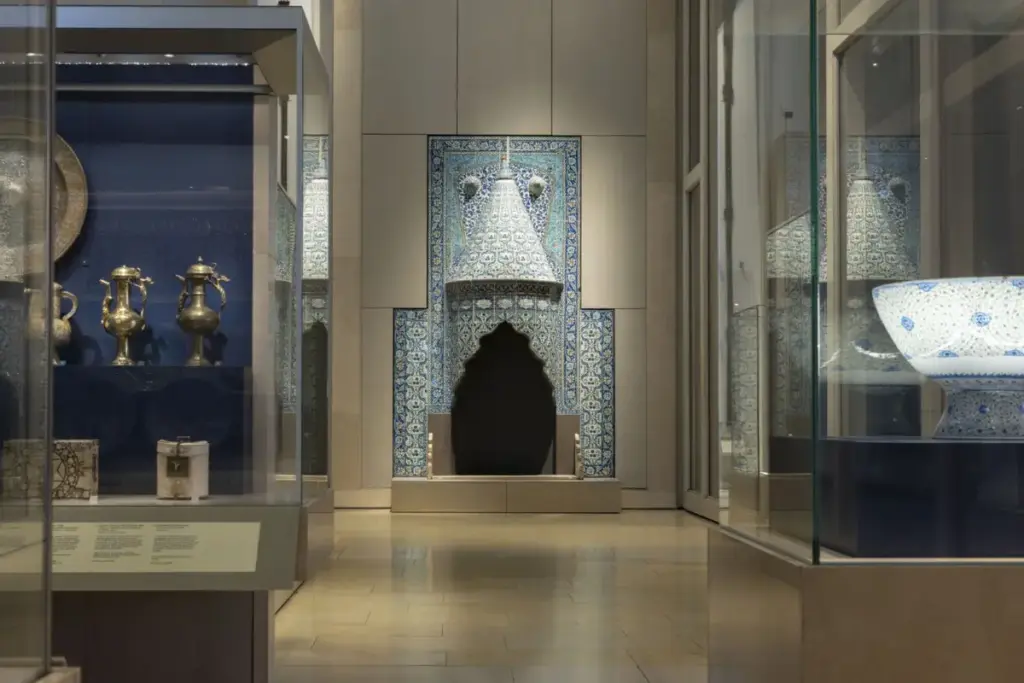
This July marks a significant milestone for London’s cultural landscape, as The Jameel Gallery of Islamic Art at the Victoria and Albert (V&A) Museum celebrates its 20th anniversary. Opened in July 2006 to serve as the museum’s dedicated home for the arts of the Islamic Middle East, the gallery has spent the past two decades bridging historical heritage and contemporary discourse. To mark this platinum anniversary, the V&A has curated a vibrant year-long calendar featuring new displays, live craft demonstrations, academic conversations, and public events supported by Community Jameel, looking back at two decades of public engagement while casting an eye toward the future of museum curation.
Today, the gallery houses a breathtaking assemblage of approximately 400 objects spanning over a millennium of human creativity, originating from regions as geographically diverse as Spain and Central Asia, and dating from the 8th century to the present day. Visitors walking through the free-admission gallery encounter an intimate juxtaposition of ceramics, intricate carpets, gleaming metalwork, masterful woodwork, delicate glass, and illuminated manuscripts sitting side by side.
The creation of the gallery two decades ago was made possible through the generous support of the Jameel family, establishing a foundational and lasting relationship with the V&A. This partnership deepened further in 2009 with the establishment of the Jameel Prize, an influential international award that continues to explore the vital relationship between contemporary artistic practice and rich Islamic traditions.
A Year of Celebration
Throughout the anniversary year, making and craft have remained at the heart of the V&A’s programming, successfully bridging the gap between living traditions and the historic objects that inspired them.

The anniversary events kicked off in earnest during May, coinciding with London Craft Week. The museum welcomed prominent Egyptian textile artist Hany Abd El-Kader, who captivated visitors with live demonstrations of khayamiyya—the traditional art of cotton applique. The demonstration was part of a sold-out talk introduced by Seif El Rashidi of the Barakat Trust. Alongside the public display, a select group of participants took part in an exclusive hands-on workshop led by Abd El-Kader, learning the intricate techniques to create their own pieces of khayamiyya to take home.
On July 17, marking the exact day of the gallery’s 20th anniversary, the museum hosted "The Islamic art Museumscape." This landmark conference brought together international experts and curators to assess the current state of Islamic art collections in museums worldwide, examining how themes, trends, and methodologies have evolved over the two decades since the gallery first opened its doors. Later that month, the anniversary celebrations continued with a vibrant Friday Late event titled "Body as a Vessel," produced in collaboration with Shubbak and celebrating contemporary Arab and Southwest Asian and North African (SWANA) creativity.
As autumn arrived, the gallery unveiled a striking new installation during the London Design Festival by artist Aziza Kadyri, which weaves fluidly through the gallery’s historic arches. Kadyri’s collaborator, skilled embroidery artist Yulduz Mukhiddinova, traveled directly from Uzbekistan to lead immersive suzani embroidery sessions both inside the gallery and at the museum’s "Awakenings" Friday Late event. Approximately 80 attendees had the rare opportunity to learn traditional stitches, accompanied by a live performance from Uzbek singer-songwriter Laylo.
Twenty Years On
Reflecting on the milestone, Mariam Rosser-Owen, Curator of the Middle East in the V&A’s Asia Department, highlighted the profound historical journey of the institution’s collections.
"As curators of Middle Eastern art, we are so fortunate to be able to work with one of the best collections of Islamic art in the world," Rosser-Owen noted. "The collecting history is so interesting as well. Collecting of Middle Eastern art began in the 1850s, when the Museum was founded, to improve British design. Over the next century the V&A’s holdings of Islamic art grew to encompass outstanding and world-famous objects. At the same time, these holdings played a real part in inspiring some of Britain’s greatest artists and designers, including William Morris."

Rosser-Owen also pointed to the extensive archival holdings that preserve the collections’ provenance. The physical space occupied by the gallery today originally opened in 1950 to provide a dedicated home for the finest pieces in the collection for the very first time. Although the space received a refresh in the 1970s, by the time the V&A established its dedicated curatorial section for Middle East specialists in 2002, the galleries were in dire need of a comprehensive overhaul. The 2006 renovation, made possible by the Jameel family, allowed these world-class collections to be showcased in an appropriately striking and modern setting.
Fady Jameel, Family Ambassador of Community Jameel and Chairman and Founder of Art Jameel, reflected on the enduring partnership and the gallery’s cultural impact.
"The Jameel Gallery at the V&A anchors the Jameel family’s long-standing commitment to supporting and celebrating Islamic art," Jameel stated. "Over the past 20 years, the gallery has become a platform for research, public engagement, and contemporary creative practice, showing how historic artistic traditions continue to evolve. Through my family’s partnership with the V&A, and Community Jameel’s wider work supporting traditional arts and craftsmanship, we remain committed to fostering partnerships that preserve these traditions, while ensuring they continue to reach new audiences."
Five Objects Not to Miss
For visitors returning to the gallery or exploring its collections for the first time, curators recommend starting with five standout items that define the breadth and mastery of the collection.
At the center of the gallery rests the legendary Ardabil Carpet, crafted in 1539–1540 for the shrine of Shaykh Safi al-Din in northwestern Iran. Widely recognized as the world’s oldest dated carpet, a specialized enclosure was constructed at the heart of the gallery when it opened in 2006, allowing visitors to view the masterpiece on the floor as originally intended. To protect its delicate pigments from fading, the carpet is illuminated for ten minutes on every hour and half-hour.

Another highlight is the rock crystal ewer, carved in Cairo between 1000 and 1050 for the treasuries of the Fatimid rulers. The vessel features intricately carved scenes of birds of prey swooping down on horned animals amidst swirling palmette scrolls, all sculpted from a single piece of rock crystal.
The collection also features the towering Minbar made for Sultan Qa’itbay, an architectural masterpiece constructed in Cairo between 1468 and 1496. Its monumental geometric patterns are assembled meticulously from hundreds of small pieces of carved wood and ivory.
Near the gallery’s entrance, visitors are greeted by a lustreware bowl with a ship, produced in Málaga, Spain, between 1425 and 1450. The bowl depicts a vessel sailing across its center, its specialized lustre glaze shimmering dynamically as viewers move around it.
Finally, a newly installed case at the rear of the gallery showcases a selection of 20th-century Iranian prints stemming from a generous 2023 gift by Tarlan Rafiee and Yashar Samimi Mofakham. Highlighting four leading figures of Iran’s pre-revolutionary modern art movement from the 1950s through the 1970s, the display includes an untitled 1975 screenprint by Nasser Ovissi, a celebrated pioneer of Iran’s Saqqakhaneh movement.
Still to Come
The anniversary programming will continue into November 2026 during Islamic Art Week, when artist Mariam Ashraf will demonstrate the traditional art of plaster carving. The technique is identical to the method used to create decorative windows set with coloured glass, such as the 19th-century examples from Cairo currently on view in the gallery. This specialized demonstration will also be broadcast via live stream to engage global audiences.

Two decades after opening its doors, The Jameel Gallery continues to illuminate the profound connections between past and present, uniting extraordinary historical artifacts, living craftsmanship, and contemporary artistic voices under one roof.
The Jameel Gallery (Room 42) is located at V&A South Kensington. Admission is entirely free, and no advance booking is required for visitors wishing to explore the space.