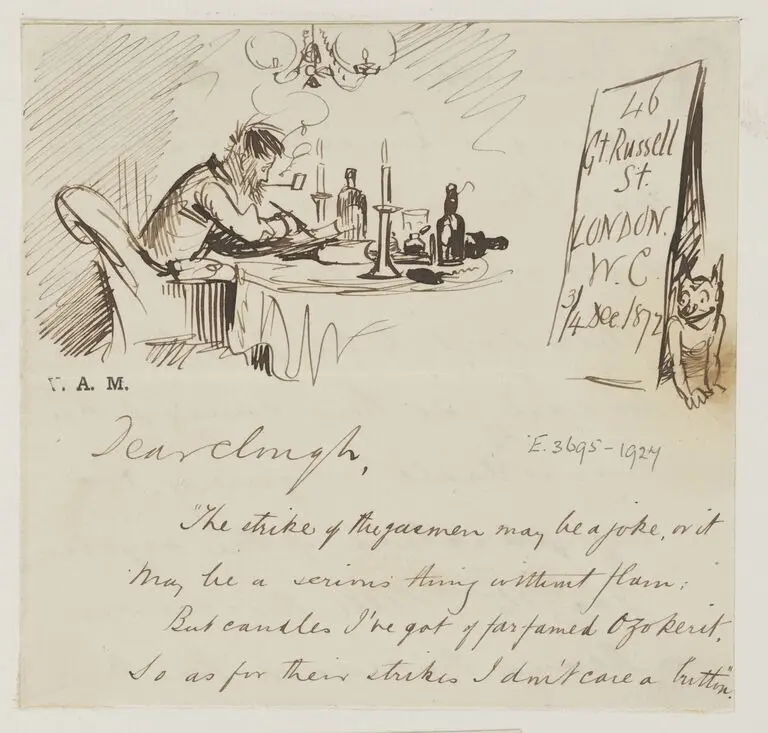
As part of an intensive five-month cataloguing and research project at the Victoria and Albert Museum (V&A) in London, a museum intern is shedding fresh light on the formative years of celebrated Victorian artist and illustrator Randolph Caldecott. Supported by The Randolph Caldecott Collection Trust, the project focuses on works on paper by Caldecott, who lived from 1846 to 1886 and remains best known for his beloved annual "Picture Books," including Victorian classics such as "The House that Jack Built" and "Babes in the Wood." While the V&A houses a rich array of prints, drawings, and paintings by the artist, the ongoing research has brought renewed attention to a particularly revealing artifact: an album of early sketches compiled by Caldecott’s former co-worker, William Clough.
This rare album contains the earliest works by Caldecott held within the museum’s collection, preserving creative output that predates the artist’s professional career as a commercial illustrator. Long before he achieved widespread acclaim for his whimsical and dynamic children’s book illustrations, Caldecott navigated a path familiar to many artists throughout history: he practiced his craft during the quiet hours of a conventional day job.
Born the son of a woollen draper and tailor who later transitioned into accountancy, Caldecott initially worked within his father’s business before securing a position as a bank clerk at Whitchurch Ellesmere Bank. By 1867, his career path led him northward to Manchester, where he took up employment at the Manchester & Salford Bank. However, balancing ledger books and managing financial accounts proved ill-suited for the spirited 21-year-old. Caldecott routinely preferred taking long walks out of the city to visit customers’ houses rather than remaining confined to the bank’s interior.
The profound mismatch between his daily employment and his true artistic ambitions is vividly reflected in his private correspondence. In an 1885 letter looking back on those years, Caldecott confessed to his former colleague Clough that "there was seldom visible in me any steady sober respect for the work of the bank." The psychological toll of his routine was similarly captured in a letter written to another fellow clerk in 1870, where he observed that "the sweet bonds of friendship between clerks are now and then temporarily broken asunder by the bad tempered engendered of a round of dreary, shut-up, daily drudgery."

To cope with what he perceived as monotonous drudgery, Caldecott turned instinctively to drawing. The newly highlighted sketch album, filled with lively illustrations of people and animals jotted down on scraps of paper, documents the foundation of relentless creativity that would eventually fuel his extensive professional output. Unlike the direct observations characteristic of many traditional sketchbooks, much of the artwork Caldecott produced at the bank consisted of imaginative, highly characterful illustrations born entirely from his mind.
There are, however, fascinating exceptions to this imaginative approach. Among the pages of the album is a rare sequence of candid portrait sketches depicting his fellow bank employees. Caught hard at work and entirely unaware that they were being immortalized in pen and ink, these men were captured in unguarded moments. For these individuals, Caldecott’s quick sketches likely represent one of the very few surviving visual likenesses of their existence. To ensure their identities were not lost to history, either Caldecott or Clough thoughtfully labeled each portrait with the subject’s name or initials.
Utilizing historical street directories from Manchester and Salford spanning 1863 to 1876, alongside the 1871 census data, researchers working on the V&A project have successfully uncovered the full names and residential addresses for all but one of the depicted colleagues. Initial assumptions pointed toward a clerk named J. R. Wilkinson, but assistance from the archivists at the NatWest Group archives—which maintain historical records concerning the Manchester & Salford Bank and its corporate lineage—confirmed the true identity of the subject as T. R. Wilkinson.
Thomas Read Wilkinson maintained an extensive 49-year career at the financial institution, having commenced his employment in 1841 at the tender age of 15. Caldecott himself had also been just 15 years old when he took his first steps into the banking sector at Whitchurch Ellesmere Bank. Furthermore, another colleague captured in the sketches, Thomas Butterworth, had a 16-year-old son who was similarly employed as a bank clerk. Entering the workforce at this young age was a standard trajectory for many youths of the era, though historical records indicate that Caldecott had managed to remain in formal education longer than the majority of his working-class and lower-middle-class peers.
Even after Caldecott relocated to London in 1872 to pursue his artistic career in earnest, he maintained the deep friendships forged during his years in Manchester. He and William Clough remained in regular contact for decades. Many of these illustrated letters sent by Caldecott to Clough have been preserved and published in the volume Yours pictorially : illustrated letters of Randolph Caldecott, edited by Michael Hutchins. Following Caldecott’s untimely death in 1886, Clough paid tribute to his lifelong friend in an article for the Manchester Quarterly, writing, "No envy, malice, or uncharitableness spoiled him; no social flattery or fashionable success, made him forget those he had known in the early years."

While the vast majority of the men captured in Caldecott’s Manchester sketch album possess no known alternative photographic or painted portraits, at least one notable exception has emerged through genealogical research. "H. B. Harrison" has been identified as Henry Bowers Harrison, a fellow banker’s clerk whose life trajectory bore striking similarities to Caldecott’s own. Though Harrison was 16 years older than the artist, he also began working at age 16 before relocating to Manchester at age 20. Following his death in 1895, one of Harrison’s daughters authored a biography chronicling his life, featuring a portrait of her father as the frontispiece. Comparing the published photograph with Caldecott’s contemporary sketch reveals that the artist’s pen-and-ink portrait was remarkably accurate.
The rediscovery and complete cataloguing of these archival materials offer modern historians and genealogists a unique lens through which to examine the ordinary lives of 19th-century bank workers whose stories would otherwise be lost to time. Through the lens of a young, frequently restless Randolph Caldecott sketching to pass the time during long hours at a bank desk, contemporary families may once again put a face to the names of their ancestors.
The complete collection of Randolph Caldecott’s bank-era drawings and sketches is now accessible to the public through the online collections portal of the Victoria and Albert Museum.