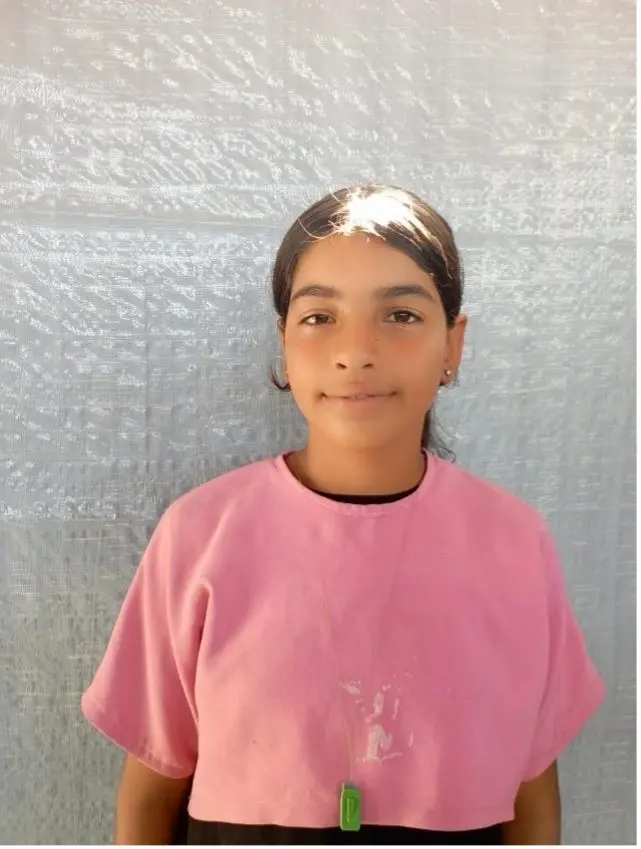
At just 12 years old, Amira has already confronted a magnitude of hardship that most people will never experience in a lifetime. She has faced the devastating loss of her father, the abrupt displacement from her community, and the utter destruction of her family home. Yet, despite the compounding crises that have upended her childhood, she continues to pursue her education remotely and steadfastly holds onto her dream of growing up to become a nurse.
Amira’s world shifted fundamentally when she was nine years old and lost her father to cancer. For a young child, his passing meant the loss of a primary anchor in her life—someone she vividly remembers as a profound source of love, safety, and unwavering strength. His death introduced an early layer of grief and altered the trajectory of her upbringing, forcing her to mature much faster than children typically should.
Tragedy struck again when the war in Gaza began, plunging Amira and her family into yet another harrowing period defined by profound loss, widespread destruction, and constant fear. The relative stability of their daily routines vanished overnight, replaced by the immediate urgency of survival.
Forced to Leave Their Home and Everything They Knew
Before the escalation of the conflict, Amira lived a relatively peaceful life with her mother, Manal, and her siblings in the Al-Salam neighbourhood of Rafah. It was a home filled with memories, community ties, and a sense of belonging. However, as the security situation deteriorated rapidly, the family was issued orders to flee, forcing them to make an agonizingly swift decision about what to leave behind.
When the family was forced to pack up and evacuate, they had to abandon the vast majority of their belongings, unable to carry more than a few essential items. They took only a small selection of clothes, basic bedding, and a handful of kitchen necessities, clinging to the persistent hope that the displacement would be short-lived and that they would soon be able to return to their doorstep.
That hope, however, was eventually crushed. Instead of returning to their neighborhood, they learned that their house had been completely destroyed. With no home to go back to, the family remained indefinitely displaced, ultimately having to construct a makeshift tent to serve as their shelter.
Life inside the tent presented a relentless daily struggle against the elements and scarcity. The temporary structure offered virtually no insulation, becoming suffocatingly hot during the scorching summer months and bitterly, bone-chillingly cold during the winter season. When storms hit, rainwater leaked directly into the living space, and the surrounding ground quickly churned into thick, impassable mud that complicated every movement.
Basic survival requirements also became major logistical hurdles. The family frequently struggled to secure enough water and food to sustain themselves. There were days when they had to endure hours of waiting in long lines just to collect water from passing delivery trucks. When they could no longer afford to buy food on their own, they were forced to rely entirely on the distribution efforts of community kitchens just to get by.
Losing Everything Again to Fire
The fragile stability of tent life was shattered further when the family suffered yet another catastrophic setback. Their tent caught fire, completely destroying the structure and reducing everything they had managed to salvage to ash.
With the fire went their remaining changes of clothing, their minimal cooking equipment, and the few personal items they had depended on for daily living.
“Everything we owned was turned to ashes,” Manal shares, reflecting on the sheer devastation of the incident. The sudden loss left the family stripped once again of the most fundamental items needed to maintain basic human dignity and functionality.
Today, their list of urgent material needs is extensive. They require a much sturdier shelter equipped with waterproof coverings to protect them from future weather elements. Beyond that, they are in dire need of a proper bathroom setup, reliable cooking equipment, clean clothes, and sturdy shoes to replace what was lost in the fire.
Continuing to Study Despite Relentless Displacement
Despite the crushing weight of these extraordinary hardships and the persistent uncertainty surrounding her living conditions, Amira refuses to let go of her education. She continues to study online and has successfully advanced to the seventh grade, showing a remarkable resilience and dedication to her personal development.
Living without access to a stable electricity grid or modern conveniences like a washing machine, Amira also takes on significant household responsibilities. She spends hours washing her family’s clothes entirely by hand, balancing her domestic duties with her coursework. Through it all, her ambition remains clear and unshakeable: she dreams of becoming a nurse, a calling inspired by a desire to help others heal just as she hopes to see her own community recover. Alongside her studies, she maintains a love for drawing, though she currently lacks the basic art materials required to practice her creativity.
Her immediate personal needs remain pressing, encompassing seasonal requirements such as warm winter clothing, essential undergarments, and proper shoes to protect her from the cold and mud.
Supporting Orphaned Children in Gaza
The realities that Amira and her family navigate every day mirror the experiences of thousands of children across Gaza who have lost parents, homes, and the foundational sense of security that every child deserves. Organizations on the ground continue to work tirelessly to address these monumental gaps in support.
Islamic Relief has a long-standing history of supporting vulnerable and orphaned children in the region, operating its Orphan Sponsorship Programme since 1999. The initiative functions through a one-to-one sponsorship model, directly connecting a compassionate donor with an individual child. The child’s guardian receives a regular monthly financial contribution, which can be flexibly allocated toward the family’s most urgent priorities—whether that is purchasing nutritious food, securing appropriate clothing, accessing essential healthcare, or covering educational expenses.
In response to the current crisis, Islamic Relief has significantly scaled up the capacity and reach of the programme. More than 25,000 children throughout Gaza are currently receiving vital sponsorship support, while over 5,000 additional children remain on the active waiting list, highlighting the immense and ongoing scale of the need.
Where logistical conditions and access allow, sponsored families also receive supplementary seasonal assistance. This includes targeted distributions such as Ramadan and Qurbani food parcels, special Eid gifts for the children, and essential winter items designed to help families endure the harshest months of the year.
Holding on to Hope for a Safer Future
Amira’s story is a testament to the profound endurance of children caught in the crosshairs of conflict, capturing both the immense scale of what has been lost and the quiet determination to rebuild.
Even as she navigates the daily trials of displacement, the loss of her father, and the destruction of her home, she continues to open her books, attend her online classes, and look toward a horizon where peace is possible. Her aspirations remain remarkably modest yet powerful: she simply wants to finish her education, step into a career in nursing, and eventually live somewhere safe alongside her family.
Through initiatives like Islamic Relief’s Orphan Sponsorship Programme, individuals have the opportunity to offer a reliable channel of support and stability to orphaned children and their families in Gaza during their darkest hours.