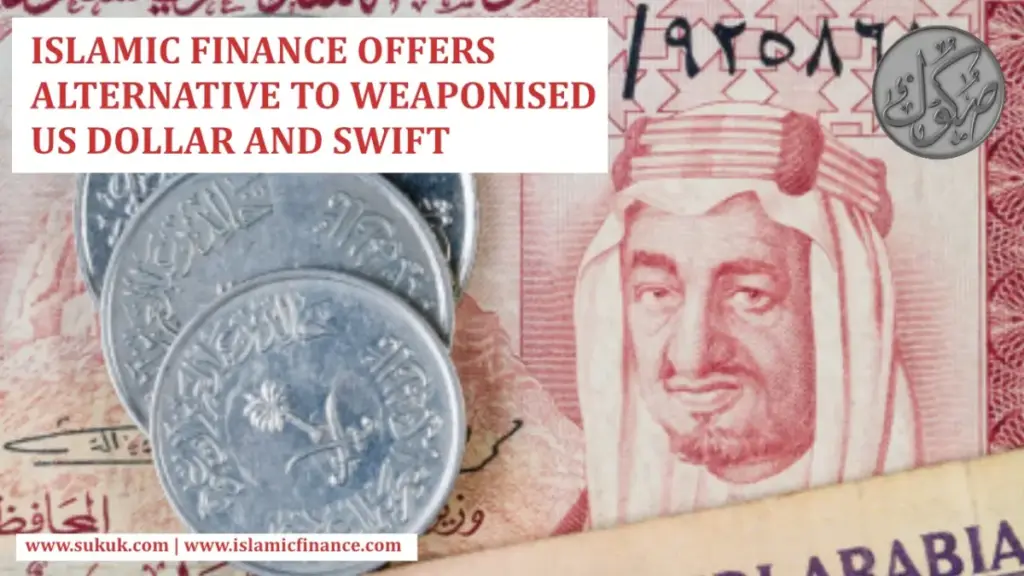
The growing weaponization of the United States dollar and the Society for Worldwide Interbank Financial Telecommunication (SWIFT) payment system has accelerated a global push for alternative trade mechanisms. As trust in the greenback and Western-dominated financial infrastructure wanes, international leaders, emerging economies, and financial institutions are actively seeking resilient ways to conduct commerce, insulate their domestic economies from unilateral sanctions, and redefine the architecture of international trade.
Islamic Finance Instruments Can Replace US Dollar in Trade
For decades, the US dollar has reigned supreme as the world’s primary reserve currency and the undisputed medium of exchange for international commodities, particularly oil. However, the frequent application of sweeping economic sanctions and the control exerted over international financial plumbing have generated profound anxiety among nations seeking strategic autonomy.
In response to these mounting pressures, Turkish President Recep Tayyip Erdogan has strongly advocated for the expansion of Islamic finance and the settlement of commerce in domestic currencies. During high-level international discussions, the Turkish leader emphasized that trade in national currencies has gained urgent significance in the current geopolitical climate, asserting that nations must prioritize the integration of Islamic finance into their broader economic agendas.
President Erdogan has a history of calling out the global financial monopoly held by the dollar, urging international partners to reduce their reliance on American currency to ensure greater economic stability and fairness. These concerns are not isolated to developing nations or targeted economies. Even within Western financial circles, acknowledgement of the risk has surfaced. Former US Treasury Secretary Steve Mnuchin publicly acknowledged the vulnerability, warning that if policymakers are not careful, international actors will increasingly look toward alternative currencies and payment systems to conduct their business.
Iranian Banks Removed from SWIFT and the Rise of Alternative Networks
The urgency behind these alternative financial architectures has been sharply underscored by concrete geopolitical actions. Chief among them is the deployment of American sanctions that have systematically removed Iranian banks from the SWIFT payment system. This exclusion has severely crippled Iran’s ability to engage in conventional foreign trade, cutting off the nation from standard international banking channels and forcing it to seek radical alternatives to survive economically.
Similar extraterritorial sanctions have also created friction among traditional Western allies, impacting European and specifically German firms involved in crucial cross-border infrastructure projects, such as the Russian-German pipeline. These punitive measures have demonstrated to major economic powers that dependence on dollar-centric systems leaves them vulnerable to sudden geopolitical shifts originating in Washington.
To insulate themselves from such disruptions, major global players have begun constructing parallel financial pathways. Notably, Russia and China have established their own dedicated payment systems to facilitate direct bilateral trade. By bypassing traditional Western-controlled networks entirely, Moscow and Beijing have created a blueprint for other nations seeking to trade securely without touching the US dollar or exposing themselves to the risk of SWIFT-related lockouts.
Increased Use of Gold and Local Currencies Across Major Economic Blocs
This collective departure from the dollar is further institutionalized within major multilateral organizations. The Shanghai Cooperation Organization (SCO), an influential eight-nation security and economic bloc that includes China, Pakistan, and Russia, accounts for nearly a quarter of global Gross Domestic Product. Recognizing their collective economic heft, SCO member states have systematically increased their gold and foreign exchange reserves, which now accumulate to an impressive total of nearly four trillion US dollars.
The strategic pivot away from Western currencies moved from theory to practice during a pivotal finance ministers meeting in Moscow. During the gathering, SCO member states formally decided to bypass the dollar entirely for bilateral trade and investment, choosing instead to conduct transactions directly in their local currencies. This monumental shift provides participating nations with a robust shield against currency volatility and external political pressure, signaling a permanent evolution in how regional trade is conducted.
Use of Gold in Islamic Cultures and Modern Financial Integration
Beyond fiat local currencies, tangible assets such as gold have re-emerged as premier instruments for trade and wealth preservation, aligning closely with traditional practices deeply rooted in Asian and Islamic cultures. Gold has long been viewed as an attractive, enduring store of wealth passed down through generations across the region. In recent years, countries such as Turkey and Malaysia have placed themselves at the forefront of Islamic financial gold banking and the development of gold-backed currency systems.
In Malaysia, state governments have taken tangible steps to operationalize this philosophy. The Malaysian states of Kelantan and Perak introduced the gold dinar and silver dirham coins as alternative mediums of exchange for local payment and trade, harkening back to historical Islamic monetary traditions while offering a modern counterweight to fiat instability.
Concurrently, the banking sector in Turkey has embraced innovative gold-backed initiatives. Kuveyt Türk, a prominent Turkish Islamic bank, pioneered widespread gold banking operations when it began offering specialized services in 2007. By July 2019, the institution had successfully collected over 26 tons of physical gold—valued at approximately $1.2 billion—effectively integrating dormant private wealth directly into the formal Turkish economy. Building upon this success, current financial initiatives are exploring the creation of an Islamic finance gold-based cryptocurrency, designed specifically to streamline and secure cross-border trade in the digital age.
Islamic Finance Gold Standard Bridges Modern Markets and Tradition
The integration of precious metals into modern Islamic finance received a major institutional boost in 2016, when the World Gold Council and the Accounting and Auditing Organisation for Islamic Financial Institutions (AAOIFI) jointly approved a comprehensive Sharia standard for gold-based products.
The primary objective of this standardized framework was to safely expand the utilization of physical bullion within Islamic finance and pave the way for the creation of sophisticated new financial instruments. Crucially, the standard addressed complex regulatory and religious requirements concerning the use of gold as collateral, as well as the parameters governing the exchange of gold in both spot and deferred transactions. By establishing clear, universally accepted guidelines, this framework has provided the necessary legal and religious certainty for institutions to deploy gold-backed financial instruments confidently on a global scale.