What really happens behind a stage door? For most music fans, the backstage area is shrouded in a persistent mystique—a realm of unchecked rock-and-roll spontaneity, exclusivity, and hidden drama. Yet, according to a new academic examination of museum ephemera, the reality of the green room and the touring circuit is defined far more by routine, meticulous preparation, and repetitive labor than by cinematic chaos.
These insights form the core of a reflective new essay written by Lola Warne, a student on the "Curation and Heritage" module at the University of Liverpool, led by Dr Marion Leonard. Warne’s writing is one of a series of student responses to Lost Music Venues, a major display curated by Harriet Reed within the Theatre and Performance Galleries at the Victoria and Albert Museum (V&A) in London. Running from May 30, 2026, through October 30, 2027, the exhibition brings together roughly 50 "lost" performance spaces that operated from the 1980s to the 2010s. By celebrating these venues as crucial crucibles of creativity, the display shines a light on both their immense cultural contributions and the severe operational challenges facing the contemporary live music sector.
Examining the ephemera associated with touring life, Warne explores how objects left behind by artists and venue staff expose the hidden practices that sustain live performance. Rather than being defined purely by onstage spectacle, the lives of touring musicians are grounded in a rhythm of waiting, preparing, and repeating.
The Tension Between Routine and Creativity Backstage
Time spent in a green room or dressing room is rarely glamorous. Instead, it is consumed by memorizing set lists, rehearsing lyrics, and revising small details again and again. Yet, even within the confines of this repetitive schedule, an unmistakable energy pervades the space. Performers grapple with the approaching pressure of an audience’s reaction, the anxiety of introducing a new song, the build-up to the opening track, and the profound relief that arrives with the final chord. These backstage environments become spaces of shared anticipation, where artists constantly shift between intense preparation and brief moments of emotional release.
Across the artifacts gathered in Lost Music Venues, these tensions become vividly visible. The items on display offer fans a rare, unvarnished look into the daily lives of performers and the exhausting preparation required before stepping into the spotlight.
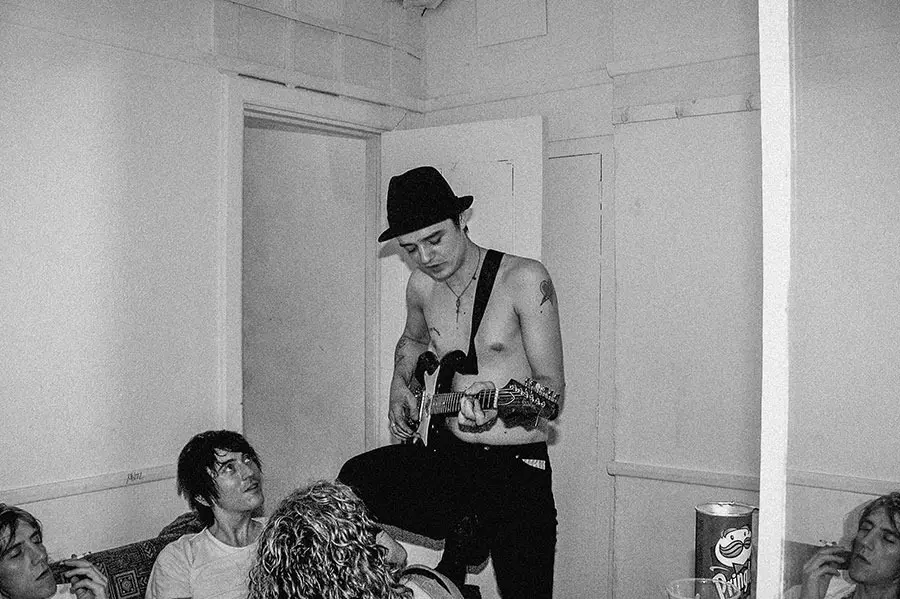
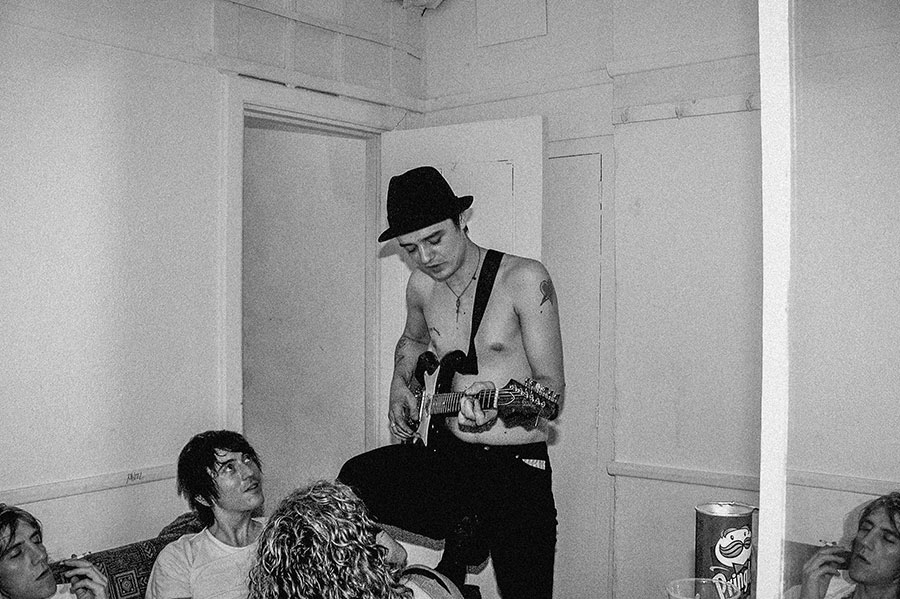
Consider, for instance, a photograph captured by Gregory Nolan depicting musician Pete Doherty backstage. Doherty is shown playing a guitar, an image that immediately prompts questions about whether it freezes a moment of focused rehearsal, spontaneous musical experimentation, or simply an artist passing time during a long wait. In contrast, other archival photographs capture performers who appear less engaged, sitting quietly and waiting out the hours, thereby reinforcing the relentless repetition that shapes the touring experience. What ultimately emerges from these visual documents is a persistent blurring of boundaries, where the traditional line between preparation and active creativity dissolves entirely.
A different perspective on this environment is offered by a photograph documenting the backstage artists’ bar at the historic Rainbow Theatre. In this space, the atmosphere appears noticeably more animated, functioning as a vibrant social hub as much as a practical backstage facility. Here, performers, touring crew members, support acts, and headliners can gather briefly away from the crushing weight of the crowd. It serves as a site of temporary escape and privacy before the artists must return to the stage, offering modern observers a glimpse into the intricate social fabric and working relationships that underpin live music touring.
The Architecture of a Gig: Set Lists, Guest Lists, and Schedules
Beyond the physical spaces of dressing rooms and bars, the actual objects utilized by musicians and venue staff reveal just how highly structured and organized live performance truly is. Among the most telling artifacts in the exhibition are physical set lists used by legendary rock acts such as The Who and Blur.

At first glance, a set list may appear to be nothing more than a simple piece of paper bearing a sequence of song titles. However, their underlying purpose is far more deliberate and strategic. The art of the set list relies on careful arrangement—shaping the overall pacing of a concert, anticipating emotional transitions, and deliberately guiding the audience’s collective experience from the first note to the encore. Spanning decades from the 1970s through the 1990s and beyond, the careful ritual of selecting, ordering, and refining a set list remains a central pillar of the live music industry.
Other items within the V&A collection further expose the extensive commercial and logistical infrastructure required to sustain touring life. A guest list for the band Supergrass and a booking sheet for the Barfly in Camden demonstrate the vast administrative coordination necessary to pull off a successful concert tour. Materials of this nature document strict schedules, access protocols, and operational workflows, proving unequivocally that touring relies on far more than musicians simply moving from one stage to another. It depends on constant, seamless communication and coordination between artists, managers, promoters, and venue staff.
Songwriting Amid the Rigors of the Road
These archival objects do much more than lay bare the structured realities of the touring industry; they actively invite speculation, academic curiosity, and a deep emotional connection from the viewer.
A prime example within the display is a handwritten lyric sheet by Noel Gallagher for the classic Oasis song "Half The World Away," dating back to 1994. This artifact reveals how profound creativity can emerge directly within the demanding environments of life on the road. The object suggests that the act of songwriting is not always confined to moments of quiet isolation at home, but can instead develop amidst the relentless routines of touring. Written amid tight schedules, constant travel, and physical exhaustion, such lyrics point toward a creative process shaped heavily by pressure, spatial constraint, and movement.

For many artists, touring can paradoxically transform into a productive condition where creativity is embedded directly within the daily labor of being a musician. The physical demands of performance, the repetition of set lists, and the endless transitions between different cities and venues can all contribute to sparking new forms of artistic inspiration. By bringing viewers face-to-face with a handwritten lyric sheet, a candid backstage photograph, or a faded set list, the exhibition effectively reduces the distance between artist and audience, uncovering human details that would otherwise remain permanently unseen.
Ultimately, these preserved artefacts pull back the curtain on the hidden routines and structural frameworks that make live performance possible in the first place. While the public fascination with backstage life—driven by the promise of discovering something hidden, exclusive, and seemingly more authentic than the public show—may never truly disappear, the reality documented by the V&A exhibition proves far more compelling than the myth. What happens beyond the stage door is not a realm of unbridled spontaneity, but rather the complex mechanisms of preparation, coordination, and quiet creativity carried out within spaces that the public is rarely permitted to see.