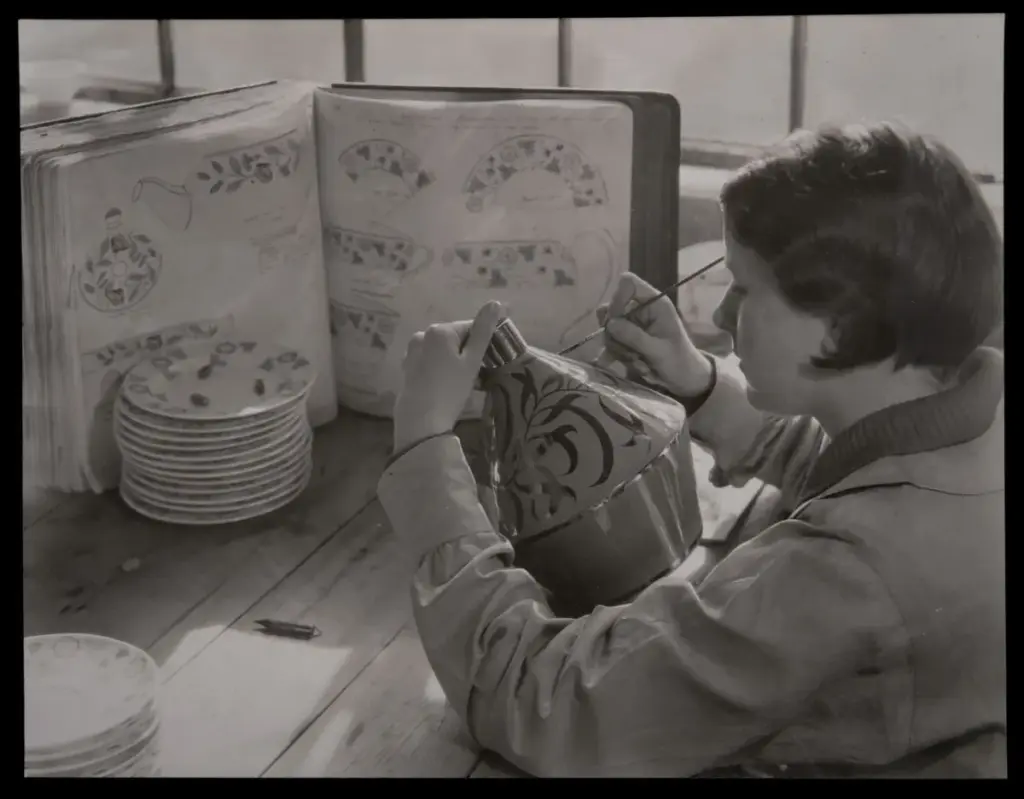
For nearly nine decades, the factories of Josiah Wedgwood and Sons produced a distinctive, vibrant, lead-glazed Victorian ceramic known as "majolica." Introduced by Mintons Ltd. at the celebrated Great Exhibition of 1851, majolica quickly captured the imagination of the Victorian public with its brilliant color palette and rich ornamentation. While Wedgwood initially delayed its entry into this lucrative market due to a period of financial reorganization, the firm ultimately emerged as one of Britain’s most prolific producers. By the time production peaked, Wedgwood’s pattern books documented more than 4,000 unique majolica designs, ranging from decorative tableware to architectural tiles.

However, the history of majolica is also intertwined with the dark realities of 19th-century industrial labor. Prized for its rich, lustrous surface finishes, the ceramic required an extraordinarily high quantity of lead in its glaze. Combined with the grueling working conditions of the era, this high lead content contributed to severe health risks for the artisans who shaped, glazed, and fired the ware.
Today, researchers are shedding new light on these industrial realities through the extensive holdings of the V&A Wedgwood Collection Archive. Funded by the Majolica International Society as part of the ongoing Majolica Project, contemporary archival research is helping historians bridge the gap between factory production records and the personal lives of the people who powered the legendary Etruria Works.

Life at the Factory
Founded in 1769 by industrial pioneer Josiah Wedgwood in the heart of the Staffordshire Potteries, the Etruria Works served as the beating heart of the company’s manufacturing empire for generations. To stabilize his workforce and foster deep loyalty, Wedgwood established a dedicated workers’ village surrounding the manufactory. This layout allowed employees to live either on-site or within a short walking distance in nearby towns.
Employment at Etruria often spanned entire lifetimes, giving rise to tight-knit familial networks where children followed their parents and grandparents into the ceramics trade. Starting at remarkably young ages as assistants, apprentices, or warehouse hands, workers spent decades mastering specialized skills. Manufacturing a single piece of majolica was a complex, collaborative enterprise that could involve up to 20 distinct processes, encompassing everything from initial clay sculpting and intricate painting to final firing, packaging, and delivery.

Yet, this dedication came at a severe physical cost. The pottery industry in Staffordshire was notoriously hazardous. Workers frequently suffered from chronic respiratory ailments such as "Potter’s Asthma," caused by the relentless inhalation of fine clay and flint dust. For those working specifically in majolica production, the omnipresent danger of heavy metal poisoning from lead-based glazes made the trade a perilous way to earn a living.
The Etruscan Breadwinners
One of the most valuable resources for understanding the human landscape of the Etruria Works is an 1898 photo album titled Etruscan Breadwinners. Compiled by designer, modeler, and decorator Harry Barnard—who would later manage the factory’s tile division—the album preserves rare group photographs of employees across various departments. Crucially, Barnard painstakingly labeled each portrait with the names of the individuals pictured, transforming anonymous faces into historical individuals.

Among these images, the photograph of the Majolica and Tile Department captures 14 workers linked directly to the production of the vibrant ceramics. Through Barnard’s handwritten annotations, researchers have been able to cross-reference these names with mid-to-late 19th-century UK census records, wage books, and hiring ledgers, unlocking detailed biographies of long-serving factory hands.
Charlotte Cartlidge (1849–1922)
Among the prominent figures identified in the Etruscan Breadwinners album is Charlotte Cartlidge, whose face peers from the center of the Majolica and Tile Department group. Born in 1849, Cartlidge grew up in Tinkers Clough, a modest neighborhood just a 17-minute walk from the gates of the Etruria factory. Her father, John Cartlidge, spent his working life as a potter’s handler, and by 1871, Charlotte and her two brothers had all joined the local ceramics industry.

According to Barnard’s marginal notes, Cartlidge dedicated an extraordinary 52 years of service to Wedgwood before her death on August 12, 1922, at the age of 73. Archival wage books from the V&A Wedgwood Collection confirm her long tenure, tracking her weekly earnings as a "potters paintress" well into the 20th century. Her final recorded payment, logged on June 28, 1922, amounted to 1 pound, 16 shillings, and 9 pence. Census records from successive decades trace her life as she moved through various homes in Stoke-on-Trent, steadily maintaining her career as a decorator in a field where decorative positions were predominantly held by women.
Harry Bentley (1875–1945)
Another notable worker identified in Barnard’s album is Harry Bentley, who appeared in photographs for both the Majolica and Tile department and the Warehouse department. Born in August 1875, Bentley began his career at Wedgwood in 1888 at the tender age of 13, starting out as a warehouse lad packing fragile ceramics for transport.

Bentley’s life and career are exceptionally well-documented through Wedgwood’s surviving hiring books, census returns, and local newspaper archives. His early working days demanded grueling physical endurance. As recounted in a 1938 article in the Staffordshire Sentinel, Bentley walked daily from his home in Newcastle-under-Lyme to the Etruria factory, arriving by 6:30 a.m. to spend an extra half-hour lighting fires and cleaning up before his formal shift began at seven. He worked continuously until six in the evening before making the long walk home.
By the late 1930s, as Wedgwood prepared to relocate its primary operations from Etruria to a modern facility in Barlaston, Bentley’s half-century of loyal service earned him a rare distinction. In 1938, the company held a foundation-laying ceremony for the new factory. Eight longstanding employees were chosen by their peers to place signed commemorative vases and a plaque into the building’s foundation. Bentley was selected as one of these eight representatives, cementing his legacy in the company’s history.

Photographs of Bentley from the period appear in the archive’s Barlaston Beginnings album. Archival and national death records indicate that he passed away on Christmas Day in 1945 at the age of 70, bringing a definitive close to a lifetime spent in service to the Staffordshire pottery trade.
Conclusion
While majolica production at Wedgwood ultimately faded near the close of the 19th century due to shifting aesthetic tastes and rising health concerns surrounding lead glazes—though small-scale production continued intermittently into the 1940s—the legacy of the workers endures. Through ongoing research into archives like the V&A Wedgwood Collection, the stories of individuals like Charlotte Cartlidge and Harry Bentley provide a tangible connection to the complex industrial heritage of Victorian Britain. The archive continues to offer researchers and descendants a portal into the past, preserving the history of the people who built the Wedgwood name.