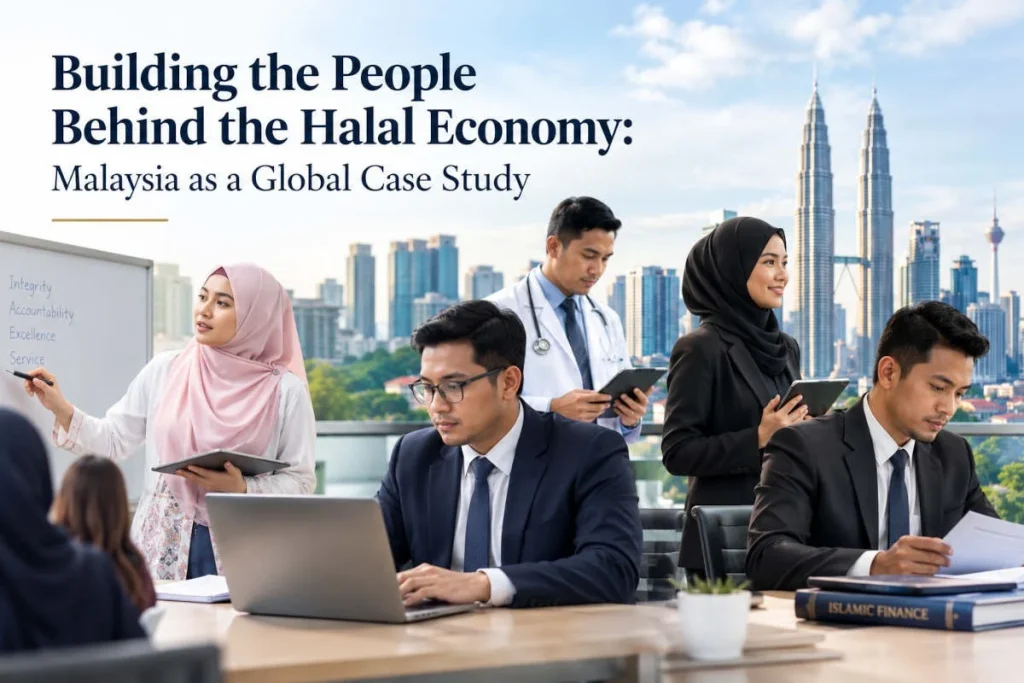
The global halal economy is rapidly entering a transformative new phase. What was once historically associated primarily with dietary compliance and basic certification has matured into a sophisticated, multi-trillion-dollar economic ecosystem. Today, this expansive network spans food production, pharmaceuticals, cosmetics, modest fashion, Muslim-friendly travel, media, recreation, and Islamic finance.
According to the State of the Global Islamic Economy Report 2025/26, Muslim consumer spending across six core consumer sectors reached an astonishing US$2.60 trillion in 2024. Furthermore, this economic momentum shows no signs of slowing down, with projections indicating spending will surge to US$3.56 trillion by 2029.
This remarkable growth is accompanied by a broader structural shift toward more resilient economic systems, localized production, digital trust infrastructure, and stronger halal value chains. Yet, this evolution brings a critical question to the forefront: as the global halal economy becomes increasingly large and sophisticated, who will possess the specialized skills and knowledge required to manage it?
Building a successful, modern halal economy cannot rely on certification alone. Behind every verified product lies an intricate network of professionals responsible for sourcing, production, quality assurance, auditing, regulatory compliance, logistics, marketing, and organizational governance. As halal commodities increasingly cross international borders and permeate highly technical sectors, the global market demands more than just a larger workforce. It requires competent halal professionals capable of translating complex religious standards and regulatory principles into everyday commercial practice.
Malaysia as a Global Case Study
Malaysia offers a compelling case study in navigating this transition. The country has successfully maintained its premier position at the top of the Global Islamic Economy Indicator for the 2025/26 edition, underscoring the enduring strength of its domestic Islamic economic framework.
However, Malaysia’s trade data demonstrates that its halal economy extends far beyond domestic certification stamps. According to the Malaysia Halal Exports 2025 data released by the Halal Development Corporation (HDC), the country recorded a staggering US$16.82 billion (RM68.52 billion) in halal exports in 2025. This represents a robust 10.9% year-on-year increase, supported by a total of 10,638 halal-certified companies and 1,563 active halal exporters.
The composition of these exports reveals a dramatic diversification of the industry. Food and beverages led the categories at US$9.05 billion (RM36.86 billion), closely followed by halal ingredients valued at US$5.25 billion (RM21.39 billion). Other significant contributors included palm oil derivatives at US$1.12 billion (RM4.57 billion), cosmetics and personal care products reaching US$903.29 million (RM3.68 billion), pharmaceuticals totaling US$274.91 million (RM1.12 billion), and industrial chemicals registering US$220.91 million (RM0.90 billion).
This wide-ranging sectoral spread highlights an undeniable reality: halal is no longer merely a question of whether a food product contains permissible ingredients. Increasingly, it involves complex technical queries regarding pharmaceutical formulation, chemical processing, personal care manufacturing, sophisticated supply-chain management, strict traceability, and advanced industrial production.
Consequently, the talent requirements across the industry have shifted dramatically. A halal professional operating within a large food manufacturer must master halal assurance systems, ingredient control, and internal auditing. Meanwhile, a professional in the pharmaceutical sector faces entirely different technical and regulatory hurdles. Similarly, a cosmetics manufacturer requires expertise that sits precisely at the intersection of Shariah jurisprudence, modern chemistry, manufacturing protocols, and evolving consumer expectations. In short, the expansion of the global halal economy is fundamentally an expansion of the knowledge required to sustain it.
Building More Than a Certification System
Malaysia’s enduring success is frequently attributed to its well-established certification system and the central regulatory role of the Department of Islamic Development Malaysia (JAKIM). Yet, certification is merely one component of a much broader institutional ecosystem.
Behind every issued halal certificate are dedicated professionals who manage documentation, meticulously assess incoming ingredients, oversee plant production processes, maintain internal controls, and ensure that compliance is continuously observed. The ultimate effectiveness of any national halal system depends heavily on the people charged with understanding and implementing those standards.
Over decades, Malaysia has deliberately cultivated the institutional structures necessary to support this human dimension. The Halal Professional Board (HPB) provides a structured professional training framework, while recognized Halal Training Providers deliver targeted programs designed to build industry-relevant competencies. Furthermore, the Halal Executive Programme institutionalizes the development of professionals tasked with managing halal matters within corporate organizations.
Industry engagement remains central to these efforts. Collaborative initiatives involving the Malaysian International Halal Academy (MIHA) reflect a national commitment to strengthening professional capabilities and directly aligning halal knowledge with shifting industry demands. By moving beyond the view of halal as a purely administrative certification exercise, Malaysia has recognized that a truly credible economy requires competent personnel, rigorous professional knowledge, and robust institutional backing.
The Institutional Architecture of Talent Development
Halal talent development does not begin in isolation; it originates within the regulatory architecture that dictates organizational compliance and flows outward into practical workplace execution.
At the center of this framework sits JAKIM. The Manual Procedure for Malaysia Halal Certification (MPPHM) provides the foundational procedural guidelines for the national certification system, operating in close coordination with State Islamic Religious Departments (JAIN) and State Islamic Religious Councils (MAIN). Strategically, the nation is also advancing an integrated policy direction through the Dasar Halal Negara (DHN) 2025–2035, accompanied by an active 2025–2030 Action Plan aimed at strengthening standards, improving enforcement, and systematically developing the industry.
Once an organization secures certification, however, internal personnel must maintain those systems daily. This is where professional training becomes indispensable. The established pipeline moves logically from regulatory direction set by authorities, through structured training frameworks delivered by specialized providers, and finally into the hands of Halal Executives implementing controls in the workplace.
With 40 recognized Halal Training Providers currently operating across universities, higher education institutions, and specialized academies as of early 2026, the institutional base is substantial. Yet, industry leaders note that network size alone does not guarantee optimal competency matching; training supply must continually adapt to the practical realities of a fast-moving commercial market.
Navigating a Changing Industrial Landscape
As international markets accelerate, the contemporary halal industry faces unprecedented complexity. Companies operating across multiple jurisdictions frequently encounter conflicting standards, diverse regulatory expectations, and intricate global supply chains.
For the modern halal professional, this means the scope of responsibility extends far beyond basic administrative paperwork. Professionals must skillfully navigate changing regulatory standards, technological supply chain requirements, and diverse consumer demands across international borders. Certification is merely the starting point; maintaining compliance requires a resilient, highly educated workforce capable of translating Shariah principles into dynamic operational environments.
Furthermore, industry experts emphasize that awareness remains a persistent hurdle. In some business segments, halal governance is still viewed narrowly as a bureaucratic hurdle rather than an integral component of enterprise risk management and corporate governance. Overcoming this mindset requires professionals who can successfully bridge the gap between religious compliance and commercial strategy.
Ultimately, the future of the global halal economy will not be determined solely by the volume of products certified, but by the caliber, adaptability, and expertise of the people standing behind the systems. As Malaysia and other nations look toward the next decade of economic growth, the central challenge remains clear: investing in a comprehensive, connected talent ecosystem is the only way to sustain long-term trust, credibility, and resilience in the international marketplace.