Building bridges across diverse faiths and cultural backgrounds remains a central mission for community organizations like Muslim Mamas, which works extensively to create safe, welcoming spaces for people to share, learn, and grow alongside like-minded individuals. Through ongoing engagement with the wider community, larger agencies, organizations, and charities, the group seeks to extend an open invitation to those outside the Islamic faith. Organizers and community advocates truly believe that widening perspectives through an active effort to understand those with different backgrounds brings a profound richness to society, fostering genuine connections and meaningful interactions that strengthen community cohesion.
Stepping inside a mosque as a non-Muslim can initially feel unfamiliar or perhaps even slightly daunting for those who have never experienced it before. However, visitors are consistently reassured that they will be met with warmth and hospitality. Far from being exclusive spaces, mosques function primarily as centers of worship, reflection, education, and community life for Muslims, while remaining fundamentally open to people of all faiths, traditions, and backgrounds. Understanding the basic etiquette, operational rhythms, and architectural diversity of these spaces can transform a first-time visit into an enlightening, positive, and deeply respectful cultural exchange.
When and Why Do Muslims Go to the Mosque?
The architectural landscape of mosques throughout the United Kingdom is remarkably diverse, reflecting the varied origins and resources of local congregations. Some are purpose-built structures featuring traditional domes and minarets that visitors might expect to see in predominantly Muslim nations. Others occupy converted former churches or community centers, while some operate out of ordinary residential houses that may present a less traditional exterior and fewer amenities. Regardless of their physical form, the Arabic word for these houses of worship is masjid, a term frequently used by community members.
The majority of mosques remain open as a minimum for the five daily prayers mandated in Islam. Depending on local resources and available staffing, smaller facilities may open primarily for morning or evening prayers, while larger centers maintain a continuous schedule throughout the day. Muslims perform ritual prayers five times daily while facing the direction of Mecca. While individual prayer is permissible, communal prayer at the mosque is strongly encouraged, particularly for the midday prayer and most notably for the congregational midday services held on Fridays.

Prayer spaces within mosques are typically segregated by gender to maintain modesty and focus during worship. However, spatial constraints mean that some smaller mosques cannot always provide a dedicated area for women. Men are religiously required to pray in congregation whenever possible, whereas women are welcomed to participate in communal worship while retaining the option to pray at home or elsewhere, as congregational attendance is not strictly obligatory for them.
Fridays hold special significance, as Muslims gather at midday for Jum’ah prayer, which includes both congregational worship and a religious sermon. Beyond daily prayers, mosques serve vital communal functions. They frequently operate as educational hubs offering Islamic and Qur’an classes for children, adults, and individuals newly embracing Islam. Furthermore, these facilities host social gatherings, life-cycle events such as weddings and funerals, seasonal festivals during Ramadan and Eid, and various community support services.
Who is the Head of the Mosque?
Leadership within a mosque structure varies widely depending on the size and resources of the community. The traditional head of a mosque is the Imam, who leads prayer services and provides spiritual guidance. However, not every mosque employs a permanent, full-time Imam. Some institutions rely on visiting religious scholars, while others depend on qualified members of the local community to step forward as prayer leaders or teachers of the Qur’an, the Muslim holy book. Additionally, mosques are typically governed by boards of trustees, supported by maintenance staff and dedicated volunteers who ensure the smooth daily operation of the building and its community services.
What to Wear at the Mosque?
Visitors planning a trip to a mosque are advised to observe general standards of modesty, with both men and women encouraged to wear loose-fitting clothing that covers the arms and legs, avoiding shorts and sleeveless shirts. Female visitors should also bring a scarf, as it is a traditional sign of respect when entering a house of worship. While not every mosque strictly requires female visitors to cover their heads—particularly outside of designated prayer halls—having a scarf ready is considered good etiquette. Visitors who happen to forget a scarf need not worry, as most mosques keep spare coverings on hand.

Makeup is entirely acceptable, and children are generally permitted to wear comfortable everyday clothing. Because visitors are required to remove their shoes before entering the carpeted prayer areas, wearing clean socks or tights is recommended. Most mosques provide dedicated shoe racks or storage rooms just off the main entrance where guests can safely leave their footwear and personal belongings before proceeding inside.
How to Greet People at the Mosque?
Entering a mosque community requires no special anxiety, as members are typically eager to welcome guests, answer questions, and share their knowledge and guidance. Greetings can be offered using the traditional Islamic phrase, “Assalamu ’alaykum,” which translates to “peace be upon you.” Visitors should not worry about mispronouncing the phrase, as locals are generally delighted by the effort. A standard English greeting and polite conversation are also entirely appropriate and never met with disapproval.
Handshakes are common when greeting individuals of the same gender. When interacting across genders, visitors are advised to follow the other person’s lead. While some community members feel entirely comfortable shaking hands across genders, others prefer to avoid physical contact for religious reasons. In such cases, placing a hand over the heart accompanied by a slight nod serves as a universal, respectful alternative that communicates warmth and goodwill. Perfect adherence to every cultural nuance is never expected; genuine respect, observation, and an open attitude are more than sufficient to bridge any cultural gaps.
What to Expect in the Prayer Space?
Upon arrival, a host will typically direct visitors where to remove and store their shoes. Guests are reminded to silence or turn off mobile phones before entering the hall and to refrain from holding conversations once inside, particularly during active prayer services.

Before entering the main prayer hall, visitors will notice areas dedicated to ablution, the ritual washing of the face, arms, and feet that Muslims perform to achieve ritual purity before prayer. Specially equipped washrooms are often provided for men and women, though visiting guests are never expected to perform ablution themselves.
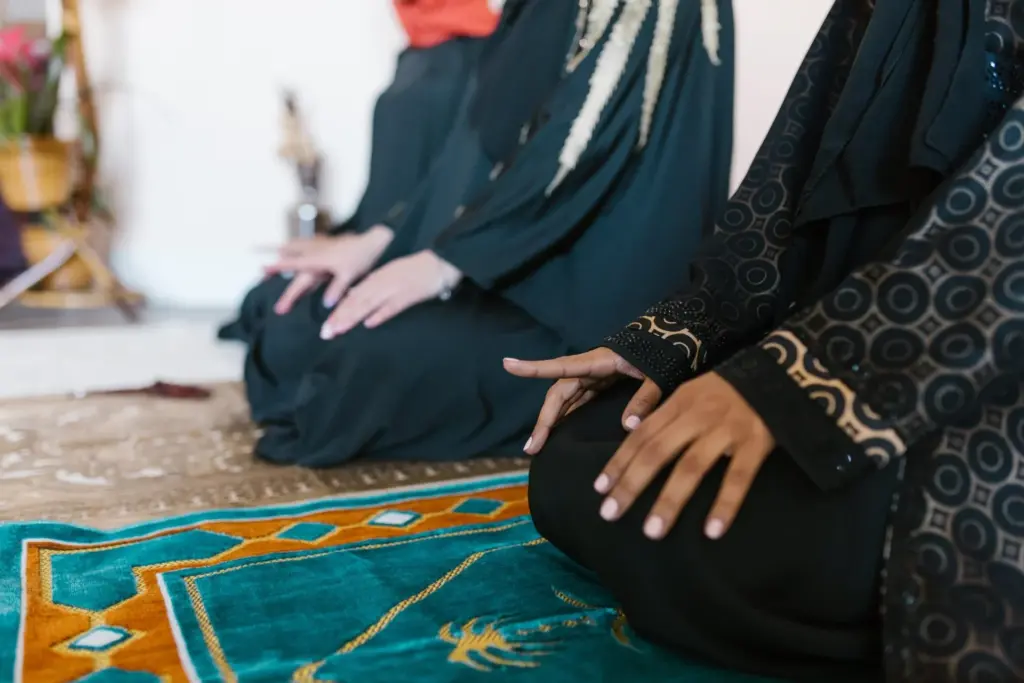
Inside the prayer hall, conventional pews or chairs are absent, replaced wall-to-wall by soft carpets or rugs. A limited number of chairs may be available at the back for elderly worshippers or those with mobility impairments. Separate entrances and segregated seating areas for men and women are standard, maintained either by separate rooms, different floor levels, or physical barriers dividing the hall. Families visiting with young children generally keep them close by, regardless of gender.
During communal prayers, worshippers stand, bow, prostrate, and sit in unison at precise intervals. Visitors are not required to participate in the physical movements and may simply observe quietly from the rear. Because Islamic prayer requires total concentration, worshippers will not converse or respond to visitors while praying, meaning any questions are best saved for before or after the service. Out of respect for those engaged in prayer, walking directly in front of someone is strictly avoided, which is why observers are typically guided toward the back of the hall.
Ultimately, a visit to a mosque offers a rich and enlightening window into a different culture and religious tradition. Organizers emphasize that the fear of making a mistake should never deter individuals from connecting with people of different backgrounds, as shared human commonalities often far outweigh differences. By approaching the experience with curiosity, respect, and adherence to basic etiquette, visitors can ensure a welcoming and mutually enriching encounter that underscores the core values of hospitality and inclusivity shared by mosque communities across the country.