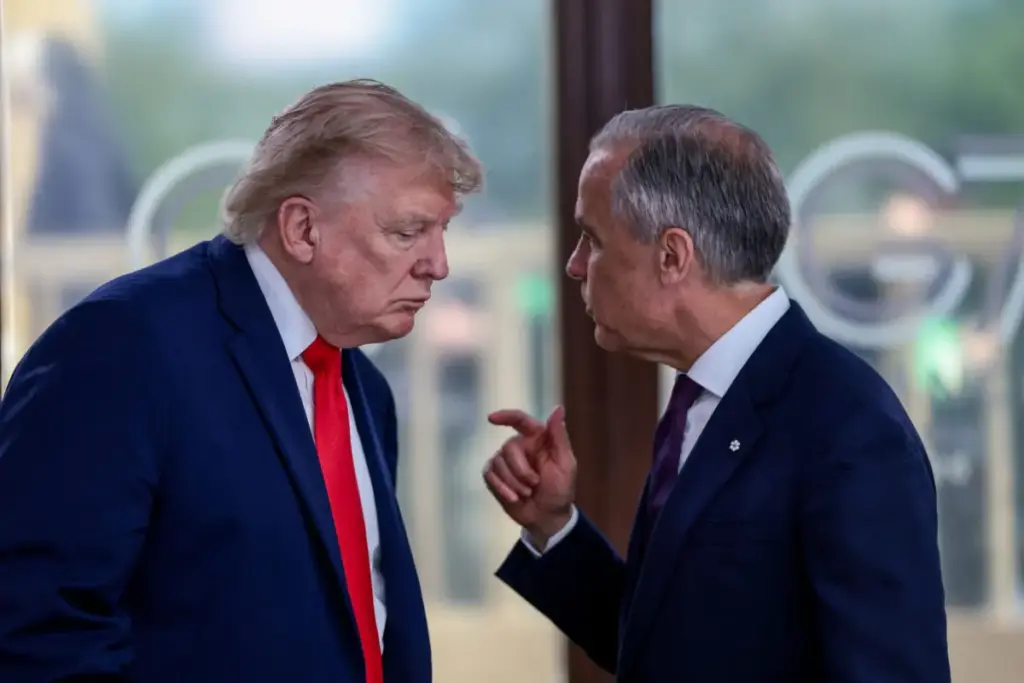
Canadian Prime Minister Mark Carney has revealed that his administration has examined the possibility of a United States military attack against Canada, characterizing the scenario as an “extreme tail risk”—an event carrying a very low probability but potentially catastrophic consequences.
In a wide-ranging interview with The New York Times, Carney defended the government’s forward-looking analytical approach to bilateral relations. “That’s just risk management,” said Carney, the former governor of the Bank of England. “It would be irresponsible not to.”
Geopolitical and international relations experts emphasize that Carney’s remarks do not signal an imminent armed conflict, nor do they suggest that Canada is actively preparing to fight a war with its southern neighbor. Rather, the comments underscore a shifting global landscape in which Canadian leadership is mapping out remote contingencies amid a rapidly deteriorating relationship with Washington.
The candid assessment brings to light a profound diplomatic and economic rift between two nations that have historically shared one of the closest and most stable alliances in the modern world. Today, however, that partnership faces unprecedented friction driven by a biting trade war, provocative rhetoric from the White House, and diverging security priorities across North America and the Arctic.
Why Are Relations Between Canada and the US Strained?
The current frostiness in Washington-Ottawa relations stems primarily from two major flashpoints: an ongoing, escalating trade war and frequent remarks from US President Donald Trump regarding Canada’s sovereignty, including suggestions that the country should become a US state.
Trade War
The economic friction escalated shortly after Trump returned to the White House in early 2025. Citing a failure to adequately curb the flow of fentanyl—a highly addictive and lethal synthetic opioid—into the United States, Trump imposed a sweeping 25 percent tariff on all goods imported from Canada and Mexico. While initial negotiations led to a temporary 30-day pause agreed upon by the North American leaders, the 25 percent duties were officially reimposed on Canada in early March 2025 after the White House declared that Ottawa had not done enough to secure the border against the drug trade.
Tensions flared again in July 2025 when the US administration threatened to hike the tariff rate to 35 percent unless Canada backed down on its proposed digital services tax. Ottawa ultimately agreed to drop the tax to avert the higher penalty.
Simultaneously, Canada—traditionally the largest foreign supplier of steel and aluminum to the United States—was heavily impacted by a separate set of 25 percent global tariffs on steel and aluminum that Trump enacted in March 2025.
Bilateral trade talks continued fitfully through the year before collapsing completely in August. Since then, both nations have locked horns in a cycle of retaliatory economic measures. Washington levied 50 percent tariffs on $20 billion worth of Canadian goods, prompting the Canadian government to match the move dollar-for-dollar with equivalent tariffs on American imports.
For Canada, the economic stakes are exceptionally high. The Canadian economy remains deeply integrated with the United States, rendering a sustained trade war uniquely damaging. In 2025 alone, approximately 72 percent of Canada’s $556 billion in goods exports were destined for the American market.
Security Threat and Geopolitical Realities
The economic dependence has been weaponized rhetorically by the US president. In 2025, Trump remarked publicly, “I think Canada would be much better off being a 51st state.” When formal trade negotiations broke down earlier this year, Trump took to his social media platform, Truth Social, to write: “Canada wants the benefits of being a State, without being one!!!”
In another provocative move, the US administration unilaterally renamed Lake Ontario—which forms part of the shared border between the two countries—to “Lake America.”
Faced with this hostile rhetoric and unpredictable policy shifts, Prime Minister Carney has pursued a deliberate strategy of reducing Canada’s economic and strategic reliance on the United States. His government initiated a comprehensive review of its planned acquisition of American-made F-35 fighter jets, and Carney has signaled that Canada intends to decrease its reliance on SpaceX’s Starlink satellite internet service for critical infrastructure.
As part of a broader diplomatic pivot, Carney traveled to Europe in September 2026 to cultivate alternative alliances. During his visit to the European Union and the United Kingdom, the EU formally offered Canada an associate membership proposal, while Ottawa formally applied to join the Joint Expeditionary Force (JEF), a UK-led European military coalition designed to rapid-response security challenges.
Ty Solomon, a professor of international relations at the University of Glasgow, noted in an interview with Al Jazeera that there are at least two distinct layers of tension driving the current crisis. The first is the overt hostility demonstrated by the Trump administration toward Canada, manifested through annexation remarks and punishing tariffs.
The second layer, according to Solomon, is a rapidly transforming global security environment. This environment includes past US threats to annex Greenland, alongside persistent Russian and Chinese military and commercial activity in the Arctic. Within this multifaceted geopolitical backdrop, Solomon observed that unexpected policy shifts or crises in one domain can easily trigger destabilizing cascading effects across others.
While acknowledging that direct US military action remains a vanishingly small possibility, Eric Taylor Woods, an associate professor of political communication at the University of Leeds, told Al Jazeera that the rhetoric from Washington has left ordinary Canadians deeply unsettled. Citizens, he noted, expect their prime minister to take proactive measures to defend the nation’s sovereignty.
Carney framed this new geopolitical reality during an address at the World Economic Forum in January, urging middle powers like Canada to band together as major global players increasingly wield their power in aggressive, unilateral ways.
“If we’re not at the table, we’re on the menu,” Carney warned at the time.
What Would Happen in a Military Conflict Between the US and Canada?
International security experts universally regard an actual military conflict between the United States and Canada as an extreme anomaly. Solomon described the prospect of a US military attack on Canada as remaining “somewhat unthinkable.”
Nevertheless, Woods pointed out that if such an unlikely scenario were to unfold, Canadians would not simply surrender their autonomy. “I would not expect Canadians simply to accept the loss of their sovereignty,” Woods said, despite the monumental disparity in military might between the two neighbors.
“The US has a vastly larger and more powerful military than Canada,” Solomon added. “On paper, then, there would appear to be no contest.”
However, analysts note that protracted foreign entanglements, such as the prolonged US military engagements in the Middle East, have historically challenged simplistic assumptions regarding overwhelming military force and clean strategic outcomes. Furthermore, Solomon emphasized that an armed conflict with Canada would represent an unmitigated disaster for broader American global interests.
“What remaining trust there is of the US would evaporate completely, and it would greatly accelerate other democracies’ efforts to forge new alliances outside of the American security and alliance system,” Solomon explained.
What Happens Next?
Diplomatic friction and economic uncertainty between Ottawa and Washington are expected to persist for the foreseeable future.
Despite the tension, Carney has maintained that his government remains open to securing a viable trade agreement with the US administration. In his interview with The New York Times, Carney revealed that he and Trump have spoken frequently since official trade talks broke down earlier in the year.
“We can pick up the phone and talk to each other about issues,” Carney said. “He’s direct. I’m direct.”
Woods observed that, unlike his frequent use of schoolyard personal insults and derogatory name-calling directed at Carney’s predecessor, Justin Trudeau, Trump has largely avoided similar personal attacks against the current prime minister.
At the same time, foreign policy analysts suggest that caution remains the baseline in Ottawa. Solomon noted that privately, Carney and his national security advisers likely harbor deep skepticism toward the Trump administration. Given Trump’s well-documented tendency to shift foreign policy positions rapidly and unpredictably, building lasting bilateral agreements remains an extraordinarily difficult task.
“As a leader, it is very difficult to trust this sort of behaviour because every agreement is built upon uncertain foundations,” Solomon said.