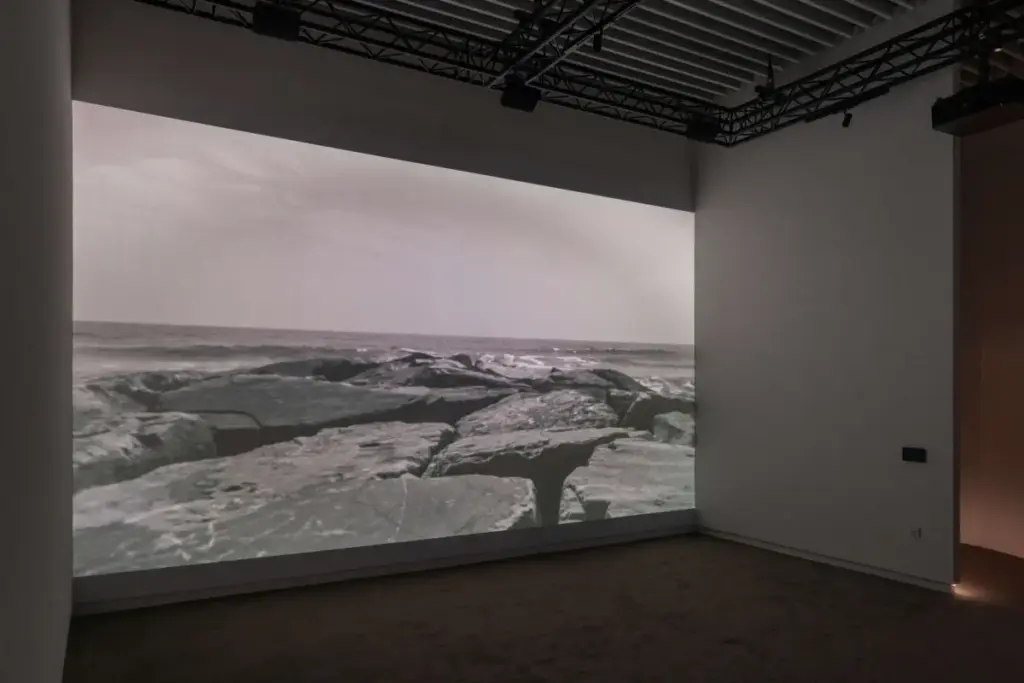
Renowned visual artist Carrie Mae Weems has unveiled The Long Goodbye, a powerful new film created for the New Work: Making East London season at the V&A East Museum. Exhibited in the Film Room of the Why We Make galleries, the ambitious multimedia project combines archival footage, music, dance, portraiture, and performance to examine how bodies of water have fundamentally shaped human history, facilitated transatlantic migration, and continue to influence communities in east London and beyond.
Through the new work, Weems investigates the ways in which immigrants—relocated across oceans either voluntarily or by force—forge new identities and artistic forms. By celebrating the cultural diversity that underpins contemporary global cities, the artist demonstrates how water and networks of migration serve as enduring catalysts for creativity, even in the face of fear and adversity.
In an extensive reflection on the project, Weems discusses the foundational questions of power, memory, and representation that drive her artistic practice, alongside the personal research, conversations, and engagement with the V&A East Youth Collective that informed The Long Goodbye.
Defining Artistic Practice and the Mechanics of Power
For decades, Weems has built a celebrated career working primarily with photography and video, occasionally expanding into performance and installation. Describing her medium-specific choices, she notes that installations allow her to work through complex ideas and concepts, while photography offers immediate and descriptive qualities. Video, meanwhile, grants her the ability to work with time, weaving together language, text, music, and imagery.
No matter the medium, Weems believes her work consistently returns to the same fundamental inquiries: who holds power, how power operates, and how privilege shapes the lives of those afforded very little. Managing and challenging power has remained a central fixture of both her life and her artistic output. Furthermore, she emphasizes the potency of voice as a tool to empower the disenfranchised and those made to feel they have lost everything.
Her approach to art-making is driven by necessity—both personal and creative—responding directly to a historical lack of visceral representation regarding the Black bodies, people, and ideas she valued. Early in her career, she recognized the damaging impact of cultural stereotypes on Black people and women, prompting her to find pathways toward a more comprehensive, complex, and nuanced visual vocabulary.
In developing her aesthetic, Weems points to profound early influences, most notably photographer Roy DeCarava and his seminal work The Sweet Flypaper of Life. She also cites the legacy of the Kamoinge Workshop—which included Beuford Smith, Frank Stewart, Shawn Walker, and Ming Smith—alongside the intellectual contributions of Alain Locke and Henry Louis Gates Jr., and the foundational documentary photography of Robert Frank and Dorothea Lange.
The Complex Realities of the V&A East Commission
Describing her commission for the V&A East Museum, Weems acknowledges the complexity and excitement of the project. At its core, her work grapples with the afterlife and ghosts of slavery, asking how humanity can be preserved and negotiated within those persistent shadows. Achieving this, she notes, requires an extraordinary level of compassion, love, and vulnerability.
The commission provided Weems with a unique lens through which to examine the transatlantic experience. By questioning what it means to cross vast oceans and arrive in territories of empire—whether in Britain, the United States, or Europe—she confronts the reality of troubled waters. Yet, her focus remains equally fixed on what springs forth from those difficulties: an extraordinary degree of ingenuity, resilience, and possibility. Using cultural languages not originally intended for them, Black and brown populations have developed entirely new modes of communication through music, dance, film, and photography, restaging themselves with hope for the future.
The project with V&A East has opened new doors for the artist, allowing her to explore the nuances of migration and water in a subtle yet impactful manner that she anticipates will shape her future body of work.

Migration, Leaving Home, and the Immigrant Experience
The foundational starting point for The Long Goodbye was the concept of migration—what it means to leave home, seek a new environment, and rebuild life from the ground up. Drawing from her own experiences of leaving family and familiar surroundings, Weems uses herself as a barometer for understanding the intensity of moving abroad and establishing a path in an unfamiliar country.
Her research extended to everyday conversations with immigrants encountered in daily life, such as taxi drivers hailing from Africa, India, Bangladesh, and Peru. Listening to their accounts of working long hours while separated from families for years emphasized that the immigrant experience cannot be separated from love and deep desperation.
Confronting these realities requires artists to illuminate the subjects people most fear or feel ashamed of, aligning with James Baldwin’s vision of the artist’s role in society. Weems stresses that discussing love in this context is not about romance, but about a profound and ongoing struggle toward a shared human awareness.
Research, Collaboration, and Community Healing
The development of the project evolved over a year of sustained research, reading, and dialogue. Initial ideas involving physical stagings of suitcases, boxes, books, and globes eventually gave way to more focused explorations of correspondence, voicemail, and the historical letters sent by migrants back home.
Crucial to the research phase were meetings with the V&A East Youth Collective. Hearing the students’ perspectives and viewing their photographs broadened Weems’s understanding of migration, bringing historical and contemporary waves of movement—including Irish, Ukrainian, and Polish migration to the UK—into sharper focus.
Weems was also deeply moved by the Polar Bear Club, a group of primarily Black individuals who gather every summer morning to bathe, heal, and sing traditional spirituals like Wading in the Water and Jacob’s Ladder. Witnessing this daily act of community remembrance and collective healing provided profound insight into how groups process shared histories and look toward the future.
Connecting East London to a Global Diaspora
Reflecting on her time in London, Weems recognized that her perspective was that of an outsider, leading her to focus on her specific intersection with East London rather than attempting to speak for the city as a whole. She observed that the conditions faced by people in East London share striking echoes with other marginalized urban centers across the global diaspora, such as East Harlem, East Los Angeles, and East St. Louis.
These shared conditions become particularly visible within the current political climate in the West. Weems notes that established structures of white privilege and male power are currently undergoing intense disruption, leading to volatile backlashes and state-level restrictions against marginalized groups and migrants in both the UK and the United States. Despite these challenges, she views this period as a critical moment for imagination and resilience.
Looking ahead, Weems intends to continue investigating the history of UK migration, pointing to the millions of workers who arrived following the Second World War to help rebuild the nation. She argues that modern reluctance to acknowledge or fully welcome these communities overlooks the profound debt of gratitude the country owes to the families who sacrificed for its endurance.
Ultimately, Weems hopes that viewers encountering The Long Goodbye will re-examine their relationship to the diverse populations that form the cultural fabric of modern Britain. Drawing on her own philosophical definition of love—defined not as an abstraction, but as an illuminating encounter that allows individuals to see the full breadth and complexity of who they are—she intends for her work to offer audiences a clearer mirror of their shared humanity in the world today.