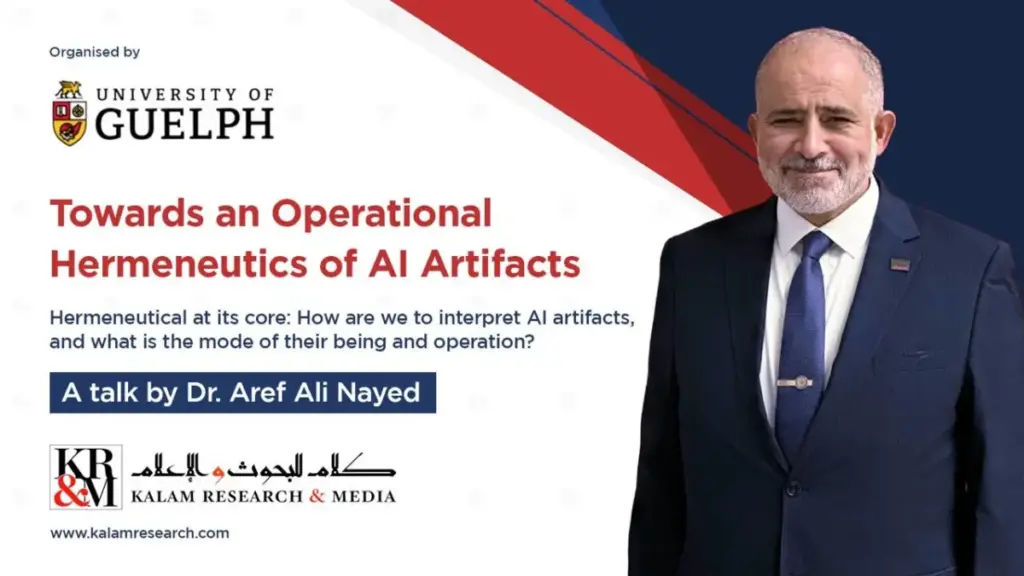
Dr. Aref Ali Nayed, Chairman of Kalam Research & Media (KRM), recently delivered a distinguished lecture at the University of Guelph, offering profound insights into the complex intersection of hermeneutics, artificial intelligence, and the ethical governance of emerging technologies. The academic gathering served as both a forward-looking examination of modern machine intelligence and a historical homecoming for Dr. Nayed, whose intellectual journey with operational hermeneutics began on the very same campus decades ago.
About the Lecture
The comprehensive presentation examined how Operational Hermeneutics—a pioneering theoretical framework developed by Dr. Nayed during the 1990s during his time at the University of Guelph—provides essential analytical tools for understanding and ethically engaging with AI-generated artifacts. As artificial intelligence systems rapidly evolve from simple computational tools into sophisticated agents of communication, Dr. Nayed discussed how these systems function as operational artifacts that actively interpret data, generate meaning, and shape human understanding.
Rather than viewing artificial intelligence merely through the lens of technical performance or data processing efficiency, the lecture emphasized the necessity of interpreting machine outputs through a hermeneutical lens. This perspective allows researchers, policymakers, and technologists to better comprehend the underlying processes through which artificial systems construct narratives, synthesize information, and influence public discourse. By applying operational hermeneutics to contemporary AI, scholars can better evaluate the societal implications of human-machine interaction and establish robust safeguards against unintended interpretive biases.
Watch the Full Lecture
For those interested in exploring the depth of Dr. Nayed’s analysis, the complete lecture has been made publicly available through the integrated video player below, offering viewers an opportunity to engage directly with the foundational arguments presented at the University of Guelph.
Related Initiatives
This high-profile academic lecture formed a central component of Dr. Nayed’s broader engagement with the Centre for Advancing Responsible and Ethical Artificial Intelligence (CARE-AI) at the University of Guelph. The visit served to significantly strengthen the ongoing collaboration between Kalam Research & Media and leading Canadian AI research institutions that are dedicated to formulating rigorous ethical frameworks for the development and deployment of artificial intelligence systems.
Through these institutional partnerships, researchers aim to bridge the gap between abstract philosophical inquiry and practical technological governance, ensuring that emerging innovations align with human values and societal well-being. Those wishing to learn more about the specifics of this institutional engagement can read more about Dr. Nayed’s visit to CARE-AI.
Further Reading
To complement the themes addressed during his University of Guelph presentation, Dr. Nayed has recently published a comprehensive academic monograph that expands extensively upon the core principles of his research.
Titled “Towards an Operational Hermeneutics of AI Artifacts,” the publication examines the ways in which artificial intelligence-generated outputs operate as complex cultural and linguistic artifacts that demand sophisticated hermeneutical engagement. The paper proposes innovative theoretical frameworks for interpreting machine-generated content while confronting the profound ethical dimensions inherent in contemporary human-AI interaction. Academics, researchers, and technology ethicists can access the full monograph online.
About the University of Guelph Partnership
The University of Guelph holds a uniquely profound significance within Dr. Nayed’s broader intellectual biography. It was precisely on this Canadian campus during the 1990s that he originally formulated the foundational concepts of Operational Hermeneutics during his doctoral research endeavors. His return to the university represents a true homecoming of ideas, bringing decades of theoretical refinement, academic exploration, and international application back to their birthplace. Today, these early academic insights find themselves uniquely adapted to meet the unprecedented challenges posed by modern artificial intelligence ethics.
Furthermore, KRM’s enduring partnership with the University of Guelph and CARE-AI is part of a much larger, interconnected network of strategic collaborations with premier Canadian AI institutions. These include prominent research centers such as the Vector Institute for Artificial Intelligence and the Canadian Institute for Advanced Research (CIFAR), reflecting a concerted international effort to advance responsible technology development.
KRM’s Artificial Understanding Research
In stark contrast to conventional artificial intelligence research methodologies that remain almost exclusively focused on raw machine performance, computational speed, and data throughput, Kalam Research & Media has charted a distinctive intellectual course. KRM has pioneered dedicated research into Artificial Understanding (AU)—an innovative approach that dares to ask fundamental, foundational questions regarding comprehension, meaning-making, and deep interpretation within artificial systems.
The broader AU research program, deeply rooted in the traditions of Operational Hermeneutics, pursues several vital objectives aimed at reshaping how humanity conceptualizes machine intelligence. By prioritizing true comprehension over mere algorithmic simulation, KRM’s research initiative seeks to establish new standards for how intelligent systems process and reflect human knowledge. Individuals interested in diving deeper into this paradigm can learn more about KRM’s Artificial Understanding program.