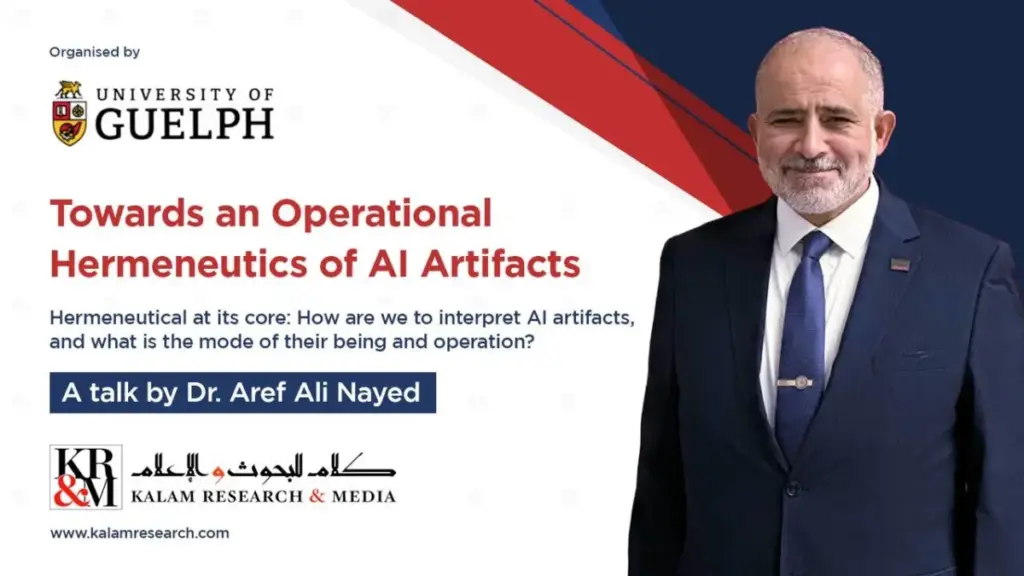
GUELPH, ONTARIO — In a poignant intellectual homecoming, Dr. Aref Ali Nayed, Chairman of Kalam Research & Media (KRM), recently returned to the University of Guelph to deliver a keynote lecture exploring the profound intersection of hermeneutics, artificial intelligence, and the ethical governance of emerging technologies. The event served as a major platform for examining how decades-old philosophical frameworks can illuminate and guide contemporary debates surrounding machine intelligence, automated decision-making, and the nature of human understanding.
The presentation focused heavily on Operational Hermeneutics, a robust theoretical framework originally formulated by Dr. Nayed during his doctoral research at the University of Guelph in the 1990s. Decades later, Dr. Nayed’s foundational concepts have found renewed relevance in the age of generative artificial intelligence and autonomous systems. Addressing an audience of academics, researchers, and students, Dr. Nayed discussed how modern AI systems function far beyond simple computational tools, operating instead as complex operational artifacts that actively interpret inputs, generate meaning, and profoundly shape human understanding.
A Homecoming of Ideas
For the University of Guelph, Dr. Nayed’s visit represented a significant milestone in ongoing academic exchanges. The institution holds a unique place in Dr. Nayed’s intellectual journey, serving as the crucible where the core tenets of Operational Hermeneutics were first forged. Returning to the campus allowed Dr. Nayed to bring decades of professional and academic refinement back to their birthplace, translating vintage philosophical insights into contemporary solutions for modern technological challenges.
This visit was hosted as part of Dr. Nayed’s broader engagement with the Centre for Advancing Responsible and Ethical Artificial Intelligence (CARE-AI) at the University of Guelph. The collaboration underscores a growing recognition among Canadian and international institutions that technical innovation in artificial intelligence must be matched by equally rigorous ethical, philosophical, and interpretive frameworks. The visit further solidified ongoing partnerships between Kalam Research & Media and Canadian AI research institutions, paving the way for joint efforts in establishing responsible governance models for emerging technologies.
Expanding the Horizons of Artificial Understanding
A central theme of the lecture and KRM’s broader research agenda is the distinction between conventional machine performance and what KRM terms "Artificial Understanding" (AU). While the broader tech industry frequently prioritizes processing speed, predictive accuracy, and generative output volume, KRM has pioneered research that asks fundamental questions about comprehension, meaning, and interpretation within artificial systems.
Grounded firmly in the principles of Operational Hermeneutics, the AU research program seeks to move beyond surface-level metrics of utility. It addresses the fundamental philosophical dilemmas posed by machine-generated artifacts, asking how humans can authentically interpret, audit, and govern outputs generated by non-conscious systems that simulate human reasoning. This distinctive approach aims to establish comprehensive frameworks for interpreting machine-generated content, thereby ensuring that human agency and ethical accountability remain at the center of the technological ecosystem.
This academic trajectory is further detailed in a recently published comprehensive monograph by Dr. Nayed titled "Towards an Operational Hermeneutics of AI Artifacts." The paper expands extensively upon the themes addressed during the Guelph lecture, examining how AI-generated outputs must be understood as operational artifacts that demand active hermeneutical engagement. By proposing novel methodologies for interpreting machine-generated content, the publication addresses the intricate ethical dimensions of human-AI interaction and offers actionable pathways for developers, policymakers, and ethicists alike.
Broadening Canadian and International Collaborations
The partnership between Kalam Research & Media and the University of Guelph is not an isolated initiative, but rather part of a broader, deliberate network of collaborations linking KRM with leading Canadian AI research institutions. These include prominent centers of excellence such as the Vector Institute for Artificial Intelligence and the Canadian Institute for Advanced Research (CIFAR). By engaging with these premier institutions, KRM continues to foster cross-disciplinary dialogues that bridge the gap between hard technological development and the humanities.
As artificial intelligence systems become increasingly embedded in daily life, the demand for sophisticated governance models has never been more urgent. Through lectures, academic publications, and institutional partnerships, Dr. Aref Ali Nayed and Kalam Research & Media continue to advocate for an approach to technology that prioritizes deep comprehension over mere capability, ensuring that human values continue to guide the evolution of digital intelligence.