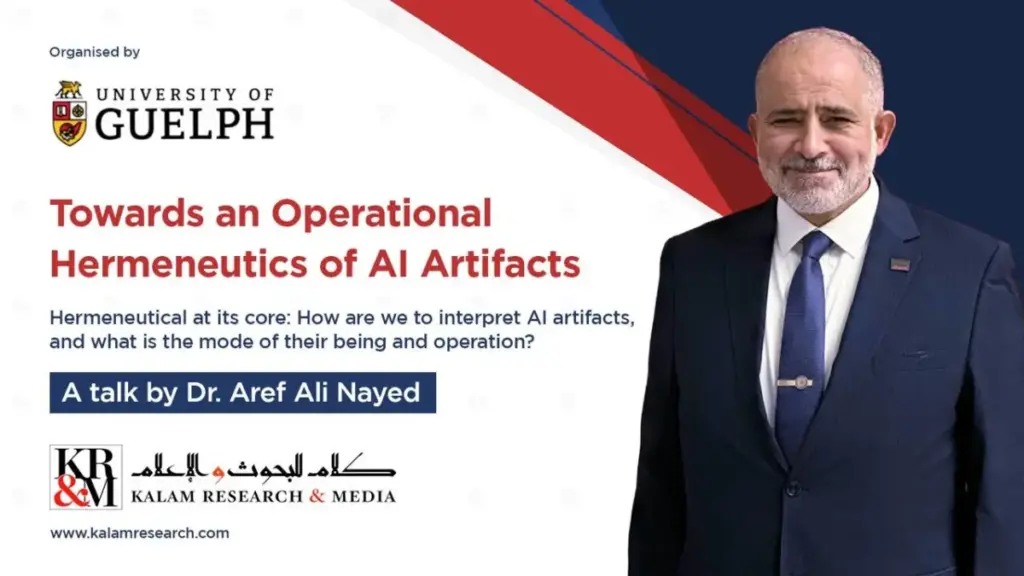
Dr. Aref Ali Nayed, Chairman of Kalam Research & Media (KRM), recently returned to the University of Guelph to deliver a comprehensive and thought-provoking academic lecture exploring the complex and rapidly evolving intersection of hermeneutics, artificial intelligence, and the ethical governance of emerging technologies. The event marked a significant intellectual homecoming for Dr. Nayed, who originally formulated the foundational concepts of Operational Hermeneutics during his doctoral research at the Canadian institution back in the 1990s.
The presentation brought decades of academic refinement back to its birthplace, applying these established philosophical frameworks to contemporary, pressing challenges in artificial intelligence and machine ethics. By bridging historical philosophical inquiry with modern technological realities, Dr. Nayed offered academics, researchers, and technology ethicists a fresh perspective on how society can better understand, interpret, and govern increasingly autonomous digital systems.
About the Lecture
During his presentation at the University of Guelph, Dr. Nayed examined how Operational Hermeneutics—the specialized framework he developed decades prior—provides essential intellectual tools for understanding and ethically engaging with AI-generated artifacts. As artificial intelligence becomes deeply embedded in daily life, the lecture addressed how modern AI systems function far beyond simple data processors, operating instead as operational artifacts that actively interpret information, generate meaning, and shape human understanding.
The lecture tackled some of the most critical questions facing contemporary technology developers and policymakers. Rather than focusing solely on the computational performance or raw efficiency of machine learning models, Dr. Nayed’s presentation delved into the deeper interpretive layers of machine outputs. He discussed how AI-generated artifacts require a sophisticated hermeneutical approach to ensure that human society remains capable of critically evaluating, contextualizing, and governing the profound cultural and cognitive shifts driven by automation.
Watch the Full Lecture
For those unable to attend the event in person, the complete recording of Dr. Aref Ali Nayed’s lecture at the University of Guelph has been made publicly available, offering viewers a detailed look at his comprehensive framework on Operational Hermeneutics and AI governance.
[YouTube video player embedded showcasing the complete lecture delivered by Dr. Aref Ali Nayed at the University of Guelph.]
Related Initiatives and Institutional Collaboration
This high-profile lecture formed a central component of Dr. Nayed’s broader engagement with the Centre for Advancing Responsible and Ethical Artificial Intelligence (CARE-AI) at the University of Guelph. The visit served to strengthen ongoing, robust collaborations between Kalam Research & Media and leading Canadian AI research institutions that are actively dedicated to developing rigorous ethical frameworks for the deployment of artificial intelligence.
By engaging directly with CARE-AI researchers, Dr. Nayed’s visit fostered an environment of cross-disciplinary dialogue, uniting philosophical hermeneutics with cutting-edge technical research. This partnership highlights the vital need for humanities-based perspectives in shaping the future trajectory of computer science and machine learning development.
Further Reading
Expanding extensively upon the themes addressed during his University of Guelph presentation, Dr. Nayed has recently published a comprehensive academic monograph titled “Towards an Operational Hermeneutics of AI Artifacts.”
The newly released paper examines in rigorous detail how machine-generated outputs must be understood as operational artifacts that demand active hermeneutical engagement from human users and creators. Furthermore, the monograph proposes innovative frameworks specifically designed for interpreting complex machine-generated content while directly addressing the intricate ethical dimensions inherent in modern human-AI interaction. Scholars, researchers, and technology ethicists can access the full publication through the Kalam Research & Media platform to explore these concepts in greater depth.
About the University of Guelph Partnership
The University of Guelph holds profound significance within Dr. Nayed’s broader intellectual journey. It was within the halls of this institution during the 1990s that he first conceptualized and articulated the foundational tenets of Operational Hermeneutics. His recent return to the campus represents a powerful homecoming of ideas, successfully bringing decades of academic refinement back to the exact environment where the theory was born, now adapted to address the unprecedented ethical challenges of the digital age.
This academic engagement is part of a much wider network of strategic partnerships cultivated by Kalam Research & Media. KRM’s ongoing cooperative efforts with the University of Guelph and CARE-AI align seamlessly with broader collaborations involving leading Canadian artificial intelligence hubs, including the Vector Institute for Artificial Intelligence and the Canadian Institute for Advanced Research (CIFAR). These alliances underscore a shared commitment to ensuring that technological innovation advances hand-in-hand with deep ethical reflection and responsible governance.
KRM’s Artificial Understanding Research
While conventional research and development initiatives within the tech industry frequently prioritize raw computational power, algorithmic speed, and machine performance, Kalam Research & Media has charted a distinctly different course. KRM has pioneered dedicated research into Artificial Understanding (AU)—a specialized, visionary approach that poses fundamental, probing questions regarding comprehension, meaning, interpretation, and truth within artificial systems.
Grounded firmly in the principles of Operational Hermeneutics, KRM’s overarching Artificial Understanding research program seeks to transcend the limitations of mere data processing. By investigating how artificial systems handle meaning and how human users interpret machine-generated realities, the program aims to establish a much deeper, more philosophically sound foundation for the future of human-technology relations. Through continuous academic inquiry, institutional partnerships, and public engagement, Kalam Research & Media remains at the forefront of shaping an ethically grounded, intellectually rigorous approach to the age of artificial intelligence.