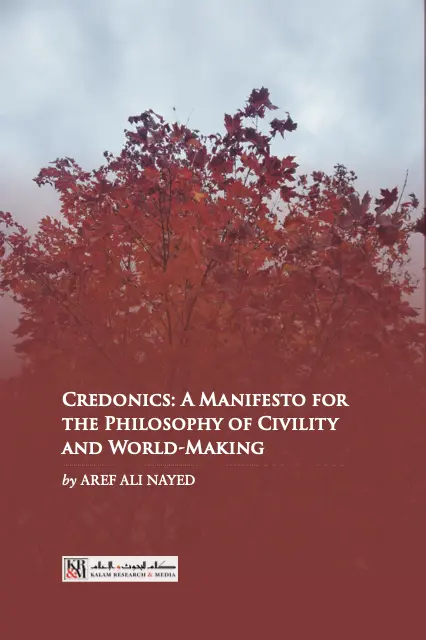
November 6, 2025 — In a significant development for contemporary philosophy and cultural studies, Dr. Nayed has formally introduced Credonics, a groundbreaking philosophical discipline designed to move beyond the perceived shortcomings of traditional memetics and offer a more robust study of how civilizations transmit meaning and culture across generations. Spanning 43 pages in a newly released monograph, the framework proposes an entirely fresh approach to understanding the deep-seated structures that govern human societies, offering profound implications for fields as diverse as artificial intelligence ethics, educational reform, and international diplomacy.
The release of the monograph comes at a time when scholars, technologists, and policymakers are increasingly grappling with the complexities of global communication, cultural friction, and the ethical alignment of rapidly advancing technologies. By challenging established paradigms of cultural transmission, Dr. Nayed’s work seeks to provide a more comprehensive lens through which to examine the foundational beliefs that shape human behavior and institutional design on a global scale.
What is Credonics?
At the core of the newly proposed discipline is the systematic study of credos—defined as intricate clusters of presuppositions, assumptions, and lived commitments that function essentially as the cultural DNA of civilizations. While previous models have often struggled to capture the depth and continuity of human traditions, Credonics treats these credos as the primary driving forces behind how societies make sense of reality, create enduring meaning, build complex narratives, and ultimately construct the physical and institutional worlds they inhabit.
Rather than viewing culture as a superficial collection of fleeting ideas or isolated traits, the framework posits that human societies are anchored by deeply ingrained systems of thought and practice. These foundational layers dictate not only how individuals interpret their immediate surroundings, but also how collective identities are formed, sustained, and adapted over time in response to historical and technological changes.
The Fourfold of Making
To operationalize this theoretical approach, the discipline outlines what is described as the Fourfold of Making, a comprehensive categorization of the processes through which human societies engage with their reality. The first component, sense-making, focuses on how societies organize raw human perception into coherent patterns. The second, meaning-making, addresses the integration of human experience into a broader, comprehensible framework of value and purpose.
Building upon these perceptual and experiential foundations, the third component, narrative-making, involves the temporal articulation of a culture’s history, aspirations, and identity across generations. Finally, world-making encompasses the tangible realization of these abstract processes, resulting in the construction of enduring social institutions, cultural artifacts, and physical environments. Together, these four dimensions provide a holistic view of civilizational development, linking abstract philosophy directly to concrete social realities.
Civility as Ethical Regulation
An essential pillar of the new discipline is its reconceptualization of civility, moving it far beyond conventional notions of mere politeness or superficial social decorum. Instead, civility is framed as a rigorous discipline of interpretive coexistence—an ethical framework that allows multiple, and often competing, credos to interact within the same societal space without the risk of mutual erasure or violent subjugation.
In an increasingly interconnected yet deeply divided world, this perspective on civility offers a vital theoretical tool for managing pluralism. By recognizing the legitimacy of diverse foundational assumptions, the discipline encourages an environment where varied cultural and philosophical traditions can engage in constructive friction rather than destructive conflict, paving the way for more resilient and inclusive global societies.
Major Contributions to Philosophy and Applied Ethics
The 43-page monograph makes several major contributions to contemporary academic and practical discourse. First, it offers a direct critique of memetics, arguing that traditional meme-based theories are ultimately too superficial to capture the profound depth of human meaning-making and civilizational transmission. Second, it extends the foundational presuppositional analysis pioneered by R.G. Collingwood, updating it to meet the complexities of the twenty-first century.
Furthermore, the work successfully unites classical hermeneutics with modern cultural inheritance theory, bridging a long-standing gap between the interpretation of texts and the sociological study of tradition. Beyond academic theory, the framework proposes the concept of credonic governance as a novel solution for contemporary AI ethics, suggesting that machine learning systems and autonomous technologies must be designed with an awareness of the deep cultural presuppositions they operate within and influence. Finally, it offers a versatile framework that can be directly applied to modern education, international diplomacy, and interfaith dialogue.
Applications Across Diverse Fields
The practical utility of the monograph extends across multiple high-stakes domains. In the realm of artificial intelligence ethics and design, the framework provides a method for addressing the cultural biases and presuppositions embedded within algorithmic systems, helping developers create more ethically aligned technologies. Educational reform stands to benefit significantly as well, as educators look for ways to teach students how
to navigate complex cultural landscapes and understand the historical roots of their own worldviews.
In the political sphere, the discipline offers fresh perspectives on political pluralism, suggesting new ways to foster social cohesion in multicultural societies without resorting to forced assimilation or falling into cultural fragmentation. Civilizational renewal is another key area of application, as communities seek to revitalize their heritage while remaining open to global exchange. Lastly, interfaith and intercultural dialogue can draw upon the framework to move beyond superficial exchanges of ideas, enabling deeper discussions regarding the fundamental presuppositions that shape different religious and philosophical traditions.
For those interested in exploring the complete theoretical arguments, methodologies, and detailed applications outlined in the new publication, the full monograph can be downloaded and viewed directly by visiting the Kalam Research publication archive.