earthing the Macabre: V&A East Storehouse Highlights Terrifying Treasures from the National Art Library
Although the official celebrations of Halloween may have drawn to a close, the spirit of the spooky season remains very much alive within the archives of the cultural sector. Embracing this enduring fascination with the eerie and the unexplained, curators are currently casting a spotlight on a selection of terrifying treasures held safely within the collections of the National Art Library, located at the newly established V&A East Storehouse.
With an estimated 300,000 library books housed within the Storehouse—spanning diverse subjects such as theatre and performance, local history, British topography, and historic children’s literature—there is certainly no shortage of unusual and captivating publications available for public and academic study.
The seven unique titles recently highlighted by the institution represent just a fraction of these frightful favorites, all of which are made accessible for viewing by appointment within the Storehouse Study Centre. From Victorian guides to historic graveyards and 19th-century optical toy books designed to debunk spiritualism, these selections offer a fascinating glimpse into how artists, writers, and thinkers across the centuries have grappled with mortality, ghosts, and the macabre.
Harrap’s Guide to Famous London Ghouls and Graves by Conrad Bailey (1975)
It stands to reason that a metropolis as ancient and expansive as London would accumulate a rich and diverse history of burial grounds and high-profile funerals over the centuries. Conrad Bailey’s 1975 publication, Harrap’s guide to famous London graves, highlights some of the most notable resting places scattered across the City of London and its surrounding boroughs.
The volume maps out the final resting places of historical figures ranging from kings and queens to pickpockets and celebrated artists. It explores London’s "magnificent seven"—the expansive garden cemeteries constructed by Victorians during the 19th century to alleviate dangerous overcrowding and unsanitary conditions in historic inner-city churchyards—alongside much older medieval churchyards.
Among the illustrious names cataloged in its pages are luminaries such as Karl Marx, William Blake, George Eliot, and Henry Cole, a founding figure of the Victoria and Albert Museum. The publication serves as a literary reminder of the rich history embedded beneath the capital’s soil, offering readers a unique lens through which to view London’s architectural and social past.
Sarah Bernhardt: Cuttings Albums Relating to Her Death and Funeral (1923)
Few historical figures were as intimately acquainted with theatrical representations of mortality as the legendary French stage actress Sarah Bernhardt. As a celebrated tragedienne of the late 19th and early 20th centuries, Bernhardt was accustomed to dying dramatically in front of audiences night after night. However, her fascination with death extended far beyond the footlights; she famously kept a satin-lined coffin in her bedroom, occasionally sleeping in it, reclining within it while preparing for roles, and posing for photographs inside it to cultivate her signature dramatic public persona.
When Bernhardt passed away in 1923 at the age of 78, her death prompted an immense public outpouring. An estimated crowd of 30,000 mourners attended her funeral procession, accompanying her casket across Paris to Père Lachaise Cemetery while making a symbolic ceremonial stop at the Sarah Bernhardt Theatre along the route.
The National Art Library holds a two-volume scrapbook compiled by an unknown admirer, containing a comprehensive collection of period obituaries and journalistic clippings documenting her remarkable life, career, and elaborate funeral. The extensive coverage details extravagant floral tributes, black plumed horses pulling her funeral cortege, and the massive entourage of grieving fans who turned out to bid her farewell.
Emblems of Mortality by John Bewick After Hans Holbein (1795)
For researchers interested in the artistic traditions surrounding death, a pocket-sized volume titled Emblems of mortality: representing, in upwards of fifty cuts, death seizing all ranks and degrees of people offers a striking window into the past. The book is densely populated with skeletal illustrations that directly reproduce Hans Holbein’s renowned woodcut series The Dance of Death, which was first published in 1538.
The Dance of Death, or Danse Macabre, was a widely popular allegorical artistic genre during the late Middle Ages. In these works, a personified figure of Death, typically depicted as a skeleton, invites representatives from every tier of society—from powerful monarchs and popes to humble peasants and children—to join in a dance leading directly to the grave. These artistic representations were produced as memento mori, serving as stark reminders to the reader of their own inevitable mortality and the egalitarian nature of death, which makes no distinction based on social standing.
The 1795 pocket edition features wood engravings executed by John Bewick, an 18th-century engraver. John was the younger brother of Thomas Bewick, a celebrated pioneer of wood engraving whose fine lines and naturalistic animal prints in works such as A History of British Birds earned him widespread acclaim. John Bewick originally apprenticed under his brother before forging an independent career that focused heavily on illustrating children’s literature. Tragically, John passed away at the age of 35, before he could fully establish his own independent artistic reputation.
The Fakenham Ghost: A True Tale by Robert Bloomfield (1806)
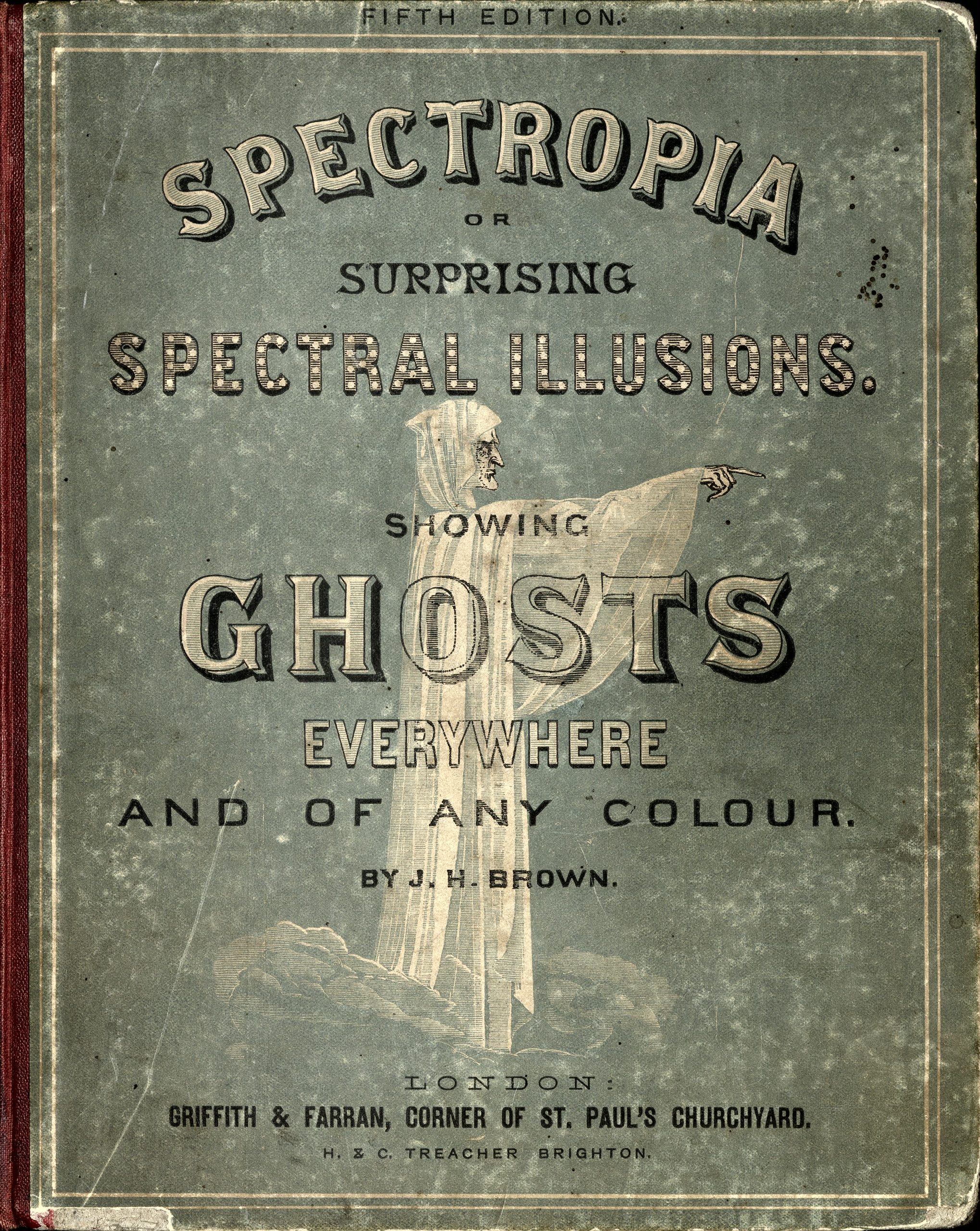
The psychological impact of darkness and imagination is central to Robert Bloomfield’s poem The Fakenham ghost, which tells an eerie tale of a traveler walking home at night through the Norfolk countryside while being followed by an unseen, potentially threatening presence. Originally published within Bloomfield’s 1802 poetry collection Rural Tales, the work was subsequently issued as a standalone children’s book in 1806 by William Darton, a publisher who specialized in literature for young readers.
Despite its initial suspense and spooky premise, Bloomfield’s poem skillfully balances tension with subtle humor. The unsigned illustrations accompanying the text mirror this tonal balance through an intricate interplay of darkness and light, quietly dropping hints early on as to the true identity of the mysterious pursuer—who turns out to be a harmless small donkey.
Robert Bloomfield himself was a self-taught poet and working cobbler from Suffolk whose evocative verses celebrating rural life received considerable critical praise during his lifetime.
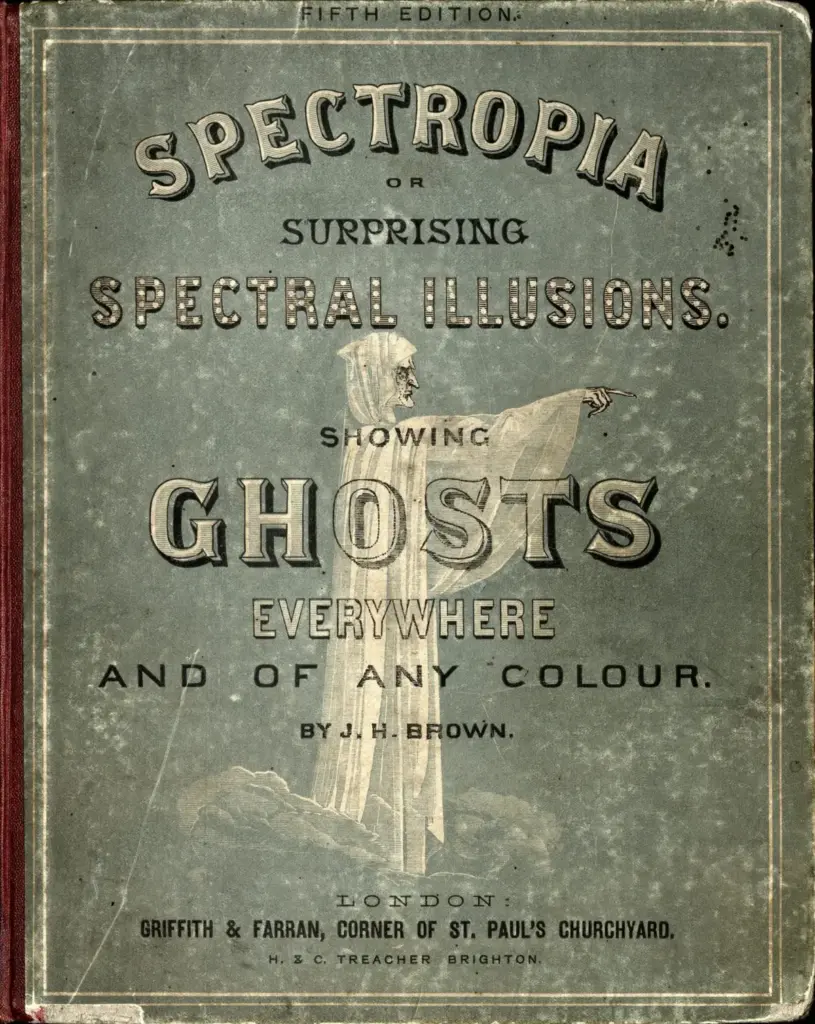
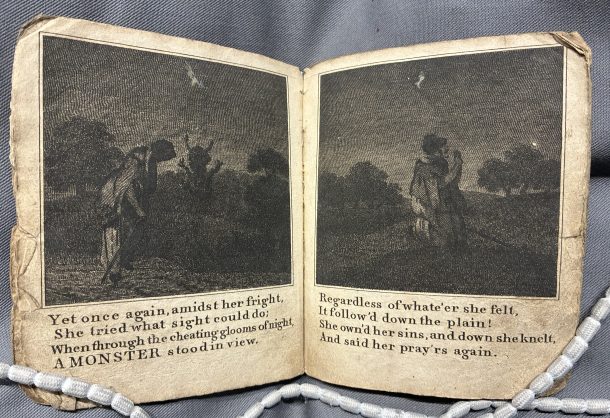
Spectropia, or Surprising Spectral Illusions by J. H. Brown (1864)
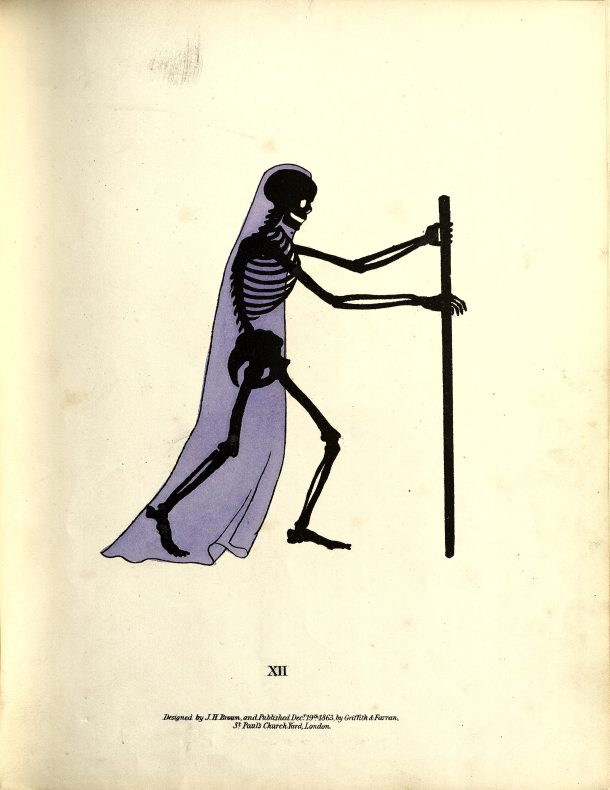
The 19th century witnessed a significant cultural surge in Spiritualism, driven by the widespread belief that the living could actively communicate with the dead, typically through the mediation of seances and spiritual mediums. J. H. Brown, the author of Spectropia, or, Surprising spectral illusions: showing ghosts everywhere, and of any colour, took a decidedly skeptical view of these practices, publishing his work in 1864 with the explicit intention of proving that ghost sightings were entirely explicable as optical illusions.
Following an introduction that strongly condemns the "absurd follies" of Spiritualism, the book features 16 lithographed plates, 13 of which are hand-coloured, specifically engineered to produce vivid afterimage illusions. Readers were instructed to stare fixedly at a marked point on an illustration for roughly 20 seconds under a strong light source. When the viewer subsequently shifted their gaze to a blank wall or ceiling, the "ghost" would momentarily materialize in inverted colors due to the biological afterimage effect, a physiological phenomenon where an image persists on the retina after the original light stimulus has ceased.
By providing a scientific framework grounded in the properties of light, optics, and human ocular anatomy, Brown hoped to contribute to "the extinction of the superstitious belief that apparitions are actual spirits." Nevertheless, the publication was frequently marketed as a novelty toy book or parlor game for children. Today, copies reside safely within the Children’s Books collection at the National Art Library, leaving modern readers to ponder whether historical visions of the supernatural were genuinely paranormal or merely a trick of the eye.
The Haunted Library: A Novocastrian Reminiscence by John F. Layson (1880)
Libraries have long been poetically described as houses of ghosts, given that the voices of historical writers and thinkers are preserved and resurrected each time a book is retrieved from a shelf. This metaphorical conceit forms the foundation of John F. Layson’s 1880 verse narrative, The haunted library : a Novocastrian reminiscence, published by the Tyne Publishing Company.
Set within the shadowy stacks and hallowed halls of Newcastle’s City Library, the story follows a perplexed doctor who unexpectedly stumbles upon a ghostly assembly of some of the most celebrated figures in literary history. Accompanied by eerie, enigmatic line-block illustrations, the narrative depicts literary giants such as Chaucer and Shakespeare engaging in an otherworldly discussion concerning the evolution of literature and the enduring cultural power of libraries.
Adding a layer of archival intrigue, the National Art Library’s copy includes a tipped-in piece of correspondence from W. J. Haggerston, the Chief Librarian at Newcastle Library. Dated December 28, 1880, and addressed simply to a "Dear Doctor," the letter playfully blurs the boundary between fiction and reality, raising the lingering question of whether Layson’s spectral tale might have been rooted in actual local events.
Haunted House by Jan Pienkowski (1971)
Moving from haunted public archives to domestic terrors, Jan Pienkowski’s Haunted House represents a masterclass in paper engineering and mechanical book design. First published in 1971, the moveable book utilizes layered illustrations and complex mechanical folds to guide readers through a multi-dimensional environment populated by dynamic pop-up horrors.
Haunted House stands as one of the best-selling moveable books in publishing history, earning its creator his second prestigious Greenaway Medal in 1979. The traditional pop-up mechanics are combined with Pienkowski’s distinctive artistic style, resulting in a tactile and immersive reading experience. Although Pienkowski is perhaps best remembered today for his beloved children’s picture book series Meg & Mog, he was also a prolific writer, illustrator, and pioneer of moveable book design, with numerous examples of his work preserved across library collections.
Researchers, students, creative practitioners, and members of the public interested in examining these items or exploring the broader holdings of the National Art Library can arrange access by visiting the V&A East Storehouse Study Centre. The Study Centre is open to registered readers from Monday to Wednesday between 10am and 5pm by appointment. Enquiries regarding visits can be directed to the library’s team, and the complete catalogue remains available for public browsing online.
Additionally, visitors seeking to explore the collections without an advance appointment can attend the upcoming Library and Archives Discovery Day, scheduled to take place from 12pm to 5pm on Friday, December 4, 2026.