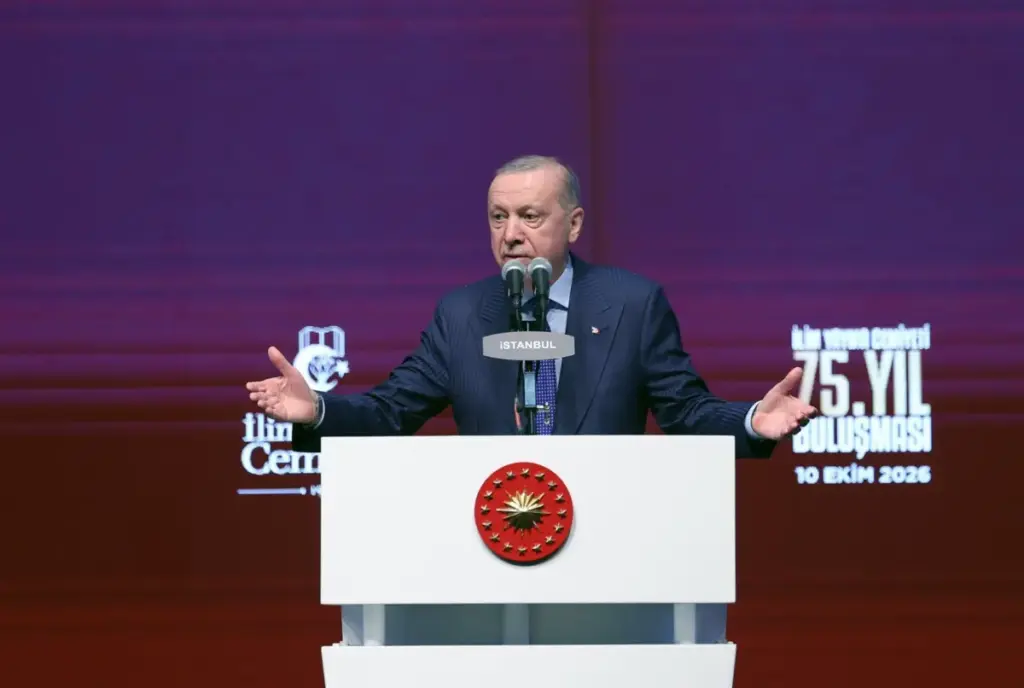
ISTANBUL — President Recep Tayyip Erdoğan warned on Saturday that powerful technology leaders are actively seeking to shape the lives, minds, and values of the younger generation. Speaking at the 75th-anniversary celebration of the Ilim Yayma Cemiyeti (Dissemination of Science Association) in Istanbul, the Turkish president emphasized that Türkiye must cultivate a dynamic generation capable of embracing modern technological advancements while steadfastly preserving its national and spiritual identity.
Addressing a large gathering of educators, students, alumni, and civil society leaders, Erdoğan described the nation’s youth as the primary target of what he termed "techno-oligarchs." He accused these influential technology executives of attempting to direct the global future exclusively according to their own economic interests and secular worldviews, bypassing traditional cultural boundaries and ethical frameworks.
The president noted that the pervasive influence of artificial intelligence and rapidly accelerating technological innovations is fundamentally transforming modern society. This rapid transformation, he argued, makes it increasingly vital to protect young people from toxic ideologies that encourage racism, excessive hedonism, and a total disregard for established moral boundaries.
"The TEKNOFEST generation will be our greatest assurance against the domineering mentality of techno-oligarchs who commodify people, nature, the sky, and even space," Erdoğan said. He was referring to Türkiye’s premier technology, aviation, and aerospace festival, an annual event that promotes domestic innovation and draws hundreds of thousands of young people interested in science, engineering, and digital development.
Erdoğan also identified the broader Ilim Yayma generation as central to this defensive and constructive cultural effort, emphasizing the critical need to develop new technologies in ways that prioritize human well-being and preserve moral responsibility.
"Our common goal is to raise a generation that uses and develops technology with a human-centered approach," he stated. He called for the cultivation of young individuals who read extensively, think critically, and produce innovative work without ever losing their conscience, their humanity, or their deep connection to national and spiritual values.
Pointing to recent troubling incidents reported in schools across the country, Erdoğan cited these events as concrete evidence of the threats posed by harmful external and internal influences. He argued that students must be shielded from ideologies that promote racial hatred and unchecked self-indulgence, urging both students and educators to remain deeply committed to their educational and moral responsibilities. The country, he said, must prepare its youth to navigate an uncertain and volatile future shaped heavily by rapid technological shifts and intense global cultural pressures.
Ilim Yayma’s 75-Year History and National Footprint
Turning to the milestone anniversary of the host organization, Erdoğan offered high praise for the Ilim Yayma Cemiyeti. Founded in 1951, the Turkish educational and civil society organization has played a monumental role in shaping the country’s national education system and fostering successive generations of students.
He described the history of the organization as deeply intertwined with the modern history of Türkiye itself, asserting that its foundational principles directly reflect the nation’s long-standing ambition to educate young people who are knowledgeable, ethical, and dedicated to serving society.
"Although it was founded in 1951, the history of Ilim Yayma is also the history of Türkiye," Erdoğan said. "Its founding philosophy is the philosophy of Türkiye’s existence, and its ultimate goal is Türkiye’s centuries-old aspiration."
During his address, the president paid profound tribute to the organization’s visionary founders. Among them was its first president, Seniyüddin Başak, who played a crucial role in protecting Turkish foundation properties during the Lausanne Conference; General Ömer Cemal Karabekir, a prominent supporter of the Turkish National Movement during the War of Independence; and retired Colonel Vehbi Bilimer, a veteran of the Gallipoli campaign, the Battle of Kut, and the Turkish War of Independence.
Erdoğan also recalled Hasan Hikmet Demirbaş, a writer for the influential Sebilürreşad magazine and a close associate of national poet Mehmet Akif Ersoy, alongside other key figures who helped establish the institution during a delicate period in the nation’s history. These founders, he noted, shared an unwavering commitment to ensuring that Turkish children would not be deprived of proper education, knowledge, or moral guidance, particularly during times of acute political and social hardship.
Their shared ambition, Erdoğan explained, was to entrust the future of the country to a confident, well-educated, and socially responsible generation. He described Ilim Yayma as a living symbol of Türkiye’s ongoing struggle for independence and its democratic future, noting that the organization’s trajectory has always mirrored the broader national battles over education, values, and societal development.
Expansion of Imam Hatip Schools and Student Support Services
A central theme of the president’s remarks was the organization’s historical contribution to the reopening and expansion of imam hatip schools, specialized educational institutions that combine comprehensive religious instruction with standard academic curricula.
Erdoğan pointed out that the organization helped establish Türkiye’s first modern imam hatip school on October 17, 1951, mere days after its official founding. In the decades that followed, the group contributed significantly to the construction and support of more than 100 such high schools throughout the country.
This steady expansion helped extend educational opportunities far beyond Istanbul, bringing formal schooling and religious instruction to communities across Anatolia, the president explained. Beyond classrooms, the organization established extensive student dormitories in several major cities, providing crucial scholarships and safe accommodation for young people traveling from distant provinces to pursue their studies in Istanbul. These vital support services enabled tens of thousands of students to continue their education in secure and nurturing environments.
Erdoğan noted that Ilim Yayma managed to expand its operations despite facing numerous obstacles, political pressures, and economic difficulties over the decades, ultimately evolving into an indispensable pillar of Türkiye’s educational and civil society landscape. He credited the original founders’ determination and deep religious faith with laying the indestructible foundations for an institution that continues to uplift students and educators today.
Current Scale: 192 Branches and 153 Dormitories
Highlighting the remarkable growth of the organization, Erdoğan shared current statistics regarding its vast national network. The Ilim Yayma Cemiyeti now operates 192 branches, 153 student dormitories, and 122 dedicated education centers, delivering services that span from basic schooling through higher education and advanced academic development.
He also extended his gratitude to the broader institutional ecosystem, praising the contributions of the Ilim Yayma Foundation, Istanbul Sabahattin Zaim University, countless volunteers, private donors, and active alumni associations. Their combined, tireless efforts, he said, have enabled the wider Ilim Yayma community to serve the country effectively across multiple generations.
"What 68 dedicated individuals set in motion 75 years ago now touches the lives of millions through schools, dormitories, scholarships, education centers, academic support, and international initiatives," Erdoğan remarked.
Describing the organization’s expansive growth as a profound source of national pride, he likened its founders’ efforts to planting a modest seed that, under divine providence, has grown into a mighty plane tree providing shade and shelter to countless citizens. Generations of students have benefited directly from the institution’s facilities, with many rising to positions of leadership and service within the state and society.
Urging current members to pass this rich legacy on to future generations with renewed determination, Erdoğan expressed absolute confidence that the organization’s scope and impact would continue to grow in the years ahead. He reminded the audience that educating human beings is a long-term endeavor requiring immense patience, sustained effort, and unwavering vision.
Investing in Future Generations Amid Technological Shifts
Looking forward, Erdoğan stressed that while Ilim Yayma’s past achievements are deeply commendable, its future relevance will depend entirely on how effectively it responds to rapidly shifting social, cultural, and technological needs.
He posed essential questions regarding how the organization can successfully reach an even broader segment of students, help young people identify and cultivate their unique talents, safeguard their spiritual development, and reinforce national identity against the homogenizing pressures of global cultural currents. Furthermore, he emphasized the critical necessity for Türkiye to produce original scientific, technological, cultural, and artistic works deeply rooted in its own historical traditions while remaining globally competitive.
Reiterating his concerns about the digital age, the president warned that artificial intelligence is already introducing fundamental alterations to everyday life, necessitating rapid adaptation by traditional educational institutions. He cautioned that powerful technology executives, whom he repeatedly characterized as "techno-oligarchs," harbor ambitions to influence not only contemporary society but also the trajectory of future generations to serve their narrow corporate interests.
The ultimate challenge for educators and policymakers, Erdoğan argued, is to ensure that technological progress actively serves humanity rather than reducing human beings and the natural world to mere economic commodities. He reiterated that the TEKNOFEST generation serves as the prime embodiment of the youth Türkiye requires to address this challenge successfully—combining high-level scientific ambition with rigorous ethical responsibility and a robust sense of national and spiritual identity.
"Do not become complacent or lose heart," Erdoğan told the attentive audience in his concluding remarks. "If you have faith, you are the ones who will prevail."
Pledging that the organization would steadfastly carry forward the vital mission initiated by its founders, the president emphasized that its members would continue their labor without seeking superficial worldly rewards such as status, fame, or accumulated wealth. He concluded by expressing his unwavering faith in Türkiye’s youth, urging them to shoulder the educational mission with courage, discipline, and historical awareness.