World leaders, delegates, and environmental experts have gathered in the Mediterranean coastal city of Antalya, Turkiye, for the opening of COP31, the United Nations’ flagship annual climate summit. Running from November 9 to 20, the conference begins against a grim backdrop of unrelenting global emissions and escalating climate impacts that continue to test the resilience of nations across every continent.
The summit opens as fresh data highlights
the persistent failure of global mitigation efforts to bend the emissions curve downwards. According to the latest figures compiled by the European Commission’s Joint Research Centre (JRC) and the International Energy Agency (IEA), the world emitted a staggering 54.1 billion tonnes of greenhouse gases in 2025. This represents a 0.7 percent increase compared to the previous year and a massive 68.5 percent jump from 1990 levels.
Greenhouse gases, primarily carbon dioxide and methane, act as an invisible blanket around the planet, trapping solar heat in the atmosphere. This steady accumulation has driven up global temperatures, supercharging heatwaves, prolonged droughts, catastrophic floods, and a host of other extreme weather conditions that are reshaping human societies and ecosystems.
To help frame the high-stakes negotiations in Antalya, observers and delegates are looking closely at comprehensive breakdowns of which gases are warming the planet, which industries and geographic regions are driving the pollution, and how historical emission patterns continue to shape the contemporary geopolitical landscape.
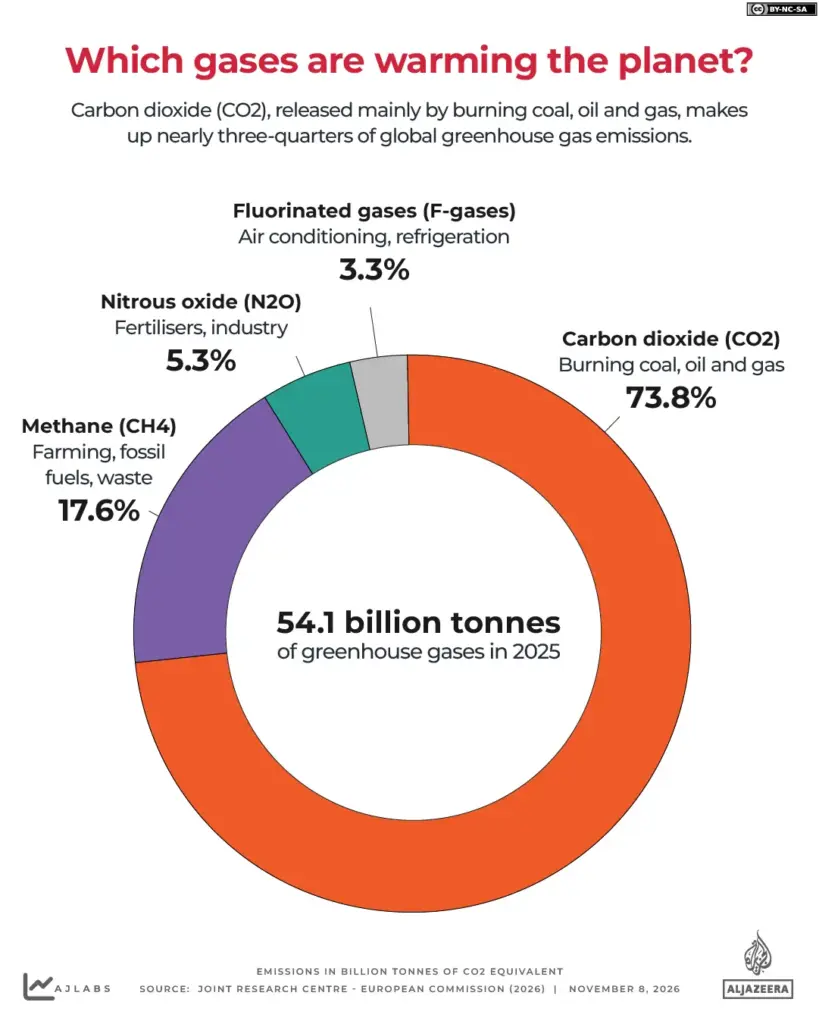
Which gases are warming the planet?
Carbon dioxide remains the single largest driver of global warming, making up 73.8 percent of global greenhouse gas emissions in 2025. CO2 is released primarily through the combustion of fossil fuels such as coal, oil, and natural gas for power generation, industrial production, and transportation. At the same time, widespread deforestation removes vital forest carbon sinks—trees and vegetation that would otherwise absorb significant quantities of the gas from the air.

Methane followed as the second-most potent contributor, accounting for 17.6 percent of emissions in 2025. Nitrous oxide made up 5.3 percent, while fluorinated gases, or F-gases, contributed 3.3 percent to the global total. Driven largely by industrial expansion and energy extraction, global CO2 emissions alone have climbed by 76.3 percent since 1990, according to JRC figures.
How is a warming planet affecting the world?
The cumulative buildup of these greenhouse gases has pushed planetary systems into uncharted territory. In 2025, the amount of heat stored in the world’s oceans reached the highest level ever recorded. According to the World Meteorological Organization (WMO), the rate of ocean warming has accelerated sharply over the past two decades, threatening marine life and intensifying coastal storms.
The consequences of this thermal overload played out violently across the globe in 2026. Extreme weather events have killed tens of thousands of people and forcibly displaced millions from their homes over the course of the year.
In Europe, a punishing succession of heatwaves, prolonged droughts, and fierce wildfires between May and August resulted in more than 30,000 excess deaths. The crisis strained emergency infrastructure across the continent, forcing the evacuation of 220,000 people in France alone as dry conditions turned vast tracts of land into tinderboxes.
Asia experienced its own catastrophic disasters. On August 26, a sudden glacier collapse triggered a massive flash flood in the Himalayas, sweeping through parts of Nepal near its border with China. The disaster killed more than 1,500 people, while approximately 5,600 individuals remain unaccounted for, according to United Nations estimates.
Earlier in the year, severe typhoon activity left a trail of destruction. In June and July, Typhoon Bavi forced the emergency evacuation of three million people in China and claimed 26 lives in the Philippines. Just weeks later, severe Tropical Storm Maysak struck the region, killing 171 people and inflicting more than $3 billion in economic losses in China alone.
Other regions faced compounding climate shocks. Severe floods and windstorms across the western Mediterranean displaced more than 180,000 people in Morocco earlier in the year, while unseasonal and extreme cold and snowstorms in North America resulted in 174 deaths.

Where do the world’s emissions come from?
Global greenhouse gas emissions have more than doubled since 1970, surging from roughly 23 billion tonnes to 54.1 billion tonnes in 2025. This long-term expansion reflects rapid industrialization, population growth, and rising standards of living across the developing and developed world.
The power generation industry remains the single largest source of global emissions, accounting for nearly 30 percent of the total in 2025. Emissions from the power sector have roughly quadrupled since 1970, fueled by soaring demand for electricity in fast-growing economies such as China and India, which have relied heavily on fossil-fuel-fired power plants to fuel their economic expansions.
Industry, including heavy manufacturing and mining, ranks as the second-largest source at 21 percent. This category encompasses both the fuel burned directly in factories and the chemical processes released during the production of cement, metals, and various industrial chemicals. Industrial emissions climbed steeply during the 2000s, coinciding with China’s unprecedented manufacturing boom.
Transportation, encompassing passenger cars, commercial trucking, maritime shipping, and aviation, represents the third-largest emitting sector at 16 percent.
Together, these three primary sectors account for approximately two-thirds of all global greenhouse gas emissions. The remaining emissions originate from agriculture at 12 percent, the extraction and fugitive release of coal, oil, and gas at 11 percent, buildings at 6.6 percent, and waste management at 3.6 percent.
Historical data shows that global emissions have fallen on only a handful of occasions since 1970—notably in the early 1980s, following the global financial crisis of 2008, and during the COVID-19 pandemic lockdowns in 2020. In each instance, however, emissions rebounded sharply as economic activity resumed.
Who are the largest emitters of greenhouse gases?

The distribution of current emissions remains heavily concentrated among a handful of major economies. In 2025, the three largest emitters alone accounted for nearly half of the entire world’s greenhouse gas output. China led the global tally by emitting nearly 16 billion tonnes, representing 29.5 percent of the global total. The United States followed as the second-largest emitter at 6.02 billion tonnes, or 11.1 percent, while India ranked third with 4.51 billion tonnes, accounting for 8.3 percent.
The 27 member states of the European Union collectively accounted for 5.8 percent of global emissions, followed by Russia at 4.8 percent, Indonesia at 2.5 percent, Brazil at 2.4 percent, and Iran at 2.1 percent. Meanwhile, international shipping and aviation, which operate across borders and generally fall outside the carbon accounting of any single nation, produced 2.6 percent of global emissions—a total larger than that of most individual countries.
This contemporary distribution represents a distinct evolution from past centuries. The Industrial Revolution of the 18th and 19th centuries first drove up emissions in Western nations, particularly the United Kingdom and the United States, as they constructed factories and transitioned toward mass manufacturing. Global emissions escalated sharply following the end of World War II, more than doubling over the subsequent decades.
China’s emissions experienced an explosive surge in the early 2000s alongside its rapid economic ascent, eventually surpassing the United States to make the country the world’s largest annual emitter by the mid-2000s.
However, looking at cumulative emissions over time shifts the perspective significantly. Since the mid-18th century, the United States has been responsible for 23.5 percent of all cumulative CO2 emissions, compared with 15.4 percent for China, according to data from the Global Carbon Budget.
Which industries drive each country’s emissions?
The underlying drivers of emissions vary markedly from one major economy to another, reflecting differences in energy mixes, industrial development, and transportation networks.
In China, the power sector is by far the largest source of pollution, generating 42 percent of the country’s nearly 16 billion tonnes of greenhouse gases. Heavy industry accounts for another 31 percent, while fuel production contributes 9.5 percent. These figures underscore the immense challenge Beijing faces in decoupling its manufacturing-heavy economy from fossil fuels.

Significantly, in September 2025, Chinese President Xi Jinping pledged for the first time that the country would actively cut its greenhouse gas emissions by 7 to 10 percent from their peak level by the year 2035.
In the United States, the emissions profile looks quite different. Transportation stands as the largest source of pollution, accounting for 29 percent of national emissions, driven heavily by a heavy reliance on cars, light trucks, and freight transport. The power sector follows closely at 26 percent, while industry accounts for 14 percent.
In India, which continues to rely heavily on coal-fired power plants to meet surging domestic electricity demand, the power sector generates 35 percent of national emissions. Industry follows at 24 percent, while agriculture represents 19 percent, reflecting the large rural and agrarian base of the Indian economy.
As delegates settle into negotiations in Antalya over the coming days, these domestic realities and sectoral challenges will form the core of the debate as nations grapple with how to accelerate the global transition toward cleaner energy and more robust climate action.