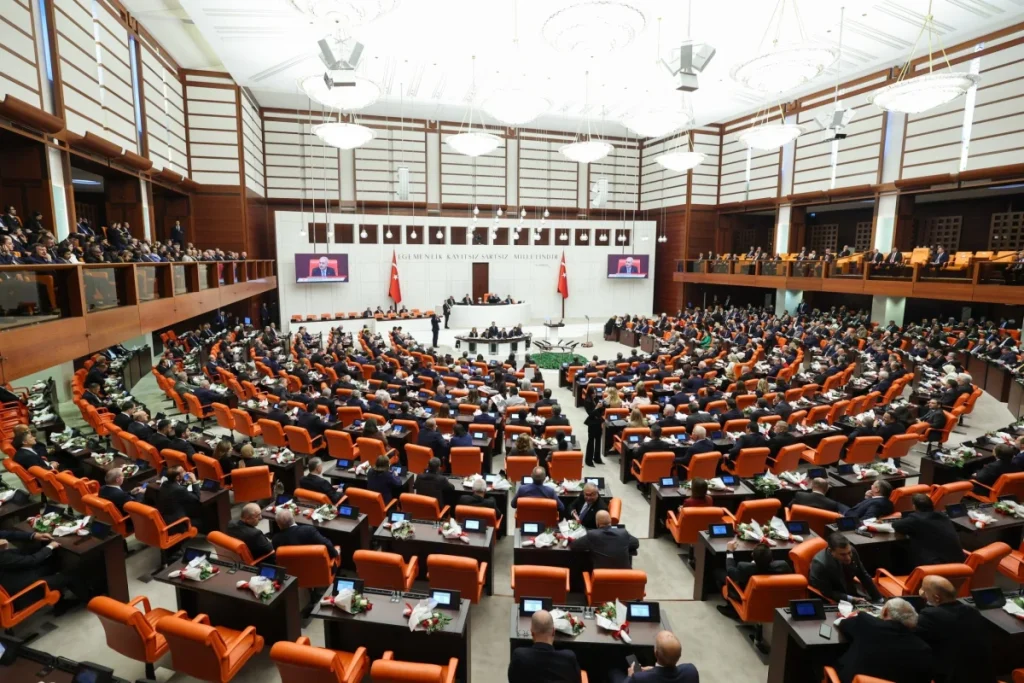
ANKARA — The Grand National Assembly of Türkiye officially commenced its new legislative year yesterday, setting the stage for what is expected to be a profoundly consequential parliamentary term. President Recep Tayyip Erdoğan delivered the keynote opening address to lawmakers, charting the course for a legislative calendar that will inevitably be shaped by the looming shadow of future elections, ongoing counterterrorism initiatives, economic imperatives, and the enduring debate over comprehensive democratic and constitutional modernization.
Even if national elections are held strictly on schedule according to the electoral calendar, the political momentum leading up to them will permeate nearly every major discussion and legislative maneuver within Parliament throughout the new term. Political debates, policy disputes, and legislative negotiations will, one way or another, be inextricably linked to the electoral horizon. Consequently, political analysts and parliamentary insiders alike anticipate an exceptionally busy and high-stakes legislative year, characterized by intense debate, critical legal overhauls, and efforts to forge broad national consensus on foundational issues.
A central pillar of the upcoming parliamentary agenda involves the implementation phase of the historic "terror-free Türkiye" process. During the previous legislative term, the foundational framework law regarding this critical national security and social cohesion initiative was successfully adopted through a historic parliamentary consensus. As the nation transitions into the active implementation phase, a dedicated parliamentary commission is slated to be established to oversee and monitor the process closely.
In tandem with this oversight role, Parliament will be tasked with passing any supplementary legal arrangements, regulatory frameworks, or legislative adjustments that may be required to ensure the smooth progression of the initiative. The successful consolidation of this process remains a paramount objective for the legislature, symbolizing a major step toward resolving long-standing security challenges and fostering lasting domestic peace.
Beyond security-related legislation, the restructuring of Türkiye’s electoral framework and political parties legislation has emerged as a major focal point for political discourse. Recently, Nationalist Movement Party (MHP) Chairperson Devlet Bahçeli and other senior MHP figures articulated detailed arguments explaining why the existing political parties and election laws need to be comprehensively rewritten from scratch. According to these proposals, the current legal framework must be thoroughly modernized and brought fully into line with the demands and operational realities of the presidential system of government.
At present, Türkiye’s electoral legislation is widely acknowledged to be highly fragmented, containing numerous provisions, technical ambiguities, and contradictory clauses that complicate legal certainty. For instance, significant discrepancies exist between the presidential election law and the parliamentary election law regarding the precise mechanisms and timelines for when elections are to be held if a decision is made to renew them prematurely. Consolidating this fragmented body of electoral legislation under a single, cohesive framework, eliminating existing contradictions, and ensuring absolute compatibility with the presidential system are seen by proponents of reform as critical steps toward enhancing administrative efficiency and legal clarity.
Compounding the need for legislative modernization are ongoing debates surrounding the status and proliferation of political parties in Türkiye. The country currently experiences a dynamic political landscape where new parties are founded almost daily. Among nations governed by a presidential system, Türkiye ranks third globally in terms of the sheer number of political parties represented in parliament. Furthermore, in recent years, inter-party alliances have evolved to become nearly as influential and consequential as individual political parties themselves.
Under the mechanics of the current electoral legislation, smaller political parties frequently resort to intense bargaining politics that critics argue far exceed their actual electoral strength, a dynamic that risks devaluing substantive political discourse. Simultaneously, some smaller factions may lean toward populist strategies solely to position themselves as kingmakers in closely contested political environments. The logistical and practical challenges of the current system are further highlighted by the fact that if all 41 political parties currently eligible to run were to participate in a general election, it remains unclear how the physical ballot papers would even be formatted and printed.
Given these multifaceted challenges, the complete renewal of both the political parties law and the electoral law is expected to remain firmly on Parliament’s agenda throughout the coming legislative year. In his opening address to the General Assembly, President Erdoğan devoted considerable attention to these structural challenges, placing special emphasis on the pressing need for a new, inclusive, and entirely civilian constitution that reflects the modern aspirations of Turkish society.
The endeavor to draft a new constitution presents a complex landscape defined by both distinct opportunities and notable political hurdles. On the side of opportunity, a genuine historic Türkiye consensus emerged within Parliament when the initial process law was adopted. Proponents argue that this established spirit of cooperation could serve as a vital foundation, making it entirely feasible to bridge political divides and draft a new, unifying constitution.
Conversely, the primary challenge facing the constitutional reform process is temporal and political. With a year and a half remaining until the scheduled elections, certain political circles and opposition figures are expected to argue that insufficient time remains to properly debate, draft, and ratify a foundational document of such magnitude.
Compounding these temporal arguments, some populist political parties may resort to political manipulation, misinformation, and disinformation campaigns by deliberately attempting to link the drafting of a new constitution to the ongoing "terror-free Türkiye" process. Anticipating that various populist factions might produce such forced, misleading interpretations for political gain, President Erdoğan used his address to preemptively address these concerns. While reiterating the imperative for a new, civilian, and inclusive constitution, he stressed firmly that there should be absolute clarity and zero concern regarding the inviolability of the first four articles of the constitution, which establish the foundational characteristics of the state.
In addition to constitutional and electoral reforms, the new legislative year will also require Parliament to address Türkiye’s broader economic security and the specific regulatory frameworks necessitated by recent financial and fund-related developments. Ensuring economic resilience, market stability, and transparent regulatory oversight remains a top priority for lawmakers as they navigate domestic and global economic complexities.
The overarching philosophical framework of President Erdoğan’s opening address centered on the concept of "competition within consensus." While political differences and ideological diversity are naturally acknowledged and celebrated as the foundational richness of a healthy democracy, finding common ground on core national interests must be treated as the fundamental responsibility of all political actors.
In recent years, Turkish political discourse has increasingly focused on developing a modernized understanding of politics—moving away from traditional "front politics" and divisive polarization toward concepts like "strengthening the home front," achieving a "grand Türkiye consensus," and embracing "competition within consensus." This evolving political approach does not seek to eliminate legitimate political competition between rival parties, nor does it imply that political movements must share identical viewpoints on every domestic or foreign policy issue. Rather, it emphasizes that acting with a profound sense of institutional and national responsibility to meet the nation’s expectations, solve societal problems, and make citizens’ lives easier is an absolute imperative that cannot be neglected for partisan gain.
Having experienced an extended period defined by the politics of intense polarization, the opening of this new legislative year offers a timely opportunity for political stakeholders to demonstrate that a constructive politics of "competition within consensus" is not only viable, but essential for the future of Turkish democracy.