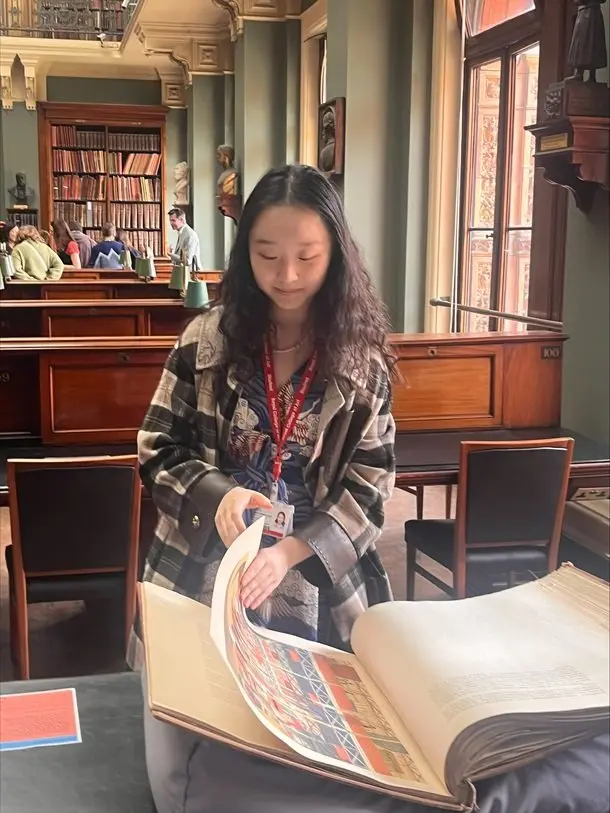
Opportunities for students to actively participate in the day-to-day running of world-class cultural institutions remain a cornerstone of advanced academic programs. Within the V&A/RCA History of Design MA programme—a joint postgraduate initiative between the Victoria and Albert Museum and the Royal College of Art—students regularly engage with the museum’s vast collections through specialized placement projects and by assisting with high-profile public events.
Demonstrating this hands-on approach to museum curation and public engagement, 2026 graduate Elizabeth (Xinyi) He recently shared her academic research and passion for design history with museum visitors. Speaking at the National Art Library Discovery Day held on 10 April 2026, He presented a rare and historically significant volume that sits at the very roots of both the V&A’s institutional history and her own master’s research.
National Art Library Discovery Days Showcase Hidden Collection Gems
Throughout the year, the renowned National Art Library hosts four separate Discovery Days. During these special events, members of the V&A staff step forward to present and discuss hidden-gem books, rare manuscripts, and other remarkable items housed within the library’s extensive collections.
For the spring event held on April 10, 2026, postgraduate students from the joint History of Design MA programme received a special invitation to participate. The students were tasked with selecting a unique item from the library that aligned with one of three featured themes: Botany, Fashion, and the Great Exhibition of 1851.
By engaging directly with the public, these emerging scholars bridge the gap between rigorous academic research and accessible museum programming, offering visitors a deeper understanding of how historical artifacts continue to resonate with contemporary society.
Dickinsons’ Comprehensive Pictures of the Great Exhibition of 1851
Among the participating students, Elizabeth He chose to present Dickinsons’ Comprehensive Pictures of the Great Exhibition of 1851. Composed of detailed, hand-colored lithographic plates, the book serves as a vivid
visual record that allows modern viewers to practically eavesdrop on the world’s first international exposition.

He was already intimately familiar with the volume, having studied it extensively for her MA dissertation. Titled “Cole, Arnoux and Minton’s 1851 Journey: Looking for British Identity in Pottery,” her research project grew organically out of a museum placement she undertook with Acting Head of Programme Dr. Simona Valeriani. That placement involved working closely on the “Henry Cole’s Diaries Project,” an initiative uncovering the detailed travel journals of the museum’s founding father.
While examining Henry Cole’s personal travel records, He first encountered Dickinson’s remarkable publication. The connection between the book and Henry Cole is deeply rooted in the history of Victorian design reform. As the primary organizer of the Great Exhibition of 1851—widely recognized as the first true world’s fair—Cole played a pivotal role in shaping international industrial standards. The massive success and global scope of the exhibition undoubtedly influenced his subsequent collecting habits, educational philosophies, and European travels.
Documenting the Great Exhibition of 1851
Dickinsons’ Comprehensive Pictures of the Great Exhibition of 1851 captured the monumental scale of the Crystal Palace event through a series of vivid lithographs. These plates reproduced original watercolor paintings created expressly for Prince Albert by prominent contemporary artists Joseph Nash (1809–1878), Louis Haghe (1806–1885), and David Roberts (1796–1864). Each individual illustration provided a meticulously detailed visual description of a different national pavilion, documenting the layout, architecture, and cultural artifacts on display.
Through the book’s illustrations and contemporary commentary, readers gain insight into how the Great Exhibition functioned as a powerful catalyst for global innovation and fierce international competition. By examining specific displays, such as the French and German pavilions, historians can trace how nations vied for supremacy in manufacturing and design.
This historical overview demonstrates the profound international investment in industrial progress during the mid-nineteenth century. Although manufacturing technology has transformed dramatically in the intervening decades, the core agenda of supporting scientific and artistic innovation remains remarkably relevant to modern audiences.
Sèvres Court: Exhibiting to Disseminate Technical Innovation
The Sèvres Court within the French pavilion quickly emerged as one of the most heavily visited and debated hotspots of the 1851 exhibition. Although historical Chinese porcelain had long provided the foundational techniques for European ceramic production, British juries at the Great Exhibition turned their critical attention toward French porcelain. They viewed French output simultaneously as a formidable commercial rival and as an artistic benchmark for domestic British manufacture.
Given its cultural and industrial significance, Dickinson’s publication devoted a full-length page exclusively to the Sèvres Court. This visual documentation closely paralleled the collecting practices of the V&A’s Department of Practical Art, which actively acquired French porcelain specimens to serve as teaching aids for British artisans and students.

The contemporary British fixation on foreign ceramics was palpable among Victorian reformers. Henry Cole and Richard Redgrave, who served as the V&A’s first art superintendent, voiced explicit concerns in the Journal of Design in 1850. They candidly admitted that the best British pottery designs of the era were largely imitations of older Dresden and Sèvres styles.
To break free from this creative reliance on continental models, English manufacturers recognized an urgent need to cultivate a more distinctive national identity. Prominent manufacturers such as Minton and Wedgwood successfully met this challenge by developing a new, competitively priced type of earthenware executed in the vibrant style of traditional Italian maiolica. These mass-produced yet artistically ambitious goods quickly captured socially aspirational markets both at home and abroad, including expanding commercial avenues in the United States.
Rivalling the Tasteful and Useful Manufactories of the German Court
Beyond the French displays, visitors and critics at the Crystal Palace closely scrutinized the contributions of the German Customs Union—a coalition comprising twenty-six Germanic states, including Prussia, Bavaria, and Saxony. The bronzes and woodcarvings presented by German manufacturers were widely perceived by contemporary observers as possessing a superior standard of taste in design, composition, and ornamentation compared to equivalent English works.
Furthermore, German industrial exhibits successfully combined utility, aesthetic taste, and economic accessibility. Observers noted that German industry stood in a highly satisfactory state of steady progress. Beyond the decorative and practical arts, the extensive German displays covering mining and metallurgy demonstrated exceptional scientific and technical capability.
This widespread British admiration for German manufacturing was not merely superficial or aesthetic; rather, it was strategically harnessed to stimulate domestic industrial progress and elevate local standards. Dickinsons’ Comprehensive Pictures of the Great Exhibition of 1851 visually amplified these cross-channel comparisons, preserving the competitive anxiety and collaborative spirit that defined the era.
Participating in the National Art Library Discovery Day offered Elizabeth He a unique platform to bring her specialized academic research to a broader public audience. The Master of Arts in History of Design program provided her with the critical framework required to identify and explore the complex intersections between science, art, and industrial production—themes she expanded upon during her placement on the Henry Cole’s Diaries Project.
When she learned that the library’s spring event would focus on the legacy of the Great Exhibition of 1851, she welcomed the chance to share her enthusiasm for the subject with V&A visitors. Through carefully preserved volumes like Dickinsons’ Comprehensive Pictures, the vibrant visual culture of the nineteenth-century world’s fair continues to offer an immersive educational window into the debates and aspirations that shaped modern design history.