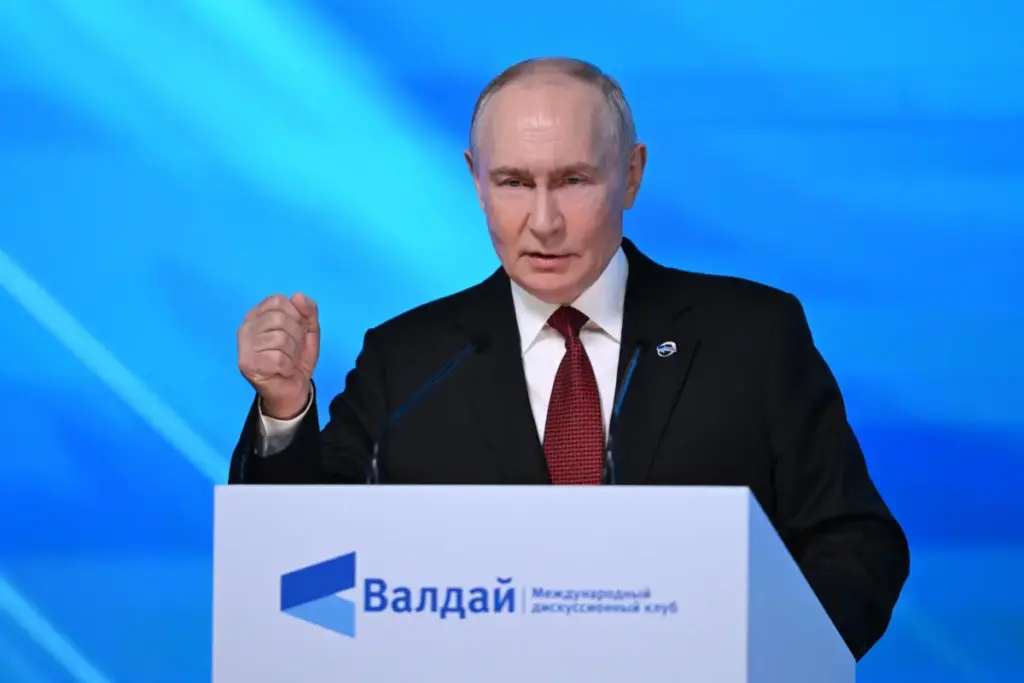
MOSCOW — Russian President Vladimir Putin has firmly ruled out any potential ceasefire agreement regarding long-range strikes with Ukraine, dealing a blow to recent diplomatic efforts spearheaded by the United States and Kyiv. Speaking at the annual Valdai political forum in Moscow on Thursday, the Russian leader dismissed a proposal floated by Ukrainian President Volodymyr Zelenskyy during their high-profile meeting in New York last month, where Kyiv signaled a willingness to halt attacks on Russian energy infrastructure if Moscow reciprocated.
The rejection comes as Moscow significantly intensifies its sprawling campaign of aerial bombardments targeting Kyiv and other Ukrainian urban centers, leaving civilian populations facing the grim prospect of another punishing winter under near-constant air raid alerts. Just hours before Putin’s remarks, a Russian attack drone struck a school inside the Ukrainian capital. Fortunately, local officials confirmed that no casualties resulted from the direct hit, as children and staff members had already taken refuge in subterranean shelters when the impact occurred.
Addressing an audience of international scholars, analysts, and policymakers at the Moscow-based think tank, Putin scoffed at the notion of an energy-focused truce. "We are told: ‘Let them stop striking your refineries, and you will stop striking their ships.’ It is simply ridiculous," Putin stated during the Thursday session.
The proposal in question gained traction following a diplomatic encounter between U.S. President Donald Trump and Ukrainian President Volodymyr Zelenskyy in New York on September 22. During those discussions, Zelenskyy conveyed that Kyiv was fully prepared to cease its drone and missile operations targeting Russian oil refineries and other critical energy facilities, provided that Moscow instituted a parallel halt to its systematic destruction of Ukraine’s power grid and energy infrastructure.
While dismissing the proposed quid pro quo, Putin acknowledged that Ukraine’s long-range drone strategy had achieved a degree of tactical success. He noted that precision strikes targeting Russian oil refineries had inflicted noticeable economic damage, costing the country roughly one percent of its gross domestic product (GDP). However, he maintained that Russia has successfully adapted to the pressure and is now responding in kind by expanding its own aerial targeting parameters.
In recent weeks, the Russian military has widened the scope of its long-range offensive, moving beyond energy infrastructure to strike Ukrainian steel manufacturing plants and critical supply chains, with a particular emphasis on disrupting the nation’s rail network. Ukrainian authorities have repeatedly accused Moscow of deliberately targeting non-military sites and critical civilian infrastructure to break the morale of the populace as freezing temperatures approach.
Despite the escalating intensity of the aerial campaign, Putin asserted that Russia still ultimately prefers to see the conflict resolved through negotiated settlements rather than battlefield attrition alone. He reiterated Moscow’s longstanding strategic demand that Ukraine must adopt a permanently neutral status once the hostilities finally come to an end, barring any future integration into Western security architectures.
The Nuclear Option and the Strategic Flashpoint of Kaliningrad
The most alarming portion of Putin’s address, however, extended far beyond the immediate theater of operations in Ukraine, directly touching upon the fragile security architecture of Eastern Europe and the Baltic region. The Russian leader issued a stark and explicit warning to Western governments, cautioning them against any attempts to escalate the ongoing standoff by threatening the Russian Baltic exclave of Kaliningrad.
Wedge geographically between Poland and Lithuania on the Baltic Sea, Kaliningrad functions as a heavily militarized Russian outpost separated from the Russian mainland. Putin vowed that Moscow would not hesitate to deploy its full strategic arsenal to defend the exclave against any perceived Western aggression.
"If it comes to a direct attack on the Russian Federation — in this case, we are referring to Kaliningrad, and perhaps other territories as well — the question of the Russian Federation deploying all the weapons at our country’s disposal will, of course, inevitably and immediately be on the agenda," Putin warned the assembly.
This stern declaration followed closely on the heels of a formal diplomatic note received by NATO earlier in the week. According to alliance officials, Moscow transmitted a formal warning to the Western military alliance, making it unequivocally clear that Russia stands prepared to resort to tactical or strategic nuclear weapons if NATO or its member states attempt to blockade, isolate, or sever Russian transit access to the Baltic exclave.
Expounding on the broader geopolitical landscape, Putin cautioned that the continuous cycles of escalation between nuclear-armed powers could swiftly spiral out of control, leading to catastrophic scenarios that no single nation could successfully manage or reverse.
"We must realise that the moment when nothing can be changed any longer may come very quickly and unexpectedly for everyone," Putin said, emphasizing the perilous nature of the current diplomatic breakdown. "The logic of escalating, increasingly harsh retaliatory measures leads to a fatal point of no return."
Economic Signals and Seized Assets
Amid the dark warnings regarding nuclear escalation and the rejection of peace overtures in Ukraine, the Russian president offered a brief and heavily qualified nod toward potential future economic reconciliation with the West, should geopolitical tensions miraculously de-escalate.
In what he described as a potentially "favourable scenario," Putin suggested that foreign commercial assets and corporate properties seized by the Russian state in recent months could conceivably be returned to their original Western owners. This hint at future restitution follows a wave of aggressive asset expropriations ordered by the Kremlin.
Last month, Putin formally signed decrees authorizing the state seizure of major commercial operations belonging to prominent Western corporations. Among the targeted entities were Swiss food manufacturing giant Nestlé, French retail conglomerate Auchan, the DIY home improvement chain formerly operating as Leroy Merlin, and German wholesale and food retail giant Metro. Whether these assets could genuinely serve as leverage or bargaining chips in future negotiations remains entirely unclear, as economic decoupling between Russia and Western economies deepens by the day.